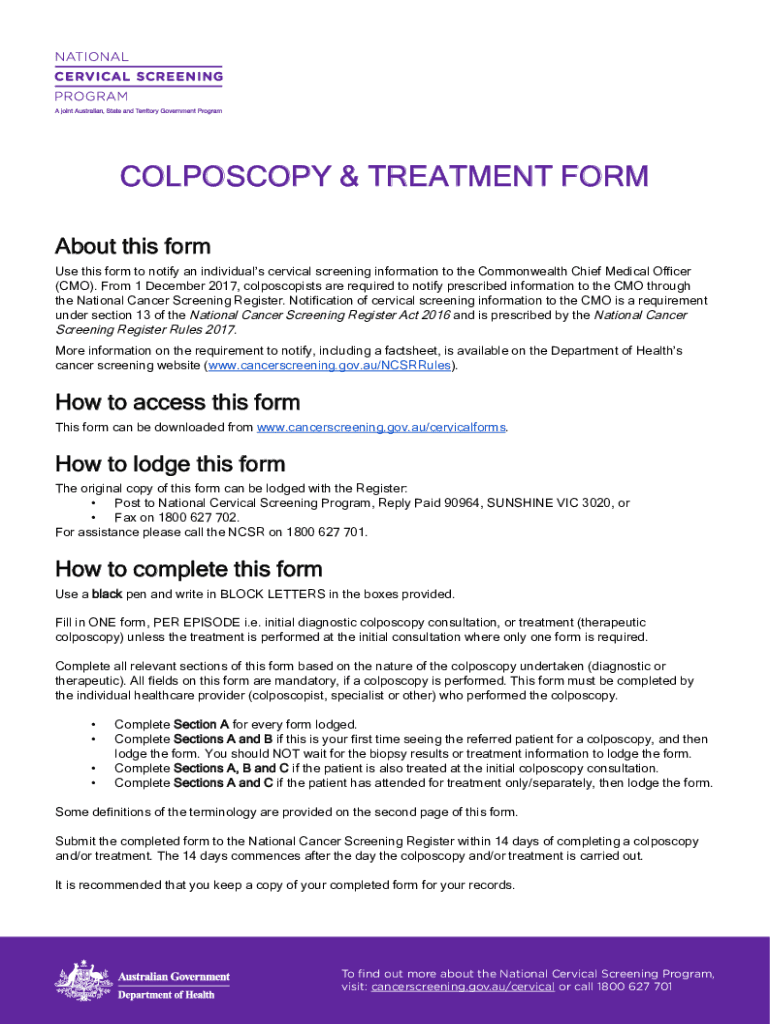
COLONOSCOPY & TREATMENT FORM How to access this form can be downloaded from www.cancerscreening.gov.au/cervicalforms. How to lodge this form The original copy of this form can be lodged with the Register:.
Loading

Open form follow the instructions

Easily sign the form with your finger

Send filled & signed form or save
How to fill out the AU Colposcopy & Treatment Form online
This guide provides clear, step-by-step instructions for filling out the AU Colposcopy & Treatment Form online. By following these guidelines, users can ensure that they complete the form accurately and efficiently.
Follow the steps to complete the form successfully.
- Press the ‘Get Form’ button to access the document and open it in your preferred editor.
- Begin by filling out the Patient, Colposcopist, and colposcopy details in Section A. Provide information such as the patient's full name, date of birth, address, Medicare or DVA number, and the details of the healthcare provider performing the colposcopy.
- If this is your first time seeing the referred patient, complete both Sections A and B. Provide the primary indications for colposcopy and assess the adequacy of colposcopy.
- For cases where treatment is performed during the initial consultation, ensure you complete Sections A, B, and C. Document the treatment details including excision type, modality used, and location of treatment.
- Review the information filled out in all sections to confirm its accuracy. Sections must be filled out in block letters, using a black pen when applicable.
- Once all required sections are completed, save changes to your document. You may also choose to download the completed form for your records.
- Finally, submit the original copy of the completed form to the National Cervical Screening Register by mailing or faxing, as per the instructions.
Start completing your AU Colposcopy & Treatment Form online today.
Experience a faster way to fill out and sign forms on the web. Access the most extensive library of templates available.
Related content
Jun 1, 2015 — Published in final edited form as: ... In our judgment, in women with...
Additional treatment might include removal of any abnormal areas of the cervix. This might...
Genital trauma is trauma to the genitalia. Contents. 1 History of studying genital trauma;...
Get answers to your most pressing questions about US Legal Forms API.
How painful is a colposcopy?
A colposcopy is nearly pain-free. You might feel pressure when the speculum goes in. It might also sting or burn a little when they wash your cervix with the vinegar-like solution. If you get a biopsy, you might have some discomfort.
What happens after a colposcopy?
What happens after a colposcopy? After a colposcopy, you may have dark vaginal discharge for up to three days, and some bleeding for up to a week. Your vagina may be sore, and you may experience mild cramping for 1 to 2 days. If no biopsy was taken, you may resume normal activity right away.
How long does it take for your cervix to heal after a colposcopy?
It takes four to six weeks for your cervix to heal. To reduce the risk of infection during this time, you should avoid sexual contact or wearing tampons. It is advisable to wear sanitary towels during this time. Have a shower rather than take a bath for six weeks following a treatment at colposcopy.
What happens if a colposcopy is abnormal?
You may need treatment if the results of your colposcopy show that there are abnormal cells in your cervix. The abnormal cells will be removed, which usually involves removing an area of the cervix about the size of a finger tip.
What if cervical biopsy is positive?
Results of a cervical biopsy A positive test means that cancer or precancerous cells have been found and treatment may be needed.
What happens if your colposcopy comes back positive?
Results. After a colposcopy, your colposcopist will usually be able to tell you what they have found straight away. If there is any uncertainty, a small sample of tissue from the cervix may need to be removed (a biopsy) for further examination. In some cases, abnormal cells can be treated during your colposcopy.
What happens if cervical biopsy is abnormal?
Other abnormal cells or precancerous changes to cells may develop into cancer if they aren't treated. Women with abnormal cervical biopsy results may have one or more of the following procedures for follow-up or treatment: A Pap test removes a small sample of cells from the cervix.
How long does it take for your cervix to heal after a biopsy?
During a cone biopsy, your doctor will remove a small, cone-shaped part of your cervix. They will study it under a microscope to look for abnormal cells. It usually takes about 4 to 6 weeks for your cervix to heal after this procedure.
Should I be worried if I have to have a colposcopy?
When a colposcopy may be needed You may be referred for a colposcopy within a few weeks of cervical screening if: some of the cells in your screening sample are abnormal. the nurse or doctor who carried out the screening test thought your cervix did not look as healthy as it should.
What is the next step after a colposcopy?
After a colposcopy, the doctor or nurse will often be able to tell you what they've found straight away. If they take a biopsy (remove a small sample of tissue to be examined in a laboratory), you may need to wait 4 to 8 weeks to receive your result by post.
Use professional pre-built templates to fill in and sign documents online faster. Get access to thousands of forms.
If you believe that this page should be taken down, please follow our DMCA take down process here.