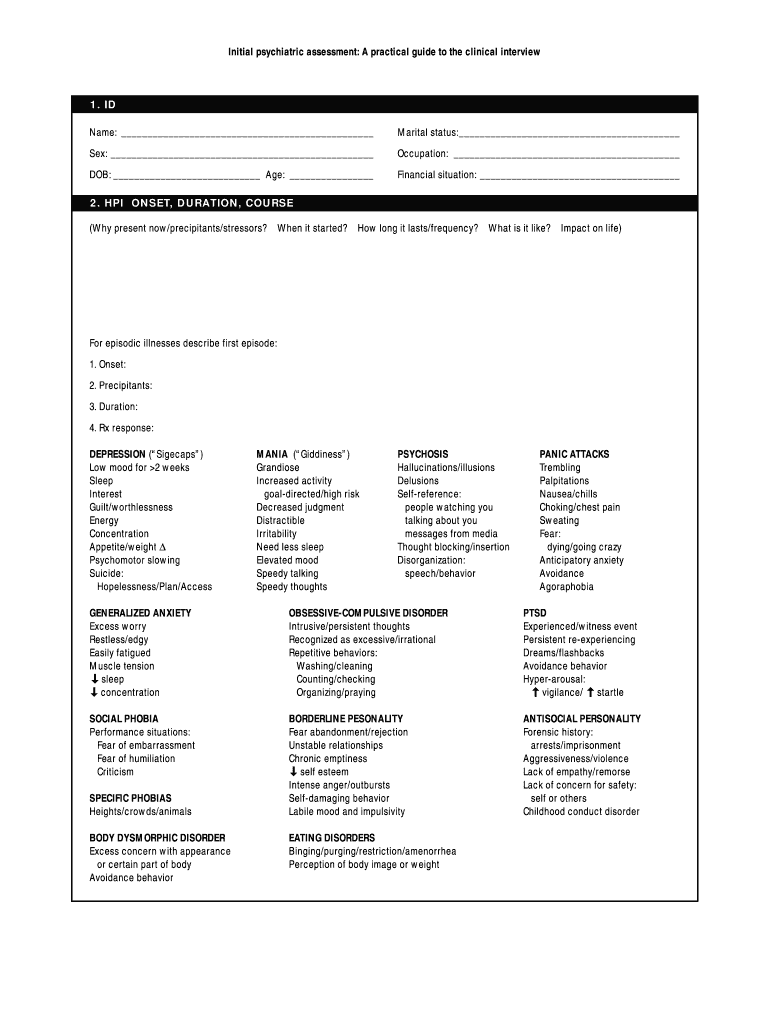
Initial psychiatric assessment: A practical guide to the clinical interview 1. ID Name: Marital status: Sex: Occupation: DOB: Age: Financial situation: 2. HPI ONSET, DURATION, COURSE (Why present.
Loading

Open form follow the instructions

Easily sign the form with your finger

Send filled & signed form or save
How to use or fill out the Canada BCMJ Initial Psychiatric Assessment: A Practical Guide to the Clinical Interview online
Filling out the Canada BCMJ Initial Psychiatric Assessment is an essential step in providing comprehensive mental health care. This guide will help you navigate the form's sections and fields effectively to ensure you capture the necessary information accurately.
Follow the steps to complete the assessment form online.
- Press the ‘Get Form’ button to access the form and open it in your preferred editor.
- Begin with the ID section. Here, fill in your name, marital status, sex, occupation, date of birth, age, and financial situation.
- Proceed to the HPI section. Describe the relevant details such as onset, duration, course of symptoms, and impact on life, using the prompts provided for various conditions.
- Complete the psychiatric history section. Include any previous psychiatric diagnoses, treatments, and medication information.
- Fill out the family psychiatric history, noting any family history of mental health issues, substance use, or suicide attempts.
- In the medical history section, provide information about previous illnesses, treatments, and any relevant surgeries or hospitalizations.
- Review and fill out the systems review, detailing any medicinal history and substance use.
- For personal history, outline your background, including your place of birth and key life events as a child, teen, and adult.
- Complete the mental status examination (MSE) and Folstein MMSE by assessing various cognitive functions and emotional states.
- Provide an impression/formulation using a biopsychosocial approach in the corresponding section.
- Utilize the multiaxial diagnosis section to classify psychiatric disorders, personality, medical conditions, and social factors.
- Conclude with the plan section, listing any necessary investigations and treatment options, including biological and psychological approaches.
- After completing the form, review all sections for accuracy, then save your changes, download, print, or share the completed form as needed.
Start filling out your Canada BCMJ Initial Psychiatric Assessment online today.
Experience a faster way to fill out and sign forms on the web. Access the most extensive library of templates available.
Related content
by D MacCarthy · 2013 · Cited by 48 — An adult mental health module was developed in...
by A Lopez · 2021 — o Supportive relationship building o Validating feelings o...
Get answers to your most pressing questions about US Legal Forms API.
What questions are asked in a psychiatric interview?
In a psychiatric interview, a psychiatrist usually inquires about your symptoms, lifestyle, medical history, and family background. They may ask about any recent life changes or stressors. These questions play a pivotal role in the Canada BCMJ Initial Psychiatric Assessment: A Practical Guide to the Clinical Interview by helping the psychiatrist understand your unique situation.
What is the initial assessment for psychiatry?
The initial assessment for psychiatry involves evaluating a patient’s mental health history and current state. This includes emotional and behavioral concerns, as well as potential diagnoses. Following the approach of the Canada BCMJ Initial Psychiatric Assessment: A Practical Guide to the Clinical Interview, this comprehensive evaluation helps in formulating an appropriate treatment strategy.
What not to say during a psych evaluation?
It's important to avoid minimizing your feelings or being deceptive during a psychiatric evaluation. Being honest about your experiences leads to better understanding and care. The Canada BCMJ Initial Psychiatric Assessment: A Practical Guide to the Clinical Interview emphasizes the need for transparency, as this fosters a more accurate diagnosis and effective treatment plan.
What happens at an initial psychiatric assessment?
During an initial psychiatric assessment, you will engage in an open conversation with the psychiatrist. They will evaluate your emotional and psychological well-being by asking questions about your life, experiences, and feelings. This process is essential to forming accurate diagnoses and developing effective strategies outlined in the Canada BCMJ Initial Psychiatric Assessment: A Practical Guide to the Clinical Interview.
What does a psychiatrist do on the first visit?
On your first visit, a psychiatrist will conduct a detailed interview to understand your mental health status. They will ask about your symptoms, personal history, and any previous treatments. The goal is to create a tailored treatment plan based on insights gathered from the Canada BCMJ Initial Psychiatric Assessment: A Practical Guide to the Clinical Interview.
How long does an initial psychiatric evaluation take?
An initial psychiatric evaluation typically lasts between 60 to 90 minutes. This time allows the psychiatrist to gather comprehensive information about your mental health history and current concerns. During this session, you will discuss your symptoms and any relevant background, which is crucial for the Canada BCMJ Initial Psychiatric Assessment: A Practical Guide to the Clinical Interview.
How is a mental status exam related to a clinical interview?
A mental status exam is a key component of a clinical interview, designed to assess a patient's current mental functioning. In the framework of the Canada BCMJ Initial Psychiatric Assessment: A Practical Guide to the Clinical Interview, both tools work hand in hand to provide a comprehensive view of the patient’s mental health. While the clinical interview delves into patient history and experiences, the MSE focuses on real-time observations, creating a holistic perspective.
How can findings from a mental status exam be applied in clinical practice?
Findings from a mental status exam can significantly influence clinical practice by guiding treatment decisions and interventions. In the context of the Canada BCMJ Initial Psychiatric Assessment: A Practical Guide to the Clinical Interview, these findings reveal crucial insights into a patient’s mental functioning. Clinicians can use this data to monitor changes over time, adjust treatment strategies, and communicate effectively with other healthcare providers about the patient’s progress.
How do you schedule a psychiatric evaluation?
Scheduling a psychiatric evaluation can be a straightforward process. First, identify a qualified mental health professional or clinic that offers services aligned with the Canada BCMJ Initial Psychiatric Assessment: A Practical Guide to the Clinical Interview. Many platforms, like US Legal Forms, provide resources to help you find professionals and understand what information you'll need to prepare. Once you gather necessary documents, simply reach out to the provider to discuss availability and set an appointment.
What is the MSE in a clinical interview?
The MSE in a clinical interview is a systematic examination of a patient's mental state at a specific time. It typically assesses key areas, including appearance, behavior, mood, thought processes, and insight. By including the MSE in the Canada BCMJ Initial Psychiatric Assessment: A Practical Guide to the Clinical Interview, clinicians enhance their ability to identify psychiatric conditions effectively. This detailed evaluation aids in developing targeted treatment plans.
Use professional pre-built templates to fill in and sign documents online faster. Get access to thousands of forms.
If you believe that this page should be taken down, please follow our DMCA take down process here.