Loading
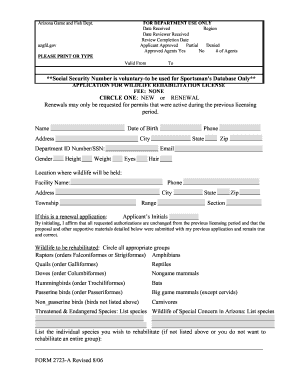
Get Az 2723-a 2006-2026
How it works
-

Open form follow the instructions
-

Easily sign the form with your finger
-

Send filled & signed form or save
How to fill out the AZ 2723-A online
The AZ 2723-A form is essential for individuals seeking a wildlife rehabilitation license in Arizona. This guide provides a clear step-by-step process for completing the form online, ensuring that applicants can navigate the requirements easily.
Follow the steps to complete the AZ 2723-A form online.
- Click the ‘Get Form’ button to access the AZ 2723-A form online. This will enable you to view and complete the document in an electronic format.
- Begin by filling out the applicant's personal information, including name, date of birth, address, city, state, phone number, email, height, weight, gender, and eye and hair color.
- Specify the duration for which the wildlife rehabilitation license is valid by indicating the 'Valid From' and 'To' dates.
- Choose whether you are submitting a new application or a renewal by circling 'NEW' or 'RENEWAL' as appropriate.
- In the section regarding wildlife to be rehabilitated, circle all appropriate groups such as raptors, amphibians, and other specified categories to indicate your areas of focus.
- If this application is a renewal, provide relevant details about your previous application, reaffirming that they remain true and unchanged by initialing in the designated area.
- Attach any additional documentation required for new applications or modifications, such as proof of a veterinarian license or wildlife rehabilitation experience, if applicable.
- Complete all test-related information if you are required to submit proof of test scores relevant to wildlife rehabilitation.
- Sign the application, certifying that the information provided is accurate and meets all necessary criteria.
- Once all sections are complete, save your changes, and you can choose to download, print, or share the form as needed.
Complete your AZ 2723-A application online today for a seamless experience.
In December 2001, the Legislature passed House Bill 2010, which provided approximately $144 million over a four-year period. HB 2010 increased the ELL student funding weight to 11.5 percent, up from 6 percent ($340, up from $179). The plaintiffs (Flores) challenged the per-pupil funding amount again in April 2002.