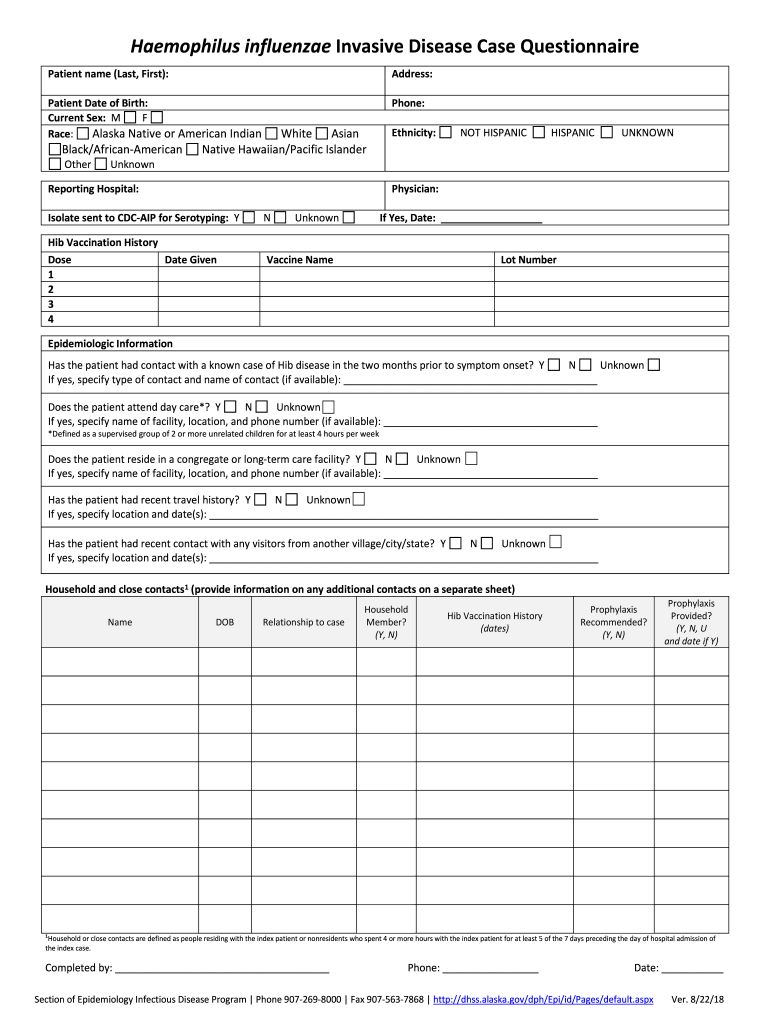
Haemophilus influenzae Invasive Disease Case Questionnaire Patient name (Last, First):Address:Patient Date of Birth: Current Sex: M F Race: Alaska Native or American IndianPhone:Black/AfricanAmerican.
Loading

Open form follow the instructions

Easily sign the form with your finger

Send filled & signed form or save
How to fill out the AK Haemophilus Influenzae Invasive Disease Case Questionnaire online
This guide provides step-by-step instructions on how to accurately complete the AK Haemophilus Influenzae Invasive Disease Case Questionnaire online. By following this comprehensive guide, you can ensure that all necessary information is reported correctly for effective management of invasive diseases.
Follow the steps to fill out the questionnaire successfully.
- Press the ‘Get Form’ button to access the questionnaire and open it in your preferred editor.
- Begin by entering the patient name in the designated field as 'Last, First'.
- Fill in the patient's address completely in the specified area.
- Input the patient's date of birth in the required format.
- Select the current sex of the patient by clicking on the appropriate option: M or F.
- Indicate the patient's race by checking the relevant box: Alaska Native or American Indian, Black/African-American, White, Asian, Native Hawaiian/Pacific Islander, Other, or Unknown.
- Provide the patient's phone number in the corresponding field.
- Enter the reporting hospital’s name to document where the case is being reported from.
- Specify the patient's ethnicity by selecting 'Not Hispanic', 'Hispanic', or 'Unknown'.
- Input the name of the physician responsible for the case.
- Indicate if an isolate has been sent to the CDC-AIP for serotyping by selecting either 'Y' (Yes), 'N' (No), or 'Unknown'.
- Document the Hib vaccination history by entering the dose numbers and dates given for up to four doses. If applicable, state the vaccine name and lot number.
- Respond to the epidemiologic questions regarding contact with known cases of Hib disease, day care attendance, residence in a congregate facility, recent travel, and contact with recent visitors, providing specific details where applicable.
- For household and close contacts, record the names, dates of birth, relationships, vaccination history, and prophylaxis recommendations for each person.
- Complete the form by signing your name, including your phone number and the date of completion.
- Lastly, save your changes, download the form, or print it out for your records.
Complete the AK Haemophilus Influenzae Invasive Disease Case Questionnaire online to ensure accurate reporting.
Experience a faster way to fill out and sign forms on the web. Access the most extensive library of templates available.
Related content
Aug 22, 2018 — Epidemiologic Information. Has the patient had contact with a known case...
Invasive Haemophilus influenzae type b disease in Alaska: background epidemiology for a...
95% of cases of invasive H. influenzae disease among children younger than 5 ... For...
Get answers to your most pressing questions about US Legal Forms API.
Which type of H. influenzae causes invasive disease to humans?
influenzae (type b or Hib) disease. Hib can cause severe infections of both the lining of the brain and spinal cord (meningitis) and the bloodstream. Vaccines can prevent Hib disease.
Which is the most virulent and most invasive strain of Haemophilus influenzae?
The most virulent strain is H influenzae type b (Hib). Some H influenzae strains have no capsule and are termed nonencapsulated H influenzae or nontypeable H influenzae (NTHi).
What invasive disease is caused by Haemophilus influenzae?
The most common types of invasive disease caused by H. influenzae are: Pneumonia* (lung infection) Bloodstream infection.
What is a Haemophilus influenzae case?
Case Definition Invasive disease caused by H. influenzae can produce any of several clinical syndromes, including meningitis, bacteremia, epiglottitis, pneumonia, septic arthritis, cellulitis, or purulent pericarditis; endocarditis and osteomyelitis occur less commonly.
What is invasive Haemophilus influenzae?
Haemophilus influenzae (Hib) is an infection caused by bacteria. The most common type of invasive Hib disease is meningitis, an infection of the membranes that cover the brain and spinal cord. It usually affects children under the age of five.
What is the most pathogenic strain of Haemophilus influenzae?
Type b H influenzae is plainly the most virulent of the Haemophilus species; 95 percent of bloodstream and meningeal Haemophilus infections in children are due to this organisms.
What is the most common Hib related invasive disease?
The most common types of disease are meningitis, bacteremia, epiglottitis, pneumonia, arthritis, and cellulitis. Meningitis, an infection of the membranes covering the brain and spinal cord, is the most common clinical manifestation of invasive Hib disease, accounting for 50% to 65% of cases in the prevaccine era.
Which strain of H. influenzae considered being most invasive and most common in humans?
Type b H influenzae is by far the most virulent organism in this group, commonly causing bloodstream invasion and meningitis in children younger than 2 years. Nontypable strains are frequent causes of respiratory tract disease in infants, children, and adults.
Use professional pre-built templates to fill in and sign documents online faster. Get access to thousands of forms.
If you believe that this page should be taken down, please follow our DMCA take down process here.