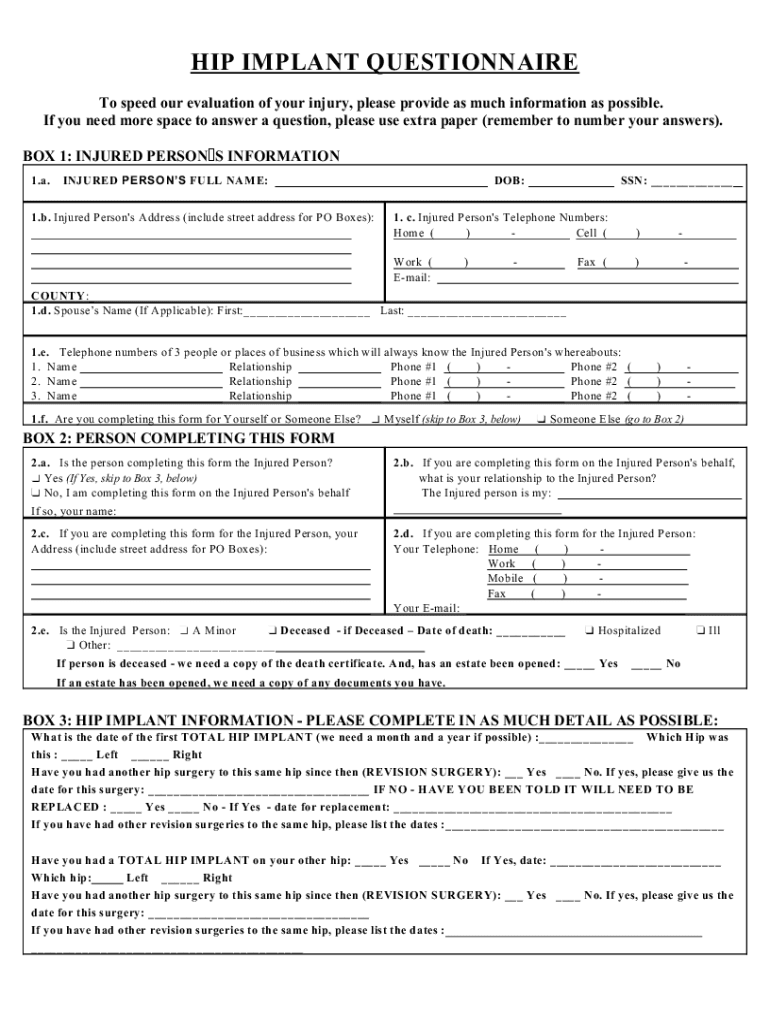
HIP IMPLANT QUESTIONNAIRE To speed our evaluation of your injury, please provide as much information as possible. If you need more space to answer a question, please use extra paper (remember to number.

Open form follow the instructions

Easily sign the form with your finger

Send filled & signed form or save
How to use or fill out the Salter Ferguson Hip Implant Questionnaire online
Filling out the Salter Ferguson Hip Implant Questionnaire can help facilitate a thorough evaluation of your injury. This guide provides detailed steps to assist you in completing the form accurately and efficiently.
Follow the steps to successfully complete the questionnaire.
- Press the ‘Get Form’ button to access the Salter Ferguson Hip Implant Questionnaire. This will allow you to open the document online.
- Begin by filling out Box 1, which contains the injured person's information. Include their full name, address, date of birth, social security number, and contact numbers. Make sure to provide their email and the county as well.
- Move to Box 1.e, and list three individuals or places that can confirm the injured person's location. Specify each person's name, relationship, and two contact numbers.
- Indicate in Box 1.f whether you are completing the form for yourself or someone else. If for another person, proceed to Box 2.
- In Box 2, confirm whether the person completing the form is the injured person (2.a). If not, provide your relationship to the injured person, and fill in your name and contact details in subsequent fields.
- Proceed to Box 3, where you will enter detailed information about the hip implant. Provide the date of the first total hip implant and whether it was for the left or right hip. Note any revision surgeries and additional hip implants, if applicable.
- In Box 4, indicate whether you have received any recall notifications regarding the hip implant. If yes, detail the manufacturer and include any implant cards you may possess.
- Box 5 requires you to specify the insurance provider that paid for the total hip implant device and note if any funds have been reimbursed.
- Fill out Box 6 with information on each hip surgery, including dates, sides, physician names, and hospital addresses.
- In Box 7, answer questions about legal representation and provide additional information that may be relevant to your claim.
- Once you have completed all boxes, review the information for accuracy. After verifying the details, you can save changes, download a copy, print the document, or share it as needed.
Complete your Salter Ferguson Hip Implant Questionnaire online today to ensure your case is accurately evaluated.
Experience a faster way to fill out and sign forms on the web. Access the most extensive library of templates available.
Related content
by O Phruetthiphat · 2021 — Matta JM, Shahrdar C, Ferguson T. Single-incision anterior...
I Ct to evaluate implant placement In this severe slipped capital femoral epiphysis...
Apr 3, 1992 — PRODUCT TEST REPORT. Len Feldman. 26. Memorex Model 87 Video Cassette...
Get answers to your most pressing questions about US Legal Forms API.
How do I know if I damaged my hip replacement?
Typical symptoms that you may have failed total hip replacement are pain in the hip, groin, or thigh as well as limited mobility. Some people describe feeling that the hip joint might “give out.”
What are the symptoms of a metal on metal hip replacement?
Most experts say surgeons should see patients with all-metal devices at least annually. (If you are not sure what kind of hip implants you have, ask your doctor.) Patients should immediately report any new or worsening symptoms, including trouble walking or pain, inflammation or numbness around the hip joint.
What causes hip replacements to deteriorate?
There are many causes for failure, including aseptic loosening, dislocation, bone or implant fracture. However, in almost all scenarios, concomitant infection should be ruled out as this plays a major role in influencing management.
Can a hip replacement rust?
The alloys used in the hip implants are considered biocompatible and show negligible corrosion in the body environment under static conditions. However, modularity and its associated mechanically assisted corrosion have been shown to release metal species into the body fluids.
What are the signs and symptoms of metallosis?
Common symptoms of metallosis include: Skin rash and skin sensitivity around the implant. Inflammation. Sensitivity and pain around the implant or around the hip and groin. Bone loss. Tissue death around the implant. Pain. Numbness. Shortness of breath.
Use professional pre-built templates to fill in and sign documents online faster. Get access to thousands of forms.
If you believe that this page should be taken down, please follow our DMCA take down process here.