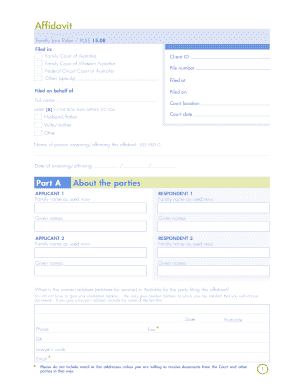
Filed on behalf of: Filed on File number Full name Court location MARK [X] IN THE BOX THAT APPLIES TO YOU Court date Husband/father Wife/mother Other Name of person swearing/affirming this affidavit Date of swearing/affirming Part A (SEE PART C) / / About the parties APPLICANT 1 Family name as used now RESPONDENT 1 Family name as used now Given names Given names APPLICANT 2 Family name as used now RESPONDENT 2 Family name as used now Given names Given names What is the co.
Open form follow the instructions
Easily sign the form with your finger
Send filled & signed form or save
How to fill out the AU Affidavit - Rule 15.08 online
Filling out the AU Affidavit - Rule 15.08 online can seem daunting, but with a clear guide, you can navigate each section with confidence. This guide will provide step-by-step instructions to ensure that your affidavit is completed accurately and efficiently.
Follow the steps to successfully complete the AU Affidavit - Rule 15.08 online.
- Press the ‘Get Form’ button to access the AU Affidavit - Rule 15.08 form and open it in your browser.
- Begin by filling out the details required for the court where you are filing the affidavit, selecting from options that include the Family Court of Australia and Federal Circuit Court of Australia.
- Enter the client ID and file number, then provide your full name and the location of the court.
- Indicate your relationship to the parties involved by marking the appropriate box (e.g., husband/father, wife/mother, etc.).
- In Part A, provide the applicant's and respondent's current family names and given names.
- Include a contact address for service in Australia, ensuring you provide an address where you can receive documents. You may use a lawyer’s address if applicable.
- Complete Part B if an independent children's lawyer has been appointed, filling in their family name, given names, and firm name.
- In Part C, as the deponent, fill in your family name, given names, usual occupation, and an address for communication.
- In Part D, outline the facts pertinent to your affidavit in numbered paragraphs. Each paragraph should address a distinct part of the subject matter.
- Ensure to sign and date your affidavit in Part E, confirming that the contents are true.
- Have your witness sign as well, and include their details.
- Once completed, review your affidavit for accuracy, and proceed to save, download, print, or share your finalized document.
Complete your AU Affidavit - Rule 15.08 online today and ensure your submissions are accurate and timely.
Experience a faster way to fill out and sign forms on the web. Access the most extensive library of templates available.
Related content
Form paragraph 15.08 or 15.08.01, where appropriate, may be used to reject a claim under...
Mar 2, 2014 — Form paragraph 15.08 or 15.08.01, where appropriate, may be used to reject...
Get answers to your most pressing questions about US Legal Forms API.
What is the purpose of the affidavit?
The purpose of an affidavit is to provide a formal statement of facts under oath, supporting claims made in legal matters. It guards against perjury, as individuals must verify the truthfulness of their statements. Employing the AU Affidavit - Rule 15.08 while preparing an affidavit helps to ensure it is compliant and effective in legal contexts.
How do I submit an affidavit to court?
To submit an affidavit to court, first ensure that it is properly signed and notarized. Next, file the affidavit with the appropriate court clerk, paying any associated filing fees. Keep copies for your records. Following the protocol outlined in the AU Affidavit - Rule 15.08 guarantees that your affidavit is recognized and processed correctly.
How to fill out an affidavit for divorce?
To fill out an affidavit for divorce, begin by clearly stating your identity, your spouse's identity, and the grounds for divorce. Include details regarding marital assets, debts, and any agreements between parties. Following the requirements of the AU Affidavit - Rule 15.08 can help streamline the divorce process and present your case effectively.
How powerful is an affidavit?
An affidavit is a powerful tool in legal proceedings, as it functions as a sworn declaration of facts. This document can significantly influence court decisions, especially if it addresses critical issues clearly and concisely. Incorporating the AU Affidavit - Rule 15.08 strengthens the affidavit’s impact by ensuring it meets legal requirements.
What is an affidavit in a child custody case?
An affidavit in a child custody case serves to present the parent's or guardian's position regarding custody arrangements. This legal document outlines relevant facts, such as the child's welfare and any concerns regarding the other parent. Utilizing the AU Affidavit - Rule 15.08 ensures that your statement is appropriately structured and recognized by the court.
Do affidavits hold up in court?
Affidavits can hold significant weight in court as they are sworn statements of facts. Courts view them as reliable documents, especially when backed by notarization. However, the effectiveness often depends on the relevance and clarity of the content provided, making adherence to the AU Affidavit - Rule 15.08 crucial for legal credibility.
What is an affidavit used for in family court?
In family court, an affidavit is often used to present evidence regarding matters like child custody, support, or divorce proceedings. It allows individuals to state facts under oath, contributing to the decision-making process of the court. The AU Affidavit - Rule 15.08 aids in formalizing your claims in a structured manner, potentially influencing the court’s outcome.
How do I fill out an affidavit of service?
To fill out an affidavit of service, start by providing the names and addresses of the parties involved. Include the date and method of service, confirming that notice was appropriately delivered. Ensure that you sign the affidavit in front of a notary to validate its authenticity. A well-completed AU Affidavit - Rule 15.08 demonstrates compliance and serves as crucial evidence.
What happens if you lie on an affidavit in Australia?
In Australia, lying on an affidavit can lead to prosecution for perjury, resulting in legal penalties. This may include fines or imprisonment, depending on the severity of the offense. Moreover, your entire case may be jeopardized if the court finds your testimony untrustworthy. It is always wise to follow the AU Affidavit - Rule 15.08 to ensure your statements remain truthful and reliable.
What makes an affidavit invalid?
An affidavit can be deemed invalid for several reasons, including lack of proper formatting, failure to swear under oath, or inclusion of false statements. Additionally, not adhering to the specific requirements of the AU Affidavit - Rule 15.08 can compromise its validity. Ensuring accuracy and proper execution is crucial in maintaining the affidavit's legal standing.
Use professional pre-built templates to fill in and sign documents online faster. Get access to thousands of forms.
If you believe that this page should be taken down, please follow our DMCA take down process here.