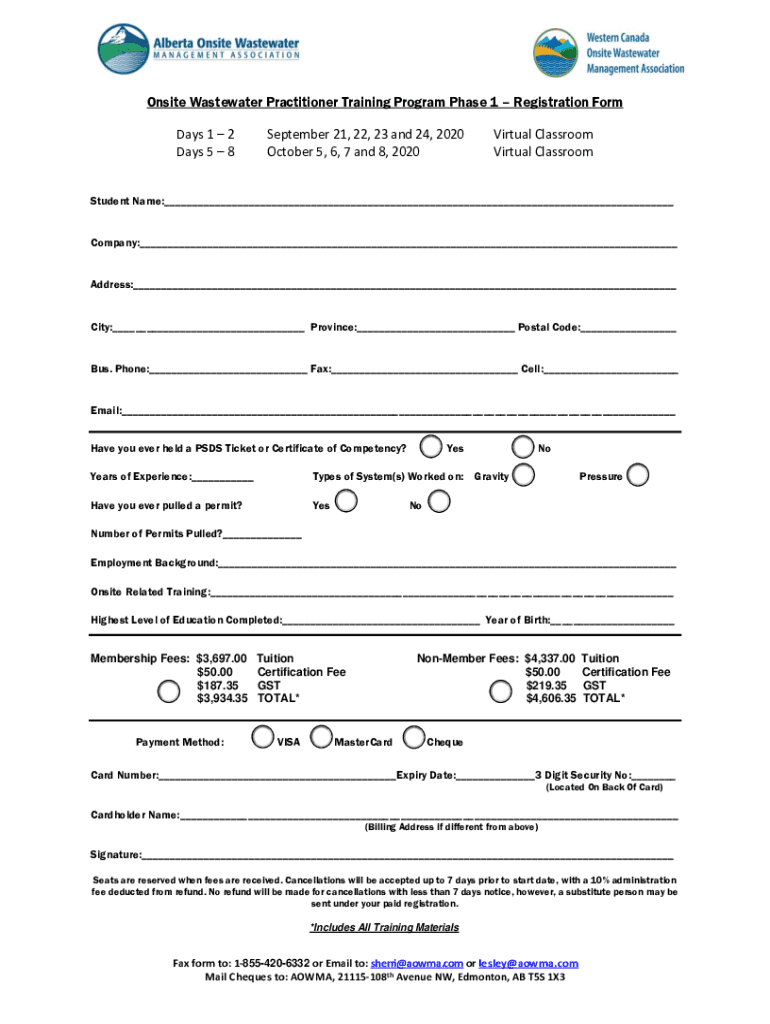
MEMO TO: applicants for the Onsite Wastewater Practitioner Training Program CONTACT: Sherri Hallett, Executive Assistant or Lesley Discarding, Executive Director SUBJECT: New Training Session Dates You.
Loading

Open form follow the instructions

Easily sign the form with your finger

Send filled & signed form or save
How to fill out the Canada Onsite Wastewater Practitioner Training Program Phase 1 – Registration Form online
This guide provides comprehensive, step-by-step instructions for users on how to complete the Canada Onsite Wastewater Practitioner Training Program Phase 1 – Registration Form online. Whether you are familiar with digital documents or new to the process, this guide ensures that you can confidently submit your registration.
Follow the steps to complete your registration form online:
- Press the ‘Get Form’ button to acquire the registration form and open it in your preferred document editor.
- Begin by filling in your personal information in the designated fields such as 'Student Name' and 'Company.' Ensure that all entries are accurate to avoid issues during processing.
- Complete your address details, including fields for 'City,' 'Province,' and 'Postal Code.' This information is essential for communication and logistics related to your training.
- Provide your business phone number, fax number, and cell number for contact purposes. Accurate contact information is vital for any updates regarding your training.
- Enter your email address in the specified field to receive important information related to your registration and training.
- Indicate whether you have ever held a PSDS Ticket or Certificate of Competency by selecting 'Yes' or 'No,' and provide any relevant years of experience along with the types of systems you have worked on.
- Complete the field about the number of permits pulled if applicable to your experience, as well as any pertinent employment background and onsite-related training.
- List your highest level of education completed and provide your year of birth in the corresponding fields.
- Review the fees section for your training, noting both member and non-member fees, then select your payment method from Visa, MasterCard, or Cheque.
- If paying by credit card, enter your card information, including card number, expiry date, and security number. Ensure the cardholder name matches the billing address provided.
- Sign the form to authorize payment and submit your application.
- Once you have filled out the form, save your changes. You may also want to download or print a copy for your records before emailing or faxing your completed registration form to the provided contacts.
Complete your registration form online now to secure your spot in the Canada Onsite Wastewater Practitioner Training Program.
Experience a faster way to fill out and sign forms on the web. Access the most extensive library of templates available.
Related content
This approach will enable States and local communities to design onsite wastewater...
1–4 1.5 Problems with existing onsite wastewater management programs . ... moving...
Suppliers shall obtain and verify the terms of the contracts between the Third-Party...
Get answers to your most pressing questions about US Legal Forms API.
What is a Rowp?
professional for Sewerage System. a registered onsite waste water practitioner (ROWP)
What is the difference between a Type 1 and Type 2 septic system?
Type 1 is treatment by septic tank and drainfield. It may be gravity fed or pumped into the drainfield. Type 2 and Type 3 systems introduce further treatment in order to produce a higher quality effluent that can be discharged into a smaller sized drainfield.
What is a Type 2 sewage treatment plant?
Type 2 treatment plants usually employ aerobic treatment processes (i.e. adding oxygen) to treat domestic sewage, using an integrated air blower to mix oxygen with the sewage. As with Type 1 systems, Type 2 disposal fields can consist of trenches, seepage beds, or sand mounds.
What is a type 3 septic system BC?
A type 3 septic system is a specially designed septic system that is capable of treating sewage to produce effluent of a higher quality standard, by including a disinfection process before being discharged into the environment via the drain field.
What does a septic engineer do?
Septic tank servicers, also called septic engineers, maintain septic tanks and systems by flushing them out on a given schedule. Properly qualified septic tank servicers, in addition to just cleaning septic tanks, also help to maintain and even new sewage systems.
Use professional pre-built templates to fill in and sign documents online faster. Get access to thousands of forms.
If you believe that this page should be taken down, please follow our DMCA take down process here.