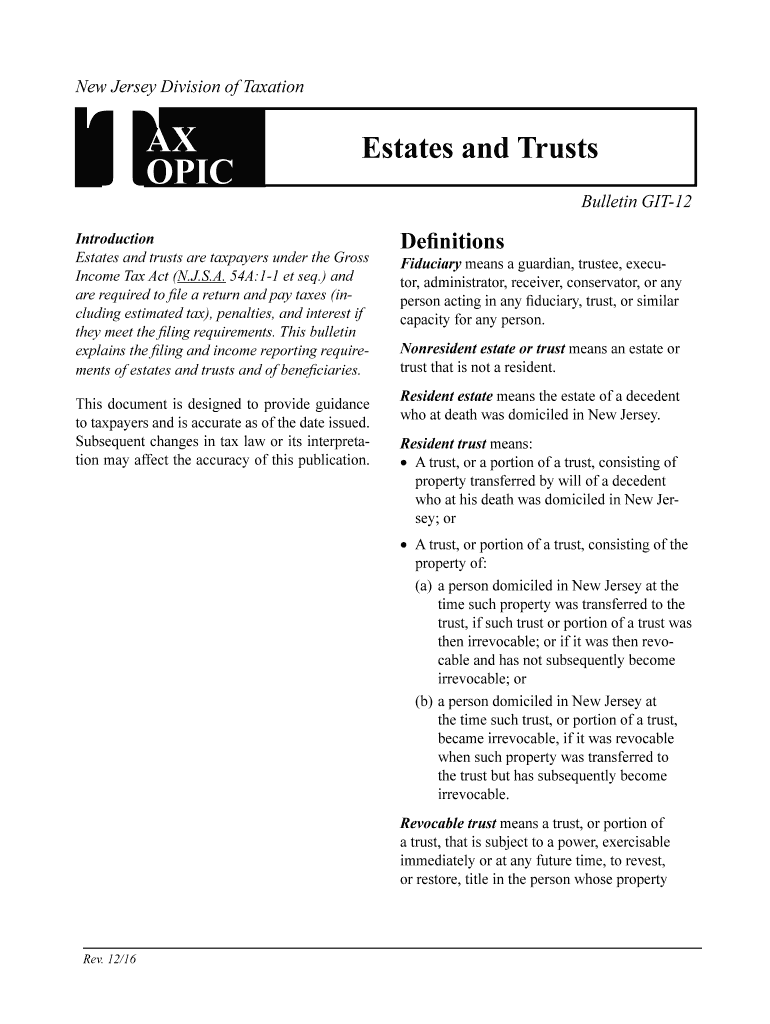
TNew Jersey Division of Taxationax opicEstates and TrustsIntroduction Estates and trusts are taxpayers under the Gross Income Tax Act (N.J.S.A. 54A:11 et seq.) and are required to file a return and.

Open form follow the instructions

Easily sign the form with your finger

Send filled & signed form or save
How to fill out the NJ GIT-12 online
This guide provides step-by-step instructions for effectively completing the NJ GIT-12 form online. Users of all backgrounds can benefit from clear guidance about each section of the form, ensuring compliance with New Jersey's tax requirements for estates and trusts.
Follow the steps to fill out the NJ GIT-12 online with ease.
- Press the ‘Get Form’ button to access the NJ GIT-12 form online and open it in the editor.
- Review the form details and ensure you understand the definitions provided for key terms such as fiduciary, resident estate, and nonresident estate.
- Begin filling out the basic information section, which typically includes the estate or trust name, identification number, and contact information.
- Indicate whether the estate or trust is a resident or nonresident estate, based on the definitions provided earlier.
- Complete the gross income section. Ensure that you have the total gross income amount, and check if it exceeds the filing threshold of $10,000.
- Address any exemptions or deductions, such as commissions based on income or distributions to beneficiaries, as applicable.
- Review the tax liability section to determine the amount calculated based on the gross income and allowable deductions.
- Double-check all filled information for accuracy before finalizing the form.
- Once you are satisfied that the form is completed and accurate, proceed to save your changes, download, print, or share the completed form.
Complete your NJ GIT-12 form online today to ensure compliance with New Jersey tax laws.
Experience a faster way to fill out and sign forms on the web. Access the most extensive library of templates available.
Related content
The tax year of the estate or trust must be the same as the tax year used for federal...
Jun 28, 2022 — Employer Payroll Tax Forms ; NJ-550, Monthly Return of Withholding from...
WNJM (89.9 FM) is a radio station licensed to Manahawkin, New Jersey. The station is owned...
Get answers to your most pressing questions about US Legal Forms API.
What are the New Jersey inheritance tax rules?
11% tax on any amount over $25,000 up to $1,100,000 (no tax below $25,000) 13% on any amount over $1,100,000 up to $1,400,000. 14% on any amount over $1,400,000 up to $1,700,000. 16% on any amount over $1,700,000.
Who must file NJ inheritance tax return?
The executor, administrator, or heir-at-law of the estate must file an Inheritance Tax return (if required) within eight (8) months of the date of the decedent's death.
How much can you inherit in NJ without paying taxes?
The inheritance tax is imposed on a beneficiary that receives property valued at $500 or more. Therefore, if you receive something worth $499, you will not be required to pay any inheritance taxes. Life insurance is also exempt.
Do I have to pay taxes on an inheritance in New Jersey?
New Jersey has had an Inheritance Tax since 1892, when a tax was imposed on property transferred from a deceased person to a beneficiary. Inheritance Tax is based on who specifically will receive or has received a decedent's assets, and how much each beneficiary is entitled to receive.
How do I get a NJ inheritance tax waiver?
How to Obtain a Waiver. Waivers (Form 0-1) can only be issued by the Inheritance Tax Branch of the NJ Division of Taxation. It is not a form you can obtain online or fill out yourself. In most circumstances, some kind of return or form must be filed with the Division in order to have a waiver issued.
Who is exempt from NJ inheritance tax?
New Jersey law puts inheritors into different groups, based on their family relationship to the deceased person. Class A beneficiaries are exempt from the inheritance tax; they pay no inheritance tax. This group includes the deceased person's: spouse, domestic partner, or civil union partner.
What is NJ Git tax?
Gross Income Tax is levied on gross income earned or received by New Jersey resident and nonresident individuals, estates, and trusts.
Use professional pre-built templates to fill in and sign documents online faster. Get access to thousands of forms.
If you believe that this page should be taken down, please follow our DMCA take down process here.