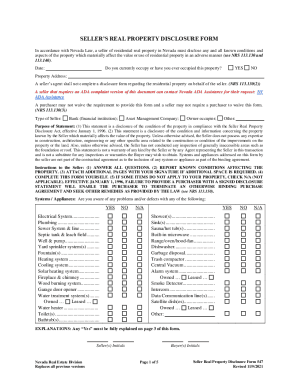
SELLERS REAL PROPERTY DISCLOSURE FORM In accordance with Nevada Law, a seller of residential real property in Nevada must disclose any and all known conditions and aspects of the property which materially.

How it works
  • Open form

    Open form follow the instructions

  • Easily sign form

    Easily sign the form with your finger

  • Share form

    Send filled & signed form or save

How to fill out the Form 547 - Seller's Real Property Disclosure online

Completing the Form 547 - Seller's Real Property Disclosure is a critical step in selling residential property in Nevada. This guide will provide clear, step-by-step instructions to help you navigate the disclosure process online, ensuring compliance with state law.

Follow the steps to accurately complete your disclosure form.

  1. Click the ‘Get Form’ button to obtain the form and open it in your preferred editor.
  2. Start by entering the date on the top of the form. This is essential for record-keeping and legal compliance.
  3. Provide the property address in the designated area. Ensure this information is accurate to avoid any complications.
  4. Indicate your status as a seller by selecting one of the options: Bank, Asset Management Company, Owner-occupier, or Other.
  5. Complete the Purpose of Statement section. This involves understanding that you are disclosing the property's condition, aligning with the Seller Real Property Disclosure Act.
  6. Answer all the questions about the systems and appliances in the property. For each item, indicate if there is a known problem or defect.
  7. For any affirmative responses in the previous step, you must provide thorough explanations on the additional page provided.
  8. Move to the Property Conditions and Improvements section. Here, disclose any issues related to the structure, land, roof, pool/spa, infestation, and environmental hazards.
  9. Continue by completing any remaining sections, ensuring that each item is answered as applicable. If a question does not pertain to your property, mark it as N/A.
  10. Review the completed form for accuracy and thoroughness. Ensure that you have initialed where required.
  11. Once finished, save your changes and prepare to download, print, or share the completed form as necessary.

Start completing your Form 547 online today to ensure a smooth property sale process.

Get form

Experience a faster way to fill out and sign forms on the web. Access the most extensive library of templates available.

Related content

Form 547 - Seller's Real Property Disclosure

This statement is a disclosure of the condition of the property in compliance with the...

Learn more
Residential Real Estate Condition Disclosure...

by RM Washburn · Cited by 61 — Article. First are statutes and regulations that require...

Learn more
Private transfer fee - Wikipedia

A private transfer fee covenant is a legal instrument that is filed in the real property...

Learn more
Questions & Answers

Get answers to your most pressing questions about US Legal Forms API.

Contact support

What is a closing disclosure for seller?

The purpose of the Seller's Closing Disclosure is to show the purchase price and itemize expenses. The Seller's Closing Disclosure shows the purchase price and then a line item breakdown of every cost paid by the seller in two columns of whether it was paid before or at closing.

Explanation Every real estate seller has to fill out a Seller Disclosure Statement.

Examples of material facts that must be disclosed include structural problems with the house, soil problems, a leaking roof, unpermitted construction, neighborhood noise problems, and anything else that a buyer would deem to be important.

In Colorado, the seller's property disclosure responsibility also extends to the real estate professional. Colorado statute provides that a broker acting as a seller's agent must disclose to any prospective buyer all adverse material facts actually known by such broker.

A Seller's Disclosure is a legal document that requires sellers to provide previously undisclosed details about the property's condition that prospective buyers may find unfavorable. This document is also known as a property disclosure, and it's important for both those buying a house and for those selling a house.

When Is a Seller's Disclosure Not Required in Texas? Every rule has exceptions—even in Texas. You don't need a seller's disclosure when you sell or give a house to your kids (such as in a will), your spouse (such as part of a divorce), someone you already co-own the house with, or the government.

The seller must complete the “Seller's Real Property Disclosure” form, detailing the condition of the property, known defects, and any other aspects of the property which may affect its use or value.

However, licensees can only disclose information that is known to them. In light of this, the Nevada Revised Statutes require property owners to complete a seller's real property disclosure form and furnish it to the buyers or buyer's agent no less than ten days before the property is sold.

Get This Form Now!

Use professional pre-built templates to fill in and sign documents online faster. Get access to thousands of forms.

If you believe that this page should be taken down, please follow our DMCA take down process here.

Get Form 547 - Seller's Real Property Disclosure