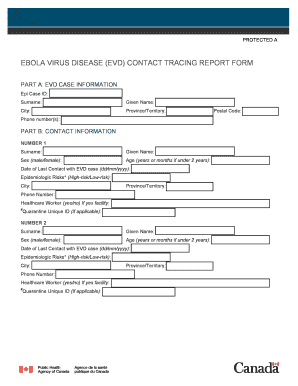
ATION NUMBER 1 Surname: Given Name: Sex (male/female): Age (years or months if under 2 years): Date of Last Contact with EVD case (dd/mm/yyyy): Epidemiologic Risks* (High-risk/Low-risk): City: Province/Territory: Phone Number: Healthcare Worker (yes/no) If yes facility: # Quarantine Unique ID (if applicable): NUMBER 2 Surname: Given Name: Sex (male/female): Age (years or months if under 2 years): Date of Last Contact with EVD case (dd/mm/yyyy): Epidemiologic Risks* (High-risk/Low-ris.

How it works
  • Open form

    Open form follow the instructions

  • Easily sign form

    Easily sign the form with your finger

  • Share form

    Send filled & signed form or save

How to fill out the Canada Ebola Virus Disease (EVD) Contact Tracing Report Form online

This guide provides step-by-step instructions on how to complete the Canada Ebola Virus Disease (EVD) Contact Tracing Report Form online. Following these directions will help ensure that you accurately fill out the required information for proper contact tracing.

Follow the steps to fill out the EVD contact tracing report form.

  1. Click ‘Get Form’ button to access the Canada Ebola Virus Disease (EVD) Contact Tracing Report Form and open it in the editor.
  2. Complete Part A: EVD Case Information. Fill in the Epi Case ID, surname, given name, city, province/territory, and phone number(s) of the EVD case.
  3. Move to Part B: Contact Information. For each contact, including numbers 1 through 5, enter the surname, given name, sex, age, date of last contact with the EVD case, epidemiologic risks (choose between high-risk or low-risk), city, province/territory, and phone number.
  4. Indicate whether the contact is a healthcare worker by selecting yes or no. If yes, provide the facility details.
  5. If applicable, fill in the quarantine unique ID number provided by the public health agency quarantine officer.
  6. Review all entered information for accuracy. Once satisfied, you can save changes, download, print, or share the form as needed.

Complete your forms online to support public health efforts efficiently.

Get form

Experience a faster way to fill out and sign forms on the web. Access the most extensive library of templates available.

Related content

Contact Tracing during an Outbreak of Ebola Virus...

by OO Olu · 2016 · Cited by 59 — Contact tracing is a critical strategy required for...

Learn more
Ebola virus: A global public health menace: A...

by S Hasan — Ebola virus disease (EVD), a fatal viral hemorrhagic illness, is due to...

Learn more
MCMi Program Update FY 2019 | FDA

Mar 11, 2015 — ing Ebola and Zika, FDA also engages in numerous ... Canada/National...

Learn more
Questions & Answers

Get answers to your most pressing questions about US Legal Forms API.

Contact support

What two methods are used for early detection of Ebola virus?

Two serological assays, the indirect fluorescent antibody detection test (IFAT) [42] and enzyme-linked immunosorbent assay (ELISA) [48] have been used in the detection of Ebola virus antibodies.

The genus Ebolavirus (/iˈboʊlə/- or /əˈboʊləˌvaɪrəs/; ee-BOH-lə- or ə-BOH-lə-VY-rəs) is a virological taxon included in the family Filoviridae (filament-shaped viruses), order Mononegavirales. The members of this genus are called ebolaviruses, and encode their genome in the form of single-stranded negative-sense RNA.

Contact tracing is an integral component of the overall strategy for controlling an outbreak of Ebola virus disease (EVD). Contact tracing is defined as the identification and follow-up of persons who may have come into contact with an infected person.

If assessment indicates possible Ebola virus infection, take action. Isolate the patient in a private room with a private bathroom or covered, bedside commode and close the door. Wear appropriate personal protective equipment (PPE). Limit the healthcare personnel who enter the room.

Ebola virus disease (formerly known as Ebola haemorrhagic fever) is a severe, often fatal illness, with a case fatality rate of up to 90%. It is one of the world's most virulent diseases. The infection is transmitted by direct contact with the blood, body fluids and tissues of infected animals or people.

There have been no cases of Ebola disease in Canada. The first case of Ebola disease was discovered in 1976. The disease is named after the Ebola River in what is now the Democratic Republic of the Congo. Since then, there have been several human outbreaks, originating exclusively in Africa.

Applying direct contact precautions is recommended when treating a suspected or confirmed Ebola case. See: Steps to put on personal protective equipment (PPE) and Steps to remove personal protective equipment (PPE).

The 2014–2016 West African outbreak of Ebola Virus Disease (EVD) was the largest and most deadly to date. Contact tracing, following up those who may have been infected through contact with an infected individual to prevent secondary spread, plays a vital role in controlling such outbreaks.

Get This Form Now!

Use professional pre-built templates to fill in and sign documents online faster. Get access to thousands of forms.

If you believe that this page should be taken down, please follow our DMCA take down process here.

Get Canada Ebola Virus Disease (EVD) Contact Tracing Report Form