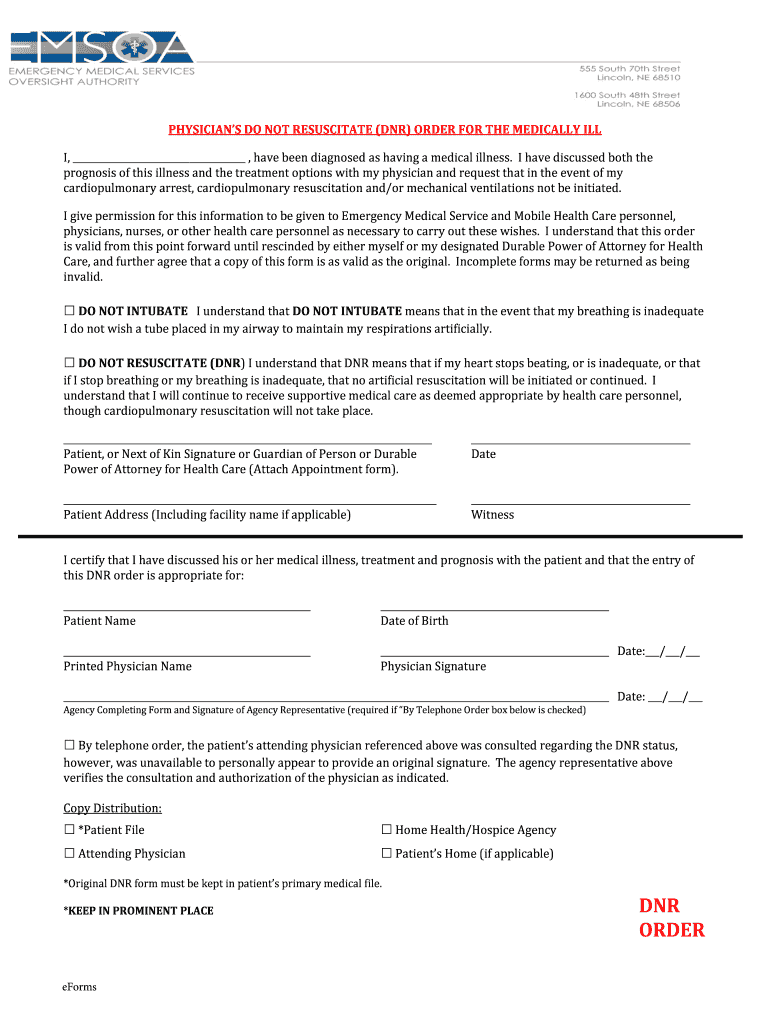
Of this illness and the treatment options with my physician and request that in the event of my cardiopulmonary arrest, cardiopulmonary resuscitation and/or mechanical ventilations not be initiated. I give permission for this information to be given to Emergency Medical Service and Mobile Health Care personnel, physicians, nurses, or other health care personnel as necessary to carry out these wishes. I understand that this order is valid from this point forward until rescinded by either myself o.
Loading

Open form follow the instructions

Easily sign the form with your finger

Send filled & signed form or save
How to fill out the NE Physician's Do-Not-Resuscitate (DNR) Orders For The Medically Ill online
Filling out the NE Physician's Do-Not-Resuscitate (DNR) Orders For The Medically Ill is an essential step in ensuring that your healthcare wishes are respected in case of a medical emergency. This guide provides clear, user-friendly steps for completing the form online, helping you navigate each section effectively.
Follow the steps to complete the DNR order form online.
- Press the ‘Get Form’ button to access the DNR order form and open it in your preferred editor.
- In the first section, you will need to fill in your name, indicating that you have a medical illness. This identification is crucial for the validity of the order.
- Next, discuss the prognosis and treatment options with your physician if not already done, as this will inform your decisions regarding resuscitation.
- Check the appropriate boxes that indicate your decisions: ‘DO NOT INTUBATE’ and/or ‘DO NOT RESUSCITATE (DNR)’. Each option has a description that outlines what it entails.
- Sign the form as the patient, or have your Next of Kin or Guardian of Person sign if applicable. Ensure that the date of your signature is included.
- Enter your address, including the facility name if you are currently in one, ensuring accurate contact information.
- A witness must sign the form to verify that all of the necessary discussions regarding your medical illness and treatment were had.
- The physician who discusses the DNR order will need to complete their section, including their name, date of birth, printed name, and signature. It is important that this section is clear and legible to ensure proper communication of your wishes.
- If the order is given by telephone, a designated agency must complete their section, signing off on the consultation with the physician.
- Finally, distribute copies of the completed DNR form to all relevant parties, including your patient file, attending physician, home health/hospice agency, and your home if applicable. Ensure that the original is kept in your primary medical file in a prominent place.
Complete your DNR order form online today to ensure your healthcare wishes are clearly communicated.
Experience a faster way to fill out and sign forms on the web. Access the most extensive library of templates available.
Related content
Jan 18, 2022 — A do-not-resuscitate order, or DNR order, is a medical order written by a...
by E Shaver · 1989 · Cited by 14 — acted "Do Not Resuscitate" (DNR) statutes...
A do-not-resuscitate order (DNR), also known as Do Not Attempt Resuscitation (DNAR), Do...
Get answers to your most pressing questions about US Legal Forms API.
Why a person would choose a do-not-resuscitate DNR order?
A DNR order is allowed for any reason. Any adult can request a DNR, including healthy adults. People most likely to use them are those who know in advance that their chance of surviving CPR is very low and/or they don't want to spend their last days on life support.
Does a DNR do-not-resuscitate order alter any treatment or care except?
It is important to understand that a DNR order only affects whether a patient will receive CPR. All other necessary treatments—including palliative care—should be continued unless the patient or their surrogate states otherwise.
What happens if you try to resuscitate a DNR?
Summary. The main point is this: as a bystander, i.e. a non-medical professional, you cannot get into any legal trouble for giving CPR to a person with a DNR, and should always give CPR as soon as possible to all victims of sudden cardiac arrest.
For what reason would a doctor write a DNR order?
Generally, a DNR is executed when an individual has a history of chronic disease or terminal illness, such as chronic lung disease or heart disease, that has in the past or may in the future necessitate cardiopulmonary resuscitation (CPR), and the patient no longer wishes to be revived because of concerns that the use ...
What is the common reason why a patient would choose to have DNR order on file?
Common reasons that people choose to get a DNR include: Religious or philosophical beliefs. Some people are morally or ethically opposed to resuscitation. Failing health.
Do doctors have to respect DNR?
The ethical obligation to respect patient autonomy and self-determination requires that the physician respect decisions to refuse care, even when such decisions will result in the patient's death.
What does it mean when the doctor writes an order for do-not-resuscitate DNR?
To use the sharing features on this page, please enable JavaScript. A do-not-resuscitate order, or DNR order, is a medical order written by a doctor. It instructs health care providers not to do cardiopulmonary resuscitation (CPR) if a patient's breathing stops or if the patient's heart stops beating.
What are the 2 types of DNR?
Did you know that there are two different types of DNR orders that can be chosen? The first is the DNR Comfort Care (DNRCC) and the other is the DNR Comfort Care- Arrest (DNRCC-Arrest).
Use professional pre-built templates to fill in and sign documents online faster. Get access to thousands of forms.
If you believe that this page should be taken down, please follow our DMCA take down process here.