How it works
  • Open form

    Open form follow the instructions

  • Easily sign form

    Easily sign the form with your finger

  • Share form

    Send filled & signed form or save

How to fill out the About Underwriting Previous Business Declaration online

Filling out the About Underwriting Previous Business Declaration is a crucial step for individuals involved in underwriting processes. This guide aims to simplify the process, providing clear instructions for each section of the form to ensure that users can complete it accurately and efficiently.

Follow the steps to successfully complete your declaration form.

  1. Click ‘Get Form’ button to obtain the form and access it for completion.
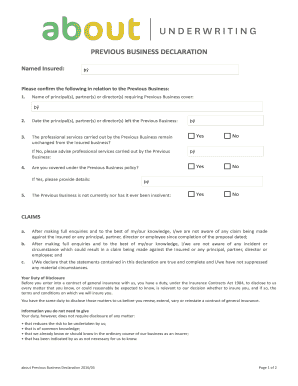
  2. In the first section, enter the names of the principal(s), partner(s), or director(s) that require Previous Business cover. This information is crucial for identifying the individuals linked to the previous business.
  3. Respond to the question regarding whether the professional services provided by the Previous Business remain unchanged. If you answer 'No,' specify the services that were carried out by the Previous Business.
  4. Indicate whether you have coverage under the Previous Business policy. If 'Yes,' provide the necessary details for clarity.
  5. Confirm that the Previous Business is not currently and has never been insolvent. This affirmation is essential for ensuring the integrity of the declaration.
  6. In the Claims section, affirm the statements regarding claims awareness and potential incidents. Ensure to declare that all statements in this declaration are true and complete, and that no material circumstances have been suppressed.
  7. Review the Duty of Disclosure information carefully to understand your responsibilities before entering into an insurance contract.
  8. Finally, sign and date the declaration, indicating your position. Save changes to the document and choose to download, print, or share the form as required.

Complete the About Underwriting Previous Business Declaration online today to ensure that your business is properly covered.

Get form

Experience a faster way to fill out and sign forms on the web. Access the most extensive library of templates available.

Related content

Underwriting Agreement - SEC.gov

The Company has filed with the Commission a registration statement on Form S-1 ... If an...

Learn more
Primer on Post-Claims Underwriting - Issue Lab

by H Haycock — If an insurance company determines through post-claims underwriting that...

Learn more
Underwriting profit - Wikipedia

Underwriting profit is a term used in the insurance industry. It consists of the earned...

Learn more
Questions & Answers

Get answers to your most pressing questions about US Legal Forms API.

Contact support

What documents are commonly used for underwriting?

Before the borrower becomes responsible for the loan, they must submit the following documents: Recent bank statements, pay stubs, business tax returns, and other income and asset verification documents. Copy of signed purchase agreement. Documented explanation of unusual changes in their financial situation.

Here are the steps in the mortgage underwriting process and what you can expect. Step 1: Complete your mortgage application. ... Step 2: Be patient with the review process. ... Step 3: Get an appraisal. ... Step 4: Protect your investment. ... Step 5: The underwriter will make an informed decision. ... Step 6: Close with confidence.

Underwriting is the process of assessing the amount of risk you present to a potential insurer. Professional underwriters review the criteria on your application to see if it's possible to offer you a policy and, if so, how much coverage you're eligible for. Then, they set your monthly premium based on the information.

Underwriters view errors, unbalanced balance sheets, late financial statements and unusual reporting formats as red flags. Debt. High debt levels may give underwriters pause. While debt levels vary by industry, a debt-to-equity ratio of 2.0 or less is generally considered acceptable.

Your loan officer will submit all your conditions back to the underwriter, who should then issue a “clear to close,” which means you're ready to sign loan documents. This last verification is your final approval.

Meet the Fantastic Four - the 4 C's: Capacity, Credit, Collateral, and Capital. These titans hold the power to make or break your dream of homeownership. They're the guardians of mortgage approval, keeping a watchful eye on every aspect of your financial life.

W-2s or I-9s from the past two years. Proof of any other sources of income. Federal tax returns. Recent bank statements or proof of other assets.

Underwriters review the applicant's credit history, bank statements, financial records, the value of any security or collateral (like personal assets), the size of the business, and revenue streams.

You may need a bachelor's degree that includes coursework in economics, business, accounting, finance, or mathematics to become an underwriter. Underwriting requires a series of specialized skills, including analytical, computer, communication, and math skills.

A mortgage loan underwriter is one of the most common types of underwriters. Their job is to ensure that a loan applicant meets all requirements before approving or denying the loan.

Get This Form Now!

Use professional pre-built templates to fill in and sign documents online faster. Get access to thousands of forms.

If you believe that this page should be taken down, please follow our DMCA take down process here.

Get About Underwriting Previous Business Declaration