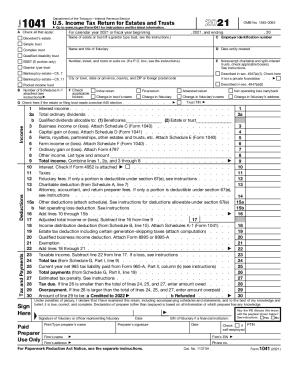
A Check all that apply: Decedent s estate For calendar year 2021 or fiscal year beginning OMB No. 1545-0092 , 2021, and ending , 20 Name of estate or trust (If a grantor type trust, see the instructions.) C Employer identification number Name and title of fiduciary D Date entity created Number, street, and room or suite no. (If a P.O. box, see the instructions.) E Nonexempt charitable and split-interest trusts, check applicable box(es). See instructions. Simple trust Complex trust.
Open form follow the instructions
Easily sign the form with your finger
Send filled & signed form or save
How to fill out the IRS 1041 online
The IRS 1041 form is used to report the income, deductions, gains, and losses of estates and trusts. Completing this form online can streamline the process and help ensure accuracy. This guide provides clear, step-by-step instructions for filling out the IRS 1041 form conveniently.
Follow the steps to complete the IRS 1041 form online effectively.
- Click ‘Get Form’ button to access the IRS 1041 form and open it in the editor.
- Begin by checking the applicable boxes at the top of the form to indicate the type of entity, such as 'Decedent’s estate' or 'Trust'.
- Enter the name of the estate or trust and the Employer Identification Number (EIN) in the designated fields.
- Provide the name and title of the fiduciary, along with the date the entity was created.
- Indicate the type of trust by checking the appropriate box for simple trust, complex trust, or any applicable special purpose.
- Fill in the address information for the estate or trust, ensuring to include city, state, and ZIP code.
- Complete the income section by reporting various types of income such as interest income, dividends, and business income, using attached schedules as necessary.
- Enter deductions related to taxes, fiduciary fees, charitable deductions, and other applicable deductions in the designated areas.
- Calculate the taxable income by subtracting total deductions from total income.
- Review the tax computation area to calculate total tax due and any payments made.
- Sign and date the form at the bottom, ensuring the declaration is completed.
- After reviewing your completed form, save your changes and choose to download, print, or share the completed IRS 1041 form as needed.
Start filling out your IRS 1041 form online today to ensure accurate reporting of estate and trust income.
Experience a faster way to fill out and sign forms on the web. Access the most extensive library of templates available.
Related content
Form 1041 is used by a fiduciary to file an income tax return for every domestic estate or...
(a) General ruleNo gain or loss shall be recognized on a transfer of property from an...
1 Feb 2018 — An estate (other than a bankruptcy estate) and a trust filing Form 1041 are...
Get answers to your most pressing questions about US Legal Forms API.
Do all trusts have to file a 1041?
Q: Do trusts have a requirement to file federal income tax returns? A: Trusts must file a Form 1041, U.S. Income Tax Return for Estates and Trusts, for each taxable year where the trust has $600 in income or the trust has a non-resident alien as a beneficiary.
Do beneficiaries file 1041?
Note. Form 1041-T, Allocation of Estimated Tax Payments to Beneficiaries, must be timely filed by the fiduciary for the beneficiary to get the credit for an estimated tax payment.
Who must file Form 1041?
If the estate generates more than $600 in annual gross income, you are required to file Form 1041, U.S. Income Tax Return for Estates and Trusts. An estate may also need to pay quarterly estimated taxes.
Where do beneficiary distributions go on 1041?
The distribution amount will be reported on Form 1041 Schedule B, Line 10 - Other Amounts paid, credited, or otherwise required to be distributed.
What is the difference between 1040 and 1041?
As executor of an estate, the form you'll file for the deceased person is Form 1040 as a final return. If you are legally deemed the executor or fiduciary of an estate, you may also file a Form 1041 for the deceased individual's estate.
What deductions are allowed on Form 1041?
On Form 1041, you can claim deductions for expenses such as attorney, accountant and return preparer fees, fiduciary fees and itemized deductions. After the section on deductions is complete you'll get to the kicker – taxes and payments.
Who must file an IRS Form 1041?
If the estate generates more than $600 in annual gross income, you are required to file Form 1041, U.S. Income Tax Return for Estates and Trusts. An estate may also need to pay quarterly estimated taxes. See Form 1041 instructions for information on when to file quarterly estimated taxes.
What is an IRS 1041?
Form 1041, U.S. Income Tax Return for Estates and TrustsPDF, is used by the fiduciary of a domestic decedent's estate, trust, or bankruptcy estate to report: Income, deductions, gains, losses, etc.
What expenses can be deducted on estate 1041?
On Form 1041, you can claim deductions for expenses such as attorney, accountant and return preparer fees, fiduciary fees and itemized deductions. After the section on deductions is complete you'll get to the kicker – taxes and payments.
Use professional pre-built templates to fill in and sign documents online faster. Get access to thousands of forms.
If you believe that this page should be taken down, please follow our DMCA take down process here.