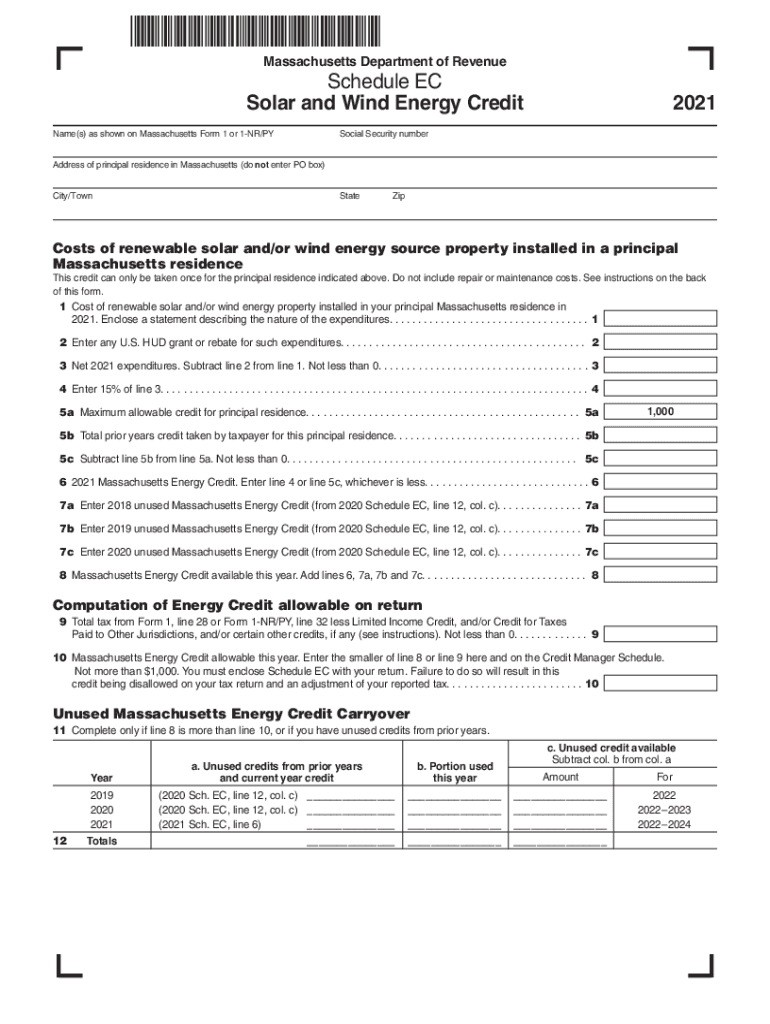
Massachusetts Department of Revenue2021Schedule EC Solar and Wind Energy Credit Name s) as shown on Massachusetts Form 1 or 1NR PYSocial Security numberAddress of principal residence in Massachusetts.
Loading

Open form follow the instructions

Easily sign the form with your finger

Send filled & signed form or save
How to fill out the MA Schedule EC online
Filling out the MA Schedule EC is an essential step for individuals seeking to claim the Solar and Wind Energy Credit for their principal residence in Massachusetts. This guide will provide you with clear, step-by-step instructions to help you complete the form effectively.
Follow the steps to fill out the MA Schedule EC online
- Press the ‘Get Form’ button to access the MA Schedule EC form and open it in your preferred editor.
- Begin by entering your name(s) as they appear on Massachusetts Form 1 or 1-NR/PY.
- Input your Social Security number in the designated field.
- Provide the address of your principal residence in Massachusetts. Note that PO boxes are not acceptable.
- State your city or town, followed by your state and zip code.
- On line 1, enter the total cost of the renewable solar and/or wind energy source property installed at your principal residence in 2021. Be sure to include a statement describing the nature of the expenditures.
- For line 2, enter any U.S. HUD grant or rebate received for the expenditures related to the renewable energy property.
- Calculate your net 2021 expenditures by subtracting the amount on line 2 from line 1 and enter the result on line 3.
- On line 4, calculate 15% of the amount shown on line 3.
- Enter the maximum allowable credit for your principal residence on line 5a, which is capped at $1,000.
- For line 5b, enter the total prior years' credit taken for this principal residence.
- To find your available credit, subtract line 5b from line 5a and enter the result on line 5c.
- On line 6, enter the 2021 Massachusetts Energy Credit, which is the lesser of line 4 or line 5c.
- If applicable, enter any unused Massachusetts Energy Credit from previous years in lines 7a, 7b, and 7c.
- Calculate the total Massachusetts Energy Credit available this year by adding lines 6, 7a, 7b, and 7c.
- Complete lines 9 through 10 to compute the energy credit allowable and final adjustments.
- If you have more than one principal residence that qualified for the Energy Credit, ensure to file a separate Schedule EC for each, keeping in mind the $1,000 maximum limit.
- Finally, save your changes, download, print, or share the completed form as needed.
Take the next step and complete your MA Schedule EC online today.
Experience a faster way to fill out and sign forms on the web. Access the most extensive library of templates available.
Related content
Get answers to your most pressing questions about US Legal Forms API.
What is the solar tax credit for 2023?
The installation of the system must be complete during the tax year . Solar PV systems installed in 2020 and 2021 are eligible for a 26% tax credit. In August 2022, Congress passed an extension of the ITC, raising it to 30% for the installation of which was between 2022-2032.
Is it worth going solar in Massachusetts?
Yes, solar is worth it in Massachusetts! In fact, solar panels are worth it in most areas, though certain factors – including the cost of electricity, available incentives, the climate, and sun angle – will all impact how quickly you break even on your investment relative to other areas.
How much does it cost to solar panels in Massachusetts?
How much do solar panels cost in Massachusetts? The average cost of a solar panel installation in Massachusetts ranges from $15,130 to $20,470. On a cost per watt ($/W) basis, a solar panel installation in Massachusetts ranges in price from $3.03 to $4.09.
What is the Massachusetts Clean Energy tax credit?
Massachusetts allows a 15% credit -- up to $1,000 -- against the state income tax for the net expenditure* of a renewable energy system (including installation costs) installed on an individual's primary residence.
What are the solar incentives for 2023 in Massachusetts?
Get a 30% Solar Tax Credit when You Go Solar in 2023 Thanks to the ITC, homeowners and businesses can reduce their federal tax liability by 30% of their total solar panel and/or solar battery installation costs, which can lead to significant savings. You can learn more about how to claim the ITC here.
What is the Massachusetts state solar incentive?
State solar tax credit in Massachusetts Massachusetts is one of the few states to offer its own solar tax credit. The Massachusetts Residential Renewable Energy Income Tax Credit gives a 15% tax credit, up to $1,000, to homeowners who solar or other renewable energy systems.
Does Massachusetts have a free solar panel program?
Unfortunately, you cannot get free solar panels in Massachusetts. However, with several rebates and tax credits available in Massachusetts, you can significantly reduce the cost of installing solar panels.
What are the solar incentives for Massachusetts 2023?
Get a 30% Solar Tax Credit when You Go Solar in 2023 Thanks to the ITC, homeowners and businesses can reduce their federal tax liability by 30% of their total solar panel and/or solar battery installation costs, which can lead to significant savings. You can learn more about how to claim the ITC here.
Use professional pre-built templates to fill in and sign documents online faster. Get access to thousands of forms.
If you believe that this page should be taken down, please follow our DMCA take down process here.