Loading
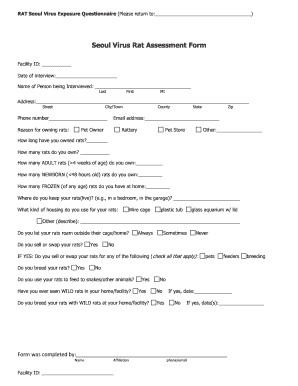
Get Ut Doh Seoul Virus Rat Assessment Form
How it works
-

Open form follow the instructions
-

Easily sign the form with your finger
-

Send filled & signed form or save
How to fill out the UT DoH Seoul Virus Rat Assessment Form online
Filling out the UT DoH Seoul Virus Rat Assessment Form is crucial for understanding and managing potential exposure to the Seoul virus. This guide will help you navigate through the online form efficiently, ensuring that you provide all necessary information accurately.
Follow the steps to successfully complete the online form.
- Click ‘Get Form’ button to obtain the form and open it in the designated editing tool.
- Begin by entering the facility ID and the date of the interview in the specified fields.
- Fill in the name of the person being interviewed, including last name, first name, and middle initial.
- Provide the complete address, including street, city/town, county, state, and zip code. Also, enter the phone number and email address.
- Indicate the reason for owning rats by selecting from options such as 'Pet Owner', 'Rattery', 'Pet Store', or specify 'Other'.
- Answer questions about the duration of rat ownership, the total number of rats, and the categorization of adult, newborn, and frozen rats.
- Describe the location where the rats are kept and the type of housing used for them.
- Respond to questions regarding the interaction of the rats with other animals and whether there has been any exchange or sale of rats.
- Complete sections regarding rodent sources and contact with confirmed facilities, providing necessary details and listings.
- Fill in details about rats obtained from vendors, including any co-mingling with confirmed infected facilities.
- Provide names and contact information for individuals who had physical contact with the rats since the specified effective date.
- Complete any necessary specimen testing information and interviewer sections.
- Once all fields are filled out, review your entries for accuracy and comprehensiveness.
- Save your changes, then download, print, or share the completed form as required.
Complete your UT DoH Seoul Virus Rat Assessment Form online today to ensure public health and safety.
Related links form
For Seoul virus, the natural host is the Norway rat (Rattus norvegicus) and the black rat (Rattus rattus), whereas for Sin Nombre it's the deer mouse (Peromyscus maniculatus). In the rodents that carry them, these viruses don't cause disease, but do cause life-long infection and shedding of the virus.