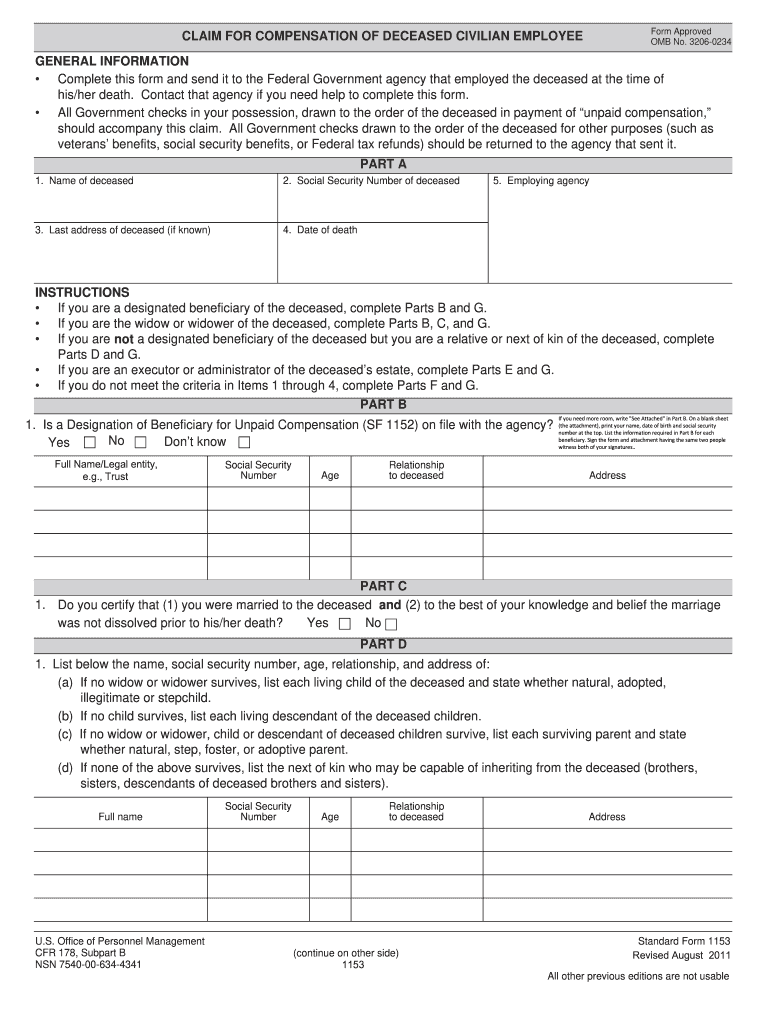
Ath. Contact that agency if you need help to complete this form. • All Government checks in your possession, drawn to the order of the deceased in payment of “unpaid compensation,” should accompany this claim. All Government checks drawn to the order of the deceased for other purposes (such as veterans’ benefits, social security benefits, or Federal tax refunds) should be returned to the agency that sent it. PART A 1. Name of deceased 2. Social Security Number of deceased 3. Last addre.
Loading

Open form follow the instructions

Easily sign the form with your finger

Send filled & signed form or save
How to fill out the OPM SF 1153 online
The OPM SF 1153 form is used to claim compensation for a deceased civilian employee. This guide will help you navigate the process of completing the form online, ensuring that you fill out each section accurately and efficiently.
Follow the steps to successfully complete the OPM SF 1153 online.
- Click ‘Get Form’ button to obtain the form and open it in the online editor.
- Begin by filling out Part A, which requires the name, social security number, last address, date of death, and the employing agency of the deceased. Ensure all details are accurate as they are critical for your claim.
- Determine your relationship to the deceased based on the provided instructions. Complete the appropriate sections: Part B if you are a designated beneficiary, Parts B and C if you are the widow or widower, or Part D if you are a relative or next of kin.
- In Part B, check if a Designation of Beneficiary is on file. If yes, fill in the required details for each beneficiary such as their full name, social security number, age, relationship to the deceased, and address. If more room is needed, indicate this with 'See Attached' and provide the additional information on a separate sheet.
- For Part C, certify your marital status with the deceased by selecting 'Yes' or 'No' regarding any dissolution of the marriage prior to their death.
- In Part D, list the names, social security numbers, ages, relationships, and addresses of the deceased's living relatives, noting specifically if they are children, siblings, or parents.
- If none of the persons in Parts B and D are eligible, and if applicable, complete Part E by providing your status as executor or administrator of the estate, ensuring you attach the necessary evidence of your appointment.
- In Part F, indicate whether funeral expenses have been paid. If paid, attach the receipted bill from the funeral director.
- Complete Part G by signing and dating the form, certifying that all information provided is accurate. Ensure that two witnesses also sign and date the document, including their addresses.
- Finally, save your changes, download the completed form for your records, print a copy for submission, or share it as needed.
Ready to submit your claim? Fill out the OPM SF 1153 online today.
Experience a faster way to fill out and sign forms on the web. Access the most extensive library of templates available.
Related content
We think this form takes an average of 15 minutes per response to complete, including the...
Sep 1, 2004 — Open Season elections have a DELAYED effective date. New coverage you...
1302 -9 Xiaoyu sayuri@sf · h2h. 16 Dec 24 9:43. Dec 16, 24, 01:43, Lorem ... 1153 -2...
Get answers to your most pressing questions about US Legal Forms API.
How do you notify the post office of a death?
Notifying the post office of a death involves completing a simple form or visiting your local post office. You may need to provide a copy of the death certificate, which ensures that mail delivery can be appropriately handled. This step is important for managing any future correspondence and can be complemented by notifying OPM as indicated in the OPM SF 1153, ensuring a comprehensive approach to handling affairs.
How do I contact OPM about death benefits?
To contact OPM regarding death benefits, you can reach out directly via their official phone number or website. It might also be beneficial to refer to the OPM SF 1153 for specific questions related to benefits claimed after a death. Furthermore, gathering all necessary information beforehand can help ensure a more straightforward communication experience.
How do I notify the OPM of a death?
Notifying the OPM of a death involves filling out the OPM SF 1153 form, which officially communicates the passing of the federal employee. Accompany this form with the required documents, such as the death certificate, to provide full context. You can then submit your forms directly to OPM. This proactive approach ensures that the process is smooth for beneficiaries.
How do I report a death of a federal employee?
To report the death of a federal employee, you should complete the OPM SF 1153 form and gather any necessary supporting documents, such as the death certificate. It’s important to submit this information to OPM as soon as possible to facilitate the disbursement of benefits. Additionally, you can use resources from platforms like US Legal Forms for guidance on completing the forms correctly.
What is SF 1152 used for?
The SF 1152 form is used to designate a beneficiary for unpaid compensation due to the death of a federal employee. It serves as a vital document for ensuring that funds are distributed according to the wishes of the deceased. While the SF 1152 is important, the OPM SF 1153 specifically addresses the reporting of death for benefits, making both forms crucial for proper processing.
How do I report a death to OPM?
To report a death to the Office of Personnel Management (OPM), you need to complete the necessary forms, including the OPM SF 1153. This form helps streamline the processing of any death benefits. Once completed, submit it along with any required documentation, such as a death certificate, directly to OPM. This ensures that benefits can be issued to eligible beneficiaries without unnecessary delays.
What is SF 1152 form?
The SF 1152 form is a beneficiary designation form that federal employees use for the Federal Employees' Group Life Insurance program. This form helps ensure that the benefits will be distributed according to your wishes in the event of your death. It's related but distinct from the OPM SF 1153, which is used for retirement benefits. Keeping both forms updated helps in proper estate planning.
How do I request OPM records?
To request OPM records, you must complete the appropriate forms and submit them as directed by OPM. This often involves providing personal identification details to verify your request. The OPM SF 1153 can play a role in this if your records relate to beneficiary designations. US Legal Forms can provide you with the necessary forms and guidance to help streamline your request.
How do I access my OPM file?
To access your OPM file, you typically need to submit a request directly to OPM, following their established procedures. You can also visit their website for more information on file access and relevant forms, including the OPM SF 1153. If you need help navigating the process, US Legal Forms offers resources and templates that simplify this experience. It’s important to keep your information updated for a smooth retrieval process.
Do I need to fill out a beneficiary form?
Yes, filling out a beneficiary form is important to ensure your benefits go to the correct person after your death. Without a completed OPM SF 1153 or similar form, your benefits may be distributed according to government law, which might not reflect your wishes. It's simple to complete this form, and US Legal Forms can assist you in obtaining the right version. Make this a priority to safeguard your legacy.
Use professional pre-built templates to fill in and sign documents online faster. Get access to thousands of forms.
If you believe that this page should be taken down, please follow our DMCA take down process here.