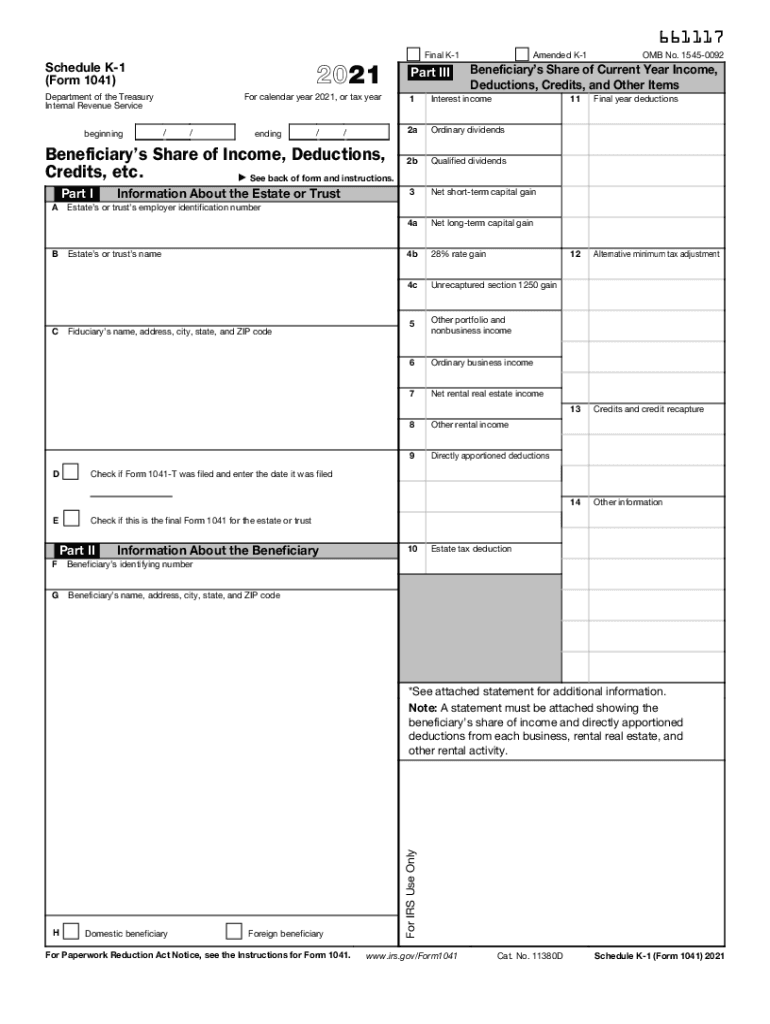
6611172021Schedule K1 (Form 1041) Department of the Treasury Internal Revenue Service beginning calendar year 2021, or tax year//ending//Beneficiaries Share of Income, Deductions, Credits, etc. See.
Loading

Open form follow the instructions

Easily sign the form with your finger

Send filled & signed form or save
How to fill out the IRS 1041 - Schedule K-1 online
Filling out the IRS 1041 - Schedule K-1 is an essential task for beneficiaries receiving income from estates or trusts. This guide provides clear and supportive steps to help users complete the form correctly and efficiently online.
Follow the steps to successfully complete the IRS 1041 - Schedule K-1 online.
- Click the ‘Get Form’ button to retrieve the IRS 1041 - Schedule K-1 form and access it in your browser.
- In Part I, provide information about the estate or trust. Enter the estate's or trust's name, employer identification number (EIN), and fiduciary’s contact information. Additionally, check if Form 1041-T was filed and the date of filing if applicable.
- Navigate to Part II to fill in your information as the beneficiary. Input your identifying number, name, address, and indicate whether you are a domestic or foreign beneficiary.
- In Part III, report the beneficiary’s share of income, deductions, credits, and other items. Fill out the relevant fields including interest income, dividends, capital gains, and any other income or deductions specific to your situation.
- Review all the information you have entered to ensure accuracy. Pay special attention to the data in each section, as this will impact your overall tax obligations.
- Once you’ve confirmed all entries are accurate, save your changes. You may then download, print, or share the completed Schedule K-1 as needed for your records or for filing purposes.
Start completing your IRS 1041 - Schedule K-1 online today!
Experience a faster way to fill out and sign forms on the web. Access the most extensive library of templates available.
Related content
Schedule K-1. (Form 1041). 2021. Beneficiary's Share of Income, Deductions,. Credits, etc...
SCHEDULE K-1. (Form 1041). Beneficiary's Share of Income, Deductions, Credits, etc. for...
Dec 6, 2017 — All Schedules K-1 you received from ... entered as a loss on Schedule D...
Get answers to your most pressing questions about US Legal Forms API.
Do I have to report a k1 on my taxes?
Purpose of Schedule K-1 The partnership uses Schedule K-1 to report your share of the partnership's income, deductions, credits, etc. Keep it for your records. Don't file it with your tax return unless you are specifically required to do so.
What is Schedule K-1 form 1041 for IRS?
Purpose of Form Use Schedule K-1 to report a beneficiary's share of the estate's or trust's income, credits, deductions, etc., on your Form 1040 or 1040-SR. Keep it for your records.
Does a 1041 generate a k1?
You would report all dividend income on the Form 1041, and you report the share of dividend income for each beneficiary on their Schedule K-1.
Are K-1 distributions considered income?
K-1s are tax forms that are used for business partnerships to report to the IRS a partner's income, losses, capital gain, dividends, etc., from the partnership for the tax year. With the K-1, a partner's earnings can be taxed at an individual tax rate versus the corporate tax rate.
Are trust funds taxed as income?
Generally all first-party trusts (those funded established with the beneficiary's own assets) are considered grantor trusts for income tax purposes and so all of the items of income, deduction and credit will be reportable on the beneficiary's personal income tax return.
Is K-1 trust income taxable?
Trust beneficiaries must pay taxes on income and other distributions that they receive from the trust. Trust beneficiaries don't have to pay taxes on returned principal from the trust's assets. IRS forms K-1 and 1041 are required for filing tax returns that receive trust disbursements.
Where do I report k1 trust income on 1040?
Include this amount on line 25c of your Form 1040 or 1040-SR and attach a copy of Schedule K-1 (Form 1041) to your return. Code C. Low-income housing credit. Report this amount on Form 8586, line 4.
Are K-1 trust distributions considered income?
Trust beneficiaries must pay taxes on income and other distributions that they receive from the trust. Trust beneficiaries don't have to pay taxes on returned principal from the trust's assets. IRS forms K-1 and 1041 are required for filing tax returns that receive trust disbursements.
Use professional pre-built templates to fill in and sign documents online faster. Get access to thousands of forms.
If you believe that this page should be taken down, please follow our DMCA take down process here.