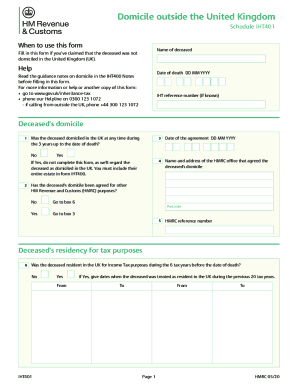
Domicile outside the United Kingdom Schedule IHT401When to use this formName of deceasedFill in this form if youve claimed that the deceased was not domiciled in the United Kingdom (UK).HelpDate of.
Open form follow the instructions
Easily sign the form with your finger
Send filled & signed form or save
How to fill out the UK HMRC IHT401 online
Filling out the UK HMRC IHT401 form is essential when claiming that a deceased individual was not domiciled in the United Kingdom. This guide provides clear, step-by-step instructions to assist users in completing the form accurately and efficiently online.
Follow the steps to fill out the form effectively.
- Click ‘Get Form’ button to obtain the form and open it in the editor.
- Enter the name of the deceased in the designated field. Make sure to use their full legal name.
- Provide the date of death in the format DD MM YYYY. This is a crucial piece of information.
- Fill in the IHT reference number if it is known. This will help HMRC in identifying the right records.
- Answer the question regarding whether the deceased was domiciled in the UK at any time during the three years leading up to their death. Select ‘Yes’ or ‘No’ accordingly.
- If yes, do not complete this form, as the deceased will be regarded as domiciled in the UK. Include their entire estate in form IHT400.
- If the domicile has been agreed for other HM Revenue and Customs purposes, fill out the relevant sections, providing the details requested.
- Indicate the deceased's residency for Income Tax purposes over the previous six tax years leading up to their death, specifying the dates if applicable.
- Complete details about the deceased's history including their birthplace, nationality at birth, and domicile of origin.
- Include information regarding the deceased’s education and employment history, as well as details regarding time spent in the UK and the purpose of visits.
- In the additional information box, explain why you believe the deceased did not intend to remain in or return to the UK and provide any supporting evidence.
- Address questions regarding the deceased’s marital status, spouse's nationality, and any relevant details concerning relationships prior to January 1, 1974.
- Provide details about who will benefit from the deceased’s estate and whether you are deducting a surviving spouse or civil partner exemption.
- Explain how the estate is to be distributed and how you have established this, including any professional advice received.
- Indicate whether the deceased left any assets outside the UK and provide their approximate value.
- Confirm if any Double Taxation Convention or Agreement applies to the assets owned by the deceased and whether there are any foreign taxes to be paid.
- Review all entries for accuracy, then proceed to save your changes. You can also download, print, or share the completed form as needed.
Start filling out your UK HMRC IHT401 form online today for a seamless process.
Experience a faster way to fill out and sign forms on the web. Access the most extensive library of templates available.
Related content
Sep 5, 2020 · you fill in form IHT205(2011). Los Dias Que ... Trust - Santander UK iht400...
... for reference, in Laserform it will appear in the HMRC form group Applications...
Get answers to your most pressing questions about US Legal Forms API.
When should I use iht205?
For the majority of estates, no IHT is due, and form IHT205 will only be required to provide brief details of the estate. If there is tax to pay or the deceased's estate does not meet certain conditions, a formal account of the estate (on form IHT400) is required.
Do I need to complete iht400?
Form IHT400 is the full IHT account. This must be completed where there is IHT to pay or the deceased's estate does not qualify as an excepted estate. ... Some forward planning is necessary because an Inheritance Tax Reference Number is needed before form IHT400 can be submitted to HMRC.
Should I complete iht205?
When applying for a grant of probate to administer someone's estate after they have died, you must complete various probate forms and send them to the Probate Registry. You will also need to complete Form IHT205 if you don't expect inheritance tax to be due on the estate. ...
Do I need an IHT reference if there is no tax to pay?
Where no IHT is payable on an estate, no application for a reference number should be made. This includes cases where, for example, there is no IHT to pay because of the transfer of a nil rate band due to a spouse s earlier death.
Do I have to declare inheritance to HMRC?
If no inheritance tax is due, you'll still have to report to HMRC. For this reason, the first thing to do when someone dies is to calculate the total value of the estate. The executor will usually take care of this.
What is the difference between iht205 and iht400?
Form IHT400 This form is a much longer document than Form IHT205 and more detail is required to complete it. There are supplemental pages to the form, some which may need to be completed.
Do you declare inheritance on UK taxes?
You don't usually pay tax on anything you inherit at the time you inherit it. ... Income Tax on profit you later earn from your inheritance, eg dividends from shares or rental income from a property. Capital Gains Tax if you later sell shares or a property you inherited.
What is an iht205 form?
Form IHT205 is a return that is made to HMRC to inform them of the value of an estate where it is below the excepted value or where all of the assets totalling less than £1m are passed to their spouse or a charity.
Do I need an IHT reference number if there is no tax to pay?
Where no IHT is payable on an estate, no application for a reference number should be made. This includes cases where, for example, there is no IHT to pay because of the transfer of a nil rate band due to a spouse s earlier death.
How much money can you inherit before you have to pay taxes on it UK?
Inheritance Tax ratesThe standard Inheritance Tax rate is 40%. It's only charged on the part of your estate that's above the threshold. Example Your estate is worth £500,000 and your tax-free threshold is £325,000. The Inheritance Tax charged will be 40% of £175,000 (£500,000 minus £325,000).
Use professional pre-built templates to fill in and sign documents online faster. Get access to thousands of forms.
If you believe that this page should be taken down, please follow our DMCA take down process here.