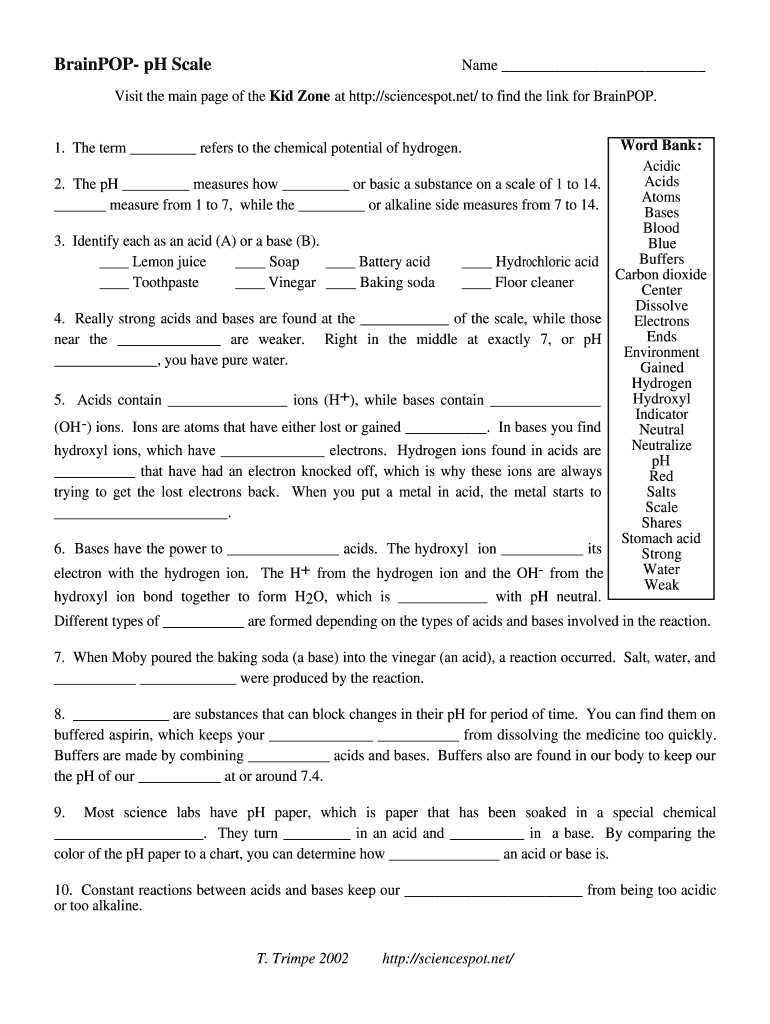
BrainPOP- pH Scale Name Visit the main page of the Kid Zone at http //sciencespot. net/ to find the link for BrainPOP. 10. Constant reactions between acids and bases keep our from being too acidic or too alkaline. T. Trimpe 2002 http //sciencespot. 1. The term refers to the chemical potential of hydrogen* 2. The pH measures how or basic a substance on a scale of 1 to 14. measure from 1 to 7 while the or alkaline side measures from 7 to 14. 3. Identify each as an acid A or a base B. Lemon juice Soap Battery acid Toothpaste Vinegar Baking soda Hydrochloric acid Floor cleaner 4. Really strong acids and bases are found at the of the scale while those near the are weaker. Right in the middle at exactly 7 or pH you have pure water. 5. Acids contain ions H while bases contain OH - ions. Ions are atoms that have either lost or gained. In bases you find hydroxyl ions which have electrons. Hydrogen ions found in acids are that have had an electron knocked off which is why these ions are always t....
Loading

Open form follow the instructions

Easily sign the form with your finger

Send filled & signed form or save
How to fill out the Science Spot BrainPOP - pH Scale online
This guide provides a clear and comprehensive overview of how to effectively complete the Science Spot BrainPOP - pH Scale form. By following these instructions, users will be equipped to navigate the online form with confidence and accuracy.
Follow the steps to fill out the Science Spot BrainPOP - pH Scale form online.
- Press the ‘Get Form’ button to acquire the document and open it in your preferred editing tool.
- Begin by identifying the first blank on the form, which is associated with the definition of pH. Enter the term that describes the chemical potential of hydrogen.
- Move to the second sentence where you will need to fill in the word describing the pH scale, indicating if substances are acidic or basic. Complete the blanks by specifying the ranges for acidic and alkaline substances.
- In this step, you will categorize various substances. Each substance listed should be identified as either an acid (A) or a base (B). Make sure to mark each item clearly.
- Refer to the provided scale concept in this section. Fill in the blanks about the strength of acids and bases, linking their position on the pH scale to their strength.
- This step requires you to identify what acids and bases contain. Complete the terms related to hydrogen and hydroxyl ions, ensuring you clarify what happens during chemical interactions.
- Fill in how bases can neutralize acids and the resulting product from this reaction, which is essential to understanding pH balance.
- In this section, discuss buffers. Identify how you can find buffers in common items and elaborate on their role in maintaining pH levels.
- Complete the section about pH paper and how it functions in testing acidity or basicity based on color changes.
- Lastly, summarize the importance of the constant reactions between acids and bases, highlighting their role in maintaining environmental balance.
- Once all fields are completed, ensure to save your changes. Options should be available to download, print, or share your completed form as needed.
Start filling out your Science Spot BrainPOP - pH Scale form online today for a better understanding of pH concepts.
Experience a faster way to fill out and sign forms on the web. Access the most extensive library of templates available.
Related content
by E Hall · 2016 · Cited by 249 — The purpose of this study was to explore how...
by ÓR Moreno — This project tries to make students learn science subjects with more...
Get answers to your most pressing questions about US Legal Forms API.
What does 0.7 and 14 represent on the pH scale?
On the pH scale, 0.7 indicates a very acidic solution, while 14 represents a highly alkaline solution. Understanding this range is essential for various scientific applications. For more insights about how these numbers affect chemical behavior, explore the educational content available on Science Spot BrainPOP - pH Scale.
How to make pH 7 solution?
Making a pH 7 solution is straightforward. You can create one by mixing a small amount of baking soda with vinegar until it reaches a neutral balance. Science Spot BrainPOP - pH Scale offers clear instructions and visuals to guide you through creating your solution effectively.
How do you get pH 7 in a solution?
To reach pH 7 in a solution, you can dilute your original solution with water or add specific chemicals that neutralize its pH. This process may require testing frequently to ensure accuracy. Dive into the examples provided by Science Spot BrainPOP - pH Scale to master this technique.
How do you get a pH of 7?
Getting a pH of 7 involves neutralizing either acidic or alkaline elements in your solution. For example, you might add baking soda to a vinegar solution. For more detailed explanations and visuals on this topic, Science Spot BrainPOP - pH Scale is the perfect resource.
How do you adjust pH to 7?
To adjust a solution's pH to 7, you need to carefully add either an acid or a base until the desired neutral level is reached. You can use pH test strips or a meter for accuracy. Science Spot BrainPOP - pH Scale shows you practical methods for making these adjustments effectively and safely.
How to get pH 7?
Achieving a pH of 7 means making a solution neutral, neither acidic nor alkaline. To reach this balance, you can mix equal parts of an acidic and a basic solution. Science Spot BrainPOP - pH Scale provides simple experiments and demonstrations to visualize this process easily.
Does the pH scale go beyond 14?
Generally, the pH scale is designed to measure values from 0 to 14. However, in extreme cases, solutions can have a pH below 0 or above 14. Understanding these exceptions can be fascinating and is discussed in detail on Science Spot BrainPOP - pH Scale, where you can explore a wide range of pH-related concepts.
How is the pH scale used in science?
The pH scale is crucial in science for measuring the acidity or alkalinity of a solution. It ranges from 0 to 14, helping scientists understand chemical reactions in various fields, including biology, chemistry, and environmental science. By learning about the pH scale from Science Spot BrainPOP, you gain valuable insights into how different substances interact in solutions.
How is pH scale made?
The pH scale is created based on the logarithmic measure of hydrogen ion concentration in aqueous solutions. Scientists established this scale to simplify understanding acidity and alkalinity. Instruments like pH meters or indicators help measure pH levels accurately. To gain a deeper understanding of how the pH scale functions and its applications, check out Science Spot BrainPOP - pH Scale for comprehensive insights.
How to calculate the pH scale?
Calculating pH involves using the formula pH = -logH⁺, where H⁺ is the concentration of hydrogen ions in a solution. This calculation helps determine whether a solution is acidic, neutral, or alkaline. Knowing how to perform this calculation is essential for experiments and various scientific applications. Resources like Science Spot BrainPOP - pH Scale provide additional guidance to help you master pH calculations effectively.
Use professional pre-built templates to fill in and sign documents online faster. Get access to thousands of forms.
If you believe that this page should be taken down, please follow our DMCA take down process here.