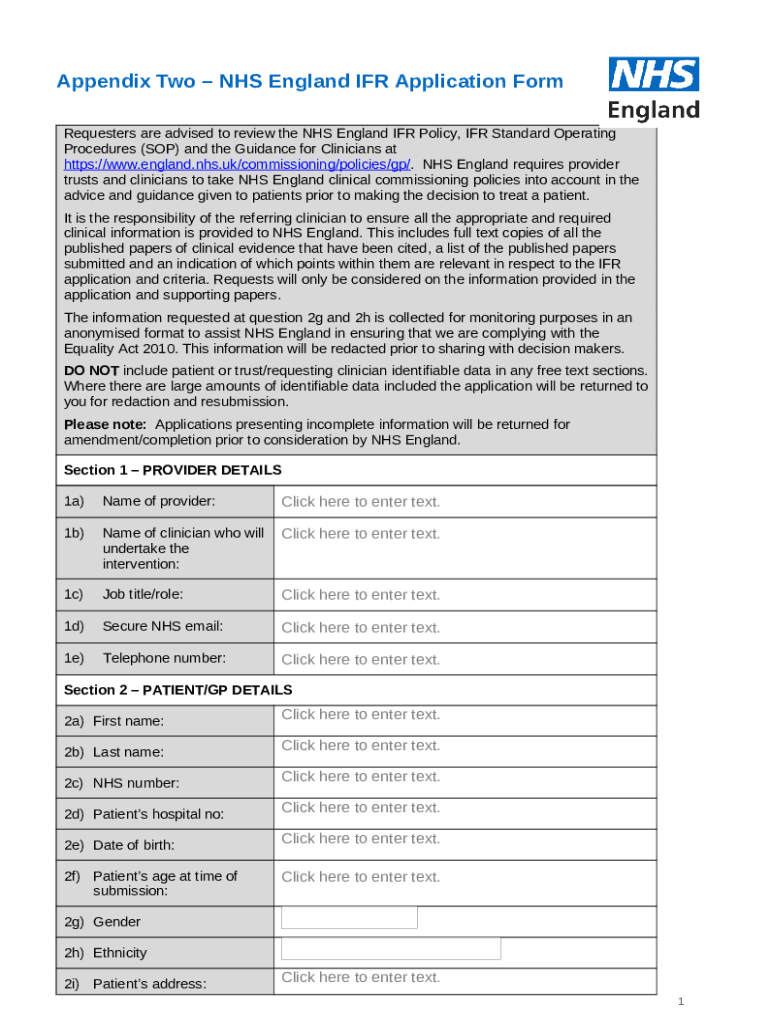
Appendix Two NHS England IFR Application FormRequesters are advised to review the NHS England IFR Policy, IFR Standard Operating Procedures (SOP) and the Guidance for Clinicians at https://www.england.nhs.uk/commissioning/policies/gp/.
Loading

Open form follow the instructions

Easily sign the form with your finger

Send filled & signed form or save
How to fill out the Appendix Two NHS England IFR Application Form online
Filling out the Appendix Two NHS England IFR Application Form accurately is essential for a successful funding request. This guide provides a clear, step-by-step approach to complete the form online, ensuring all necessary information is included for a thorough evaluation. Follow these instructions to streamline your application process.
Follow the steps to complete the form effectively.
- Press the ‘Get Form’ button to access the Appendix Two NHS England IFR Application Form and open it in your chosen editor.
- Begin with Section 1, which requires provider details. Input the name of the provider, the clinician undertaking the intervention, their job title, secure NHS email, and telephone number in the designated fields.
- Move to Section 2, where you will enter patient and GP details. Fill in the patient's first and last name, NHS number, hospital number, date of birth, age at the time of submission, gender, ethnicity, address, postcode, GP name, practice name, and GP postcode.
- Proceed to Section 3, requesting details about the treatment. Specify the service type, urgency reasons if applicable, the proposed start and stop dates for treatment, and provide supportive documentation from relevant committees as outlined in the instructions.
- In Section 4, outline the treatment details, including the primary diagnosis, intervention specifics, existence of clinical policies, and the costs associated with treatment. Also, include anticipated clinical outcomes and any reporting mechanisms you will provide to NHS England.
- Section 5 covers clinical background. Summarize the patient's clinical situation, treatment history, and any alternative treatments considered, explaining why they are not suitable.
- In Section 6, describe the clinical exceptionality of the case, providing detailed information about the patient's unique clinical circumstances and how they differ from standard policy guidelines.
- Complete Section 7 by estimating the incidence and prevalence of the condition, discussing potential future cases, and summarizing the evidence base relevant to the application.
- Lastly, in Section 8, review the completed form, ensuring all sections are filled out. If satisfied, submit the application to NHS England using the indicated email.
Complete your application and submit the Appendix Two NHS England IFR Application Form online today.
Experience a faster way to fill out and sign forms on the web. Access the most extensive library of templates available.
Related content
by PM Wilson · 2017 — Cochrane Database of Systematic Reviews (CDSR). During the course...
by E Gkeredakis · Cited by 6 — Abstract. In this paper, we aim at exploring how...
Mar 18, 2016 — This Annual Report on Form 10-K for the period ended December 31, ... a...
Get answers to your most pressing questions about US Legal Forms API.
Who is the head of Specialised Commissioning NHS England?
Jonathan Rowell, Director of Finance, Specialised Commissioning, NHS England.
Who runs clinical commissioning groups?
led by an elected governing body made up of GPs, other clinicians including a nurse and a secondary care consultant, and lay members.
How do I apply for IFR?
Applications can only be made by the clinician responsible for your care – usually your secondary care (hospital) clinician. You can work with your hospital clinician to make an application if they believe you may be eligible. To make an application your clinician should use our IFR application portal.
How long does it take to get NHS funding?
As long as all the required information is submitted, it usually takes 30 working days from receiving an application to a decision, but it can often be sooner. Urgent cases can be processed more quickly if needed. How can I find out how my application is progressing?
Who is the head of NHS specialized commissioning?
Ian Jackson - Director of Commissioning, Specialised Commissioning (London) - NHS England | LinkedIn.
What is strategic commissioning NHS?
What is strategic commissioning? Strategic commissioning is the main process for understanding, planning and delivering better health and wellbeing outcomes, but it is recognised that a substantial amount of work can be needed to deliver this process effectively.
What is an NHS IFR?
In such cases, NHS clinicians can ask NHS England, on behalf of a patient, to fund a treatment which would not usually be provided by NHS England for that patient. This request is called an Individual Funding Request (IFR).
Use professional pre-built templates to fill in and sign documents online faster. Get access to thousands of forms.
If you believe that this page should be taken down, please follow our DMCA take down process here.