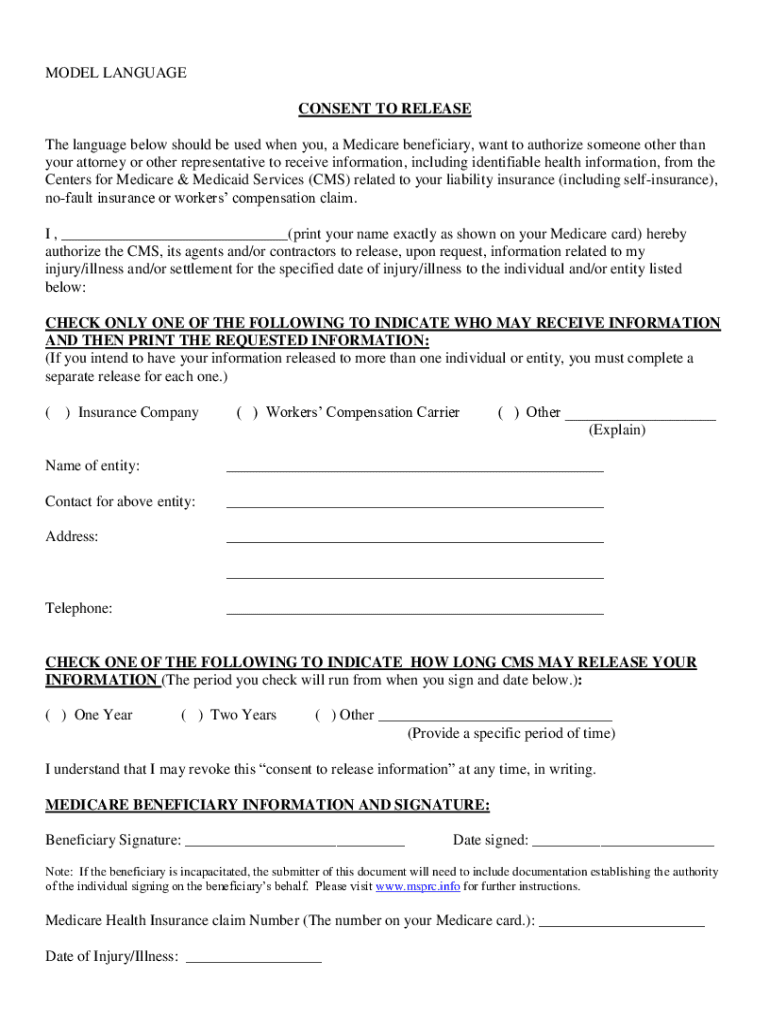
______________________________________ Address: __________________________________________________ __________________________________________________ Telephone: __________________________________________________ CHECK ONE OF THE FOLLOWING TO INDICATE HOW LONG CMS MAY RELEASE YOUR INFORMATION (The period you check will run from when you sign and date below.): ( ) One Year ( ) Two Years ( ) Other _______________________________ (Provide a specific period of time) I understand that I may re.

Open form follow the instructions

Easily sign the form with your finger

Send filled & signed form or save
How to fill out the CMS Consent to Release online
Filling out the CMS Consent to Release form is a crucial step for individuals who want to authorize others to access their Medicare-related information. This guide provides clear instructions to help you navigate the process effortlessly.
Follow the steps to complete the form successfully.
- Press the ‘Get Form’ button to obtain the CMS Consent to Release document, and ensure it is opened in your preferred editor.
- In the first section, print your name exactly as it appears on your Medicare card. Ensure accuracy to avoid any processing delays.
- Select one of the options to indicate who may receive your information. You can choose from 'Insurance Company,' 'Workers’ Compensation Carrier,' or 'Other.' If you select 'Other,' provide the specific name of the entity in the designated space.
- Fill out the contact information for the individual or entity authorized to receive your information, including the address and telephone number.
- Indicate how long CMS may release your information by selecting one of the duration options: 'One Year,' 'Two Years,' or specifying a different period. Remember, this period begins from the date you sign the form.
- Sign and date the form in the designated areas to validate your consent.
- If applicable, provide the necessary documentation to establish authority if the form is being signed on behalf of an incapacitated beneficiary.
- Include your Medicare Health Insurance claim number and the date of injury or illness in the appropriate fields.
- Once you have filled out the form, you can save changes, download, print, or share the document as needed.
Begin completing your CMS Consent to Release form online today.
Experience a faster way to fill out and sign forms on the web. Access the most extensive library of templates available.
Related content
A “consent to release” document is used by an individual or entity who does not...
Feb 25, 2021 — UPMC now requires that all signed documents uploaded into a medical...
Upload the press release in CMS. 6-3 INSPECTION WARRANTS. 6-3-1 Purpose. To provide...
Get answers to your most pressing questions about US Legal Forms API.
Why does Social Security not accept power of attorney?
Social Security typically does not accept Power of Attorney because they prefer to designate a representative payee who has been specifically authorized to manage benefits for an individual. However, using the CMS Consent to Release can facilitate communication and access to information when you need to advocate for someone else. It’s important to understand their policies regarding representation to navigate the system effectively.
How to submit POA to Social Security?
To submit a Power of Attorney to Social Security, you need to provide the completed POA document along with any required identification. Make sure to attach the CMS Consent to Release when necessary to ensure that Social Security can share information regarding the individual in question. Submission can be done in person or by mail, depending on the preference of the Social Security office.
How do I apply for Medicare on someone else's behalf?
To apply for Medicare on another individual's behalf, you need to demonstrate your authority through a Power of Attorney and complete the appropriate applications for Medicare. Including the CMS Consent to Release is essential to allow Medicare to communicate with you regarding that person's health information. It's advisable to help the individual understand the benefits of enrolling in Medicare.
How many years does the CMS consent form stay on a patient's record?
The CMS consent form remains a part of a patient's medical record for as long as it is relevant to their healthcare services. Typically, the form is retained for several years, usually in line with the retention policies of the healthcare provider or facility. Always check the specific guidelines of each institution for precise timelines.
How do I submit documents to Medicare?
You can submit documents to Medicare by mail or electronically, depending on the specific requirements for the documents you are sending. Make sure to include the CMS Consent to Release form if you are submitting information on behalf of someone else. Medicare will provide guidelines on where and how to send your documentation, so be attentive to those details.
How to file POA with Medicare?
To file a Power of Attorney (POA) with Medicare, you will need to complete the necessary forms and submit them along with proof of your authority to act on behalf of the individual. It is important to include the CMS Consent to Release as part of this package to allow Medicare to discuss the patient's information with you. Ensure all documentation is correct and submitted to the appropriate Medicare office for processing.
What is consent to release?
Consent to release refers to a formal agreement that allows healthcare providers to share a patient's medical information with specified parties. This is crucial for access to healthcare services and for coordinating care. The CMS Consent to Release form provides a standardized method for ensuring that patient privacy is respected while allowing important information to be shared when necessary.
What are the requirements for CMS consent?
To obtain CMS consent, the patient must be competent to make decisions and provide clear authorization for the release of their medical information. This often involves filling out the CMS Consent to Release form, which outlines exactly what information is being released and to whom. It's essential that the consent form is signed and dated appropriately to ensure compliance with regulations.
What does authorization to disclose health information mean?
Authorization to disclose health information means that a patient has given explicit permission for their medical records to be shared with designated individuals or organizations. This authorization is crucial in allowing healthcare providers to communicate and coordinate care effectively. With CMS Consent to Release, patients maintain control over their health information.
What is the CMS consent rule?
The CMS consent rule outlines the requirements healthcare providers must follow when obtaining patient consent for information sharing. This rule ensures that patients are informed about how their health data will be used and who it will be shared with. Understanding this rule can help healthcare providers navigate compliance while keeping patients' interests in mind.
Use professional pre-built templates to fill in and sign documents online faster. Get access to thousands of forms.
If you believe that this page should be taken down, please follow our DMCA take down process here.