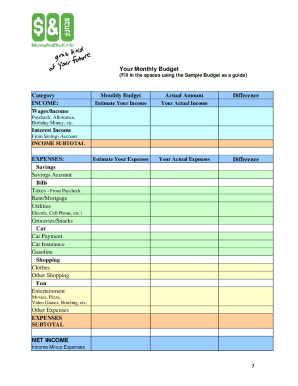
Es (the money you spend). By writing down your monthly income and expenses, you can see how much money you expect to have for the month and plan for how much you can spend. The First Rule of Budgeting The first rule of budgeting is simple: Spend less than you earn! If you earn $150 a month from your job, and earn another $50 from your allowance or birthday money, your income for the month is $200. If your savings account earns another $5, your total income is $205. Now you know that you have to .
Loading
Open form follow the instructions
Easily sign the form with your finger
Send filled & signed form or save
How to fill out the Money and Staff Sample Monthly Budget for Teens online
Creating a budget is essential for financial management, especially for teens. This guide provides clear, step-by-step instructions on how to effectively fill out the Money and Staff Sample Monthly Budget for Teens online, ensuring users can easily track their income and expenses.
Follow the steps to complete your monthly budget
- Press the ‘Get Form’ button to obtain the form and open it in your preferred online editor.
- Identify the Income section of the form. Here, enter all sources of income, such as wages from a job, allowances from guardians, and any birthday money. Use the provided fields to estimate your total income for the month.
- Proceed to the Expenses section. Begin by listing your required expenses, including taxes and bills. This may consist of your mobile phone bill, gas money, or payments into your savings account, ensuring you account for necessities essential for daily living.
- Next, evaluate your discretionary expenses. This section allows you to budget for non-essential spending, like shopping for clothes, eating out, and entertainment options such as video games or movies. Fill in these amounts based on your expected expenditures.
- After filling in all income and expense categories, calculate your Income Subtotal and Expenses Subtotal to understand your financial position for the month. Ensure you assess your net income, which is the difference between your total income and total expenses.
- Finally, review your completed budget for accuracy, save your changes, and choose to download, print, or share the form based on your needs.
Start creating your budget today by completing the Money and Staff Sample Monthly Budget for Teens online.
Experience a faster way to fill out and sign forms on the web. Access the most extensive library of templates available.
Related content
It's a plan that helps you see how much money you have coming in each month and how much...
Compare income with expenses –. Use Monthly Budget Worksheet. Make adjustments. Is...
This workbook is for use by teachers and students as an aid in teaching basic financial...
Get answers to your most pressing questions about US Legal Forms API.
What are the 3 steps of budgeting?
The three steps of budgeting include planning, tracking, and adjusting. First, devise a what your ideal budget looks like based on your income and expenses. Next, actively track your spending to ensure you remain within that budget. Lastly, be ready to adjust your budget as necessary to adapt to changing financial circumstances.
What are the 3 P's of budgeting?
The three P's of budgeting are Purpose, Plan, and Performance. First, identify the purpose of your budget to align your financial goals. Next, create a plan that outlines your income and expenses clearly. Finally, regularly assess your performance against your budget to ensure you stay on track.
How to create a 50 30 20 budget?
The idea is to divide your income into three categories, spending 50% on needs, 30% on wants, and 20% on savings. Learn more about the 50/30/20 budget rule and if it's right for you.
How do I start a 50 30 20 budget?
Getting Started. Start by taking a look at your paycheck. ... Needs: 50% About half of your budget should go toward needs. ... Wants: 30% You subscribe to a streaming service to watch your favorite show, not because you need the subscription to live. ... Savings: 20% The remaining 20% of your budget should go toward the future.
What is the 75 15 10 rule?
The 75/15/10 method involves allocating 75% of your earnings for spending, 15% for investing, and 10% for saving, prioritizing building wealth through investments rather than relying on savings. Why is it important to invest in assets instead of material possessions?
What is the 50 30 20 tool for budgeting?
Our 50/30/20 calculator divides your take-home income into suggested spending in three categories: 50% of net pay for needs, 30% for wants and 20% for savings and debt repayment. Find out how this budgeting approach applies to your money. Monthly after-tax income.
What is a budget for high school students?
As shown in the image below, you would allocate 50% of your income to essential expenses, such as housing, transportation and groceries; 30% to flexible expenses, like dining out and entertainment; and 20% to savings to cover unexpected costs, build an emergency fund, and meet personal or family goals, such as college ...
Is the 50 30 20 rule a good budget?
The 50/30/20 Rule can be a good budgeting method for some, but whether the system is right for you will be determined by your unique monthly expenses.
What is a 50 30 20 budget example?
The 50-30-20 rule recommends putting 50% of your money toward needs, 30% toward wants, and 20% toward savings. The savings category also includes money you will need to realize your future goals.
Use professional pre-built templates to fill in and sign documents online faster. Get access to thousands of forms.
If you believe that this page should be taken down, please follow our DMCA take down process here.