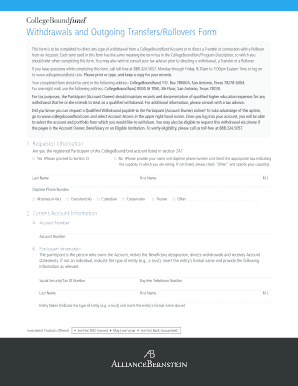
Nsfer in connection with a Rollover  from an Account. Each term used in this form has the same meaning the term has in the CollegeBoundfund Program Description, to which you  should refer when completing this form. You may also wish to consult your tax advisor prior to directing a withdrawal, a Transfer or a Rollover.  If you have questions while completing this form, cal.

How it works
  • Open form

    Open form follow the instructions

  • Easily sign form

    Easily sign the form with your finger

  • Share form

    Send filled & signed form or save

How to fill out the CollegeBoundfund Withdrawals and Outgoing Transfers/Rollover Form online

The CollegeBoundfund Withdrawals and Outgoing Transfers/Rollover Form is essential for managing your CollegeBoundfund account. This guide will walk you through each step of the form, ensuring you can complete it with confidence.

Follow the steps to successfully complete the form.

  1. Click ‘Get Form’ button to access the CollegeBoundfund Withdrawals and Outgoing Transfers/Rollover Form and open it for editing.
  2. In Section 1, provide the requestor information. If you are the registered participant listed in Section 2A, select 'Yes' and proceed to Section 2. If not, enter your information including last name, first name, middle initial, and daytime phone number. Specify your role using the given options.
  3. Section 2 asks for current account information. Enter the account number in Section 2A. In Section 2B, fill out the participant’s details. If the participant is an entity, provide the entity’s name and the relevant information. For beneficiary details, complete Section 2C with their social security or tax ID number, date of birth, last name, first name, and middle initial.
  4. In Section 5, provide payment instructions. Indicate if the payment will be made to the participant, beneficiary, or another qualified institution. Fill in the necessary details including names, account numbers or student IDs, and mailing addresses.
  5. After successfully completing the form, review all fields for accuracy. You can then save the changes, download, print, or share your completed form according to your needs.

Complete your CollegeBoundfund Withdrawals and Outgoing Transfers/Rollover Form online today!

Get form

Experience a faster way to fill out and sign forms on the web. Access the most extensive library of templates available.

Related content

Q 2 2025 Review Meeting - Alabama State Treasury

Aug 20, 2025 — • Tax-free withdrawals for qualified college expenses. Federal Income...

Learn more
Questions & Answers

Get answers to your most pressing questions about US Legal Forms API.

Contact support

Is transferring ownership of a 529 a taxable event?

Transferring ownership of a 529 plan is generally not considered a taxable event. However, be mindful of specific circumstances that might incur taxes, especially if the new owner is not a qualified relative of the original account holder. Using the CollegeBoundfund Withdrawals and Outgoing Transfers/Rollover Form can guide you through this process and ensure compliance with regulations.

When discussing a rollover versus a transfer, it's crucial to note that a rollover involves moving funds out of one account to another, while a transfer means changing the ownership or beneficiary of an account. Both actions may be facilitated through the CollegeBoundfund Withdrawals and Outgoing Transfers/Rollover Form for your convenience. Being clear about these differences can help you make informed decisions.

The terms rollover and transfer often confuse many, but they refer to different actions. A rollover typically involves moving assets from one 529 plan to another under the same beneficiary, while a transfer changes the beneficiary or ownership of the same plan. Using the CollegeBoundfund Withdrawals and Outgoing Transfers/Rollover Form can simplify either process.

A 529 rollover refers to moving funds from one 529 plan to another, while a transfer involves changing the beneficiary or ownership of the account. With CollegeBoundfund Withdrawals and Outgoing Transfers/Rollover Form, you can initiate both processes easily. It's important to understand these distinctions to manage your education savings effectively.

To process CollegeBoundfund Withdrawals and Outgoing Transfers/Rollover Form, you typically need the account holder's identification, the beneficiary's Social Security number, and proof of qualified educational expenses. These might include tuition bills, room and board invoices, or other related receipts. Ensure you have all required documents ready to avoid delays in processing your request.

If your child decides not to go to college or only uses part of the total funds while in school, you can transfer the remaining funds to another family member who is planning to attend college. 529 college savings planning: What to do with leftover 529 funds - U.S. Bank usbank.com https://.usbank.com › financial-planning › using-lef... usbank.com https://.usbank.com › financial-planning › using-lef...

The 529 plan account owner must indicate that the contribution to the new 529 plan is a rollover contribution, and they must provide a breakdown of the contributions and earnings being rolled over. The rollover contribution can be completed with the enrollment application for the new 529 plan.

If you're moving funds from one 529 plan to another, it's considered a rollover and can only be done tax-free once in a 12-month period. What to Consider Before Doing a 529 Plan Rollover Saving for College https://.savingforcollege.com › article › 5-things-t... Saving for College https://.savingforcollege.com › article › 5-things-t...

Congress combined the lifetime exemptions for the gift tax and estate tax so taxpayers couldn't avoid the tax by gifting their money to loved ones before they died. 529 plan contributions are exempt from federal estate taxes but are considered completed gifts for tax purposes. Do You Have to Pay Gift Taxes on 529 Plan Contributions? savingforcollege.com https://.savingforcollege.com › article › dont-worry... savingforcollege.com https://.savingforcollege.com › article › dont-worry...

The account owner can roll over assets from one 529 plan into another 529 plan. If a rollover satisfies the following conditions, you will not incur any tax consequences: You are permitted only one rollover to another 529 plan per twelve-month period for the same beneficiary. How Can I Move My Funds From One 529 Plan to Another Without ... savingforcollege.com https://.savingforcollege.com › article › ask-an-expe... savingforcollege.com https://.savingforcollege.com › article › ask-an-expe...

Get This Form Now!

Use professional pre-built templates to fill in and sign documents online faster. Get access to thousands of forms.

If you believe that this page should be taken down, please follow our DMCA take down process here.

Get CollegeBoundfund Withdrawals and Outgoing Transfers/Rollover Form