MATTOX LAW FIRM Attorneys at Law MARIE A. MATTOX, P.A. 203 North Gadsden St Tallahassee, FL 32301 Telephone: 850.383.4800 Facsimile: 850.383.4801 www.mattoxlaw.com Dear Sir/Madam: Attached is our.
Loading

Open form follow the instructions

Easily sign the form with your finger

Send filled & signed form or save
How to fill out the Law Enforcement Intake #2 online
The Law Enforcement Intake #2 form is designed for individuals seeking to explore civil claims against law enforcement and related entities. Completing this form accurately is crucial for evaluating your claim and obtaining appropriate legal representation.
Follow the steps to fill out the Law Enforcement Intake #2 form effectively.
- Press the ‘Get Form’ button to access the online form and open it for editing.
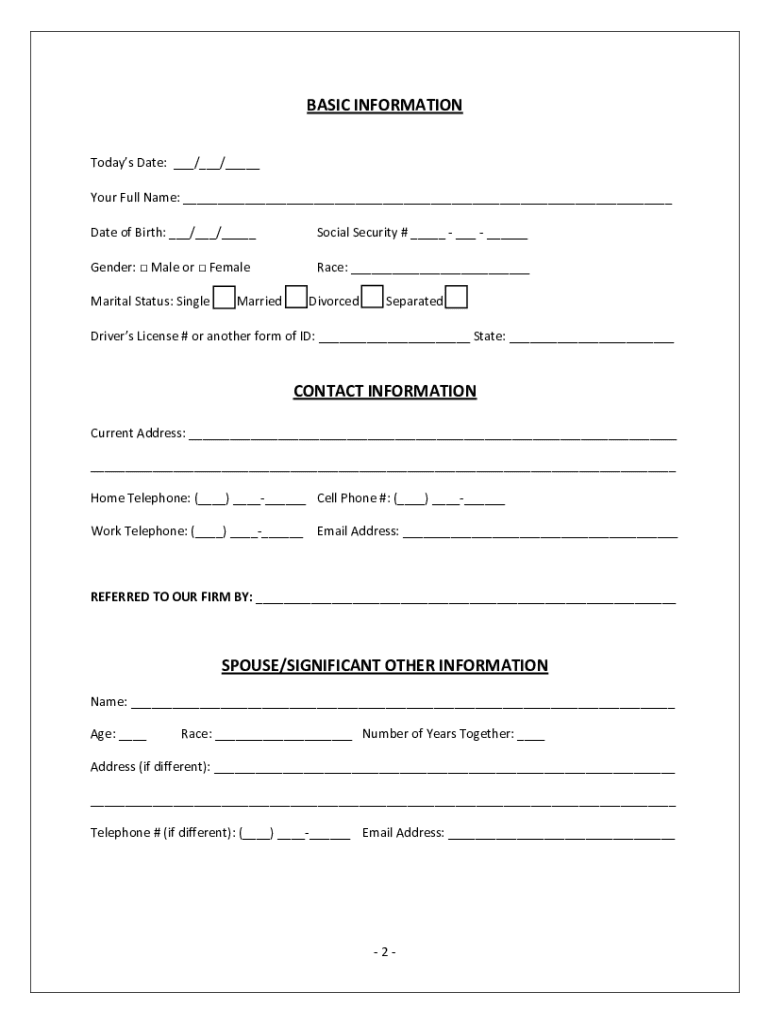
- Begin by filling out the basic information section. Include today’s date, your full name, date of birth, social security number, and other requested identifiers such as race and marital status.
- Proceed to the contact information section. Input your current address, home, cell, and work telephone numbers, as well as your email address.
- If applicable, fill in information regarding your spouse or significant other, including their name, age, race, and contact details.
- Document your marital history and children by providing details such as names, relationships, and relevant dates.
- Detail your educational background by listing schools attended, dates, city/state, and degrees obtained.
- Record your most recent employment history, including business name, positions held, dates employed, and reasons for leaving.
- In the information regarding your claim section, describe the individual or entity you feel wronged you, the basis of your claim, and any relevant civil rights violations.
- If applicable, provide details about any current incarceration, including facility name and address, and summarize your criminal history.
- Answer the general information questions to the best of your ability. If any questions receive a 'yes' response, provide explanations in the designated area.
- In the final section, detail how you believe you were treated wrongfully, including witness information and follow-up questions.
- After completing the form, save your changes and email the finalized document to the designated address.
Complete your Law Enforcement Intake #2 form online today to initiate your claim process.
Experience a faster way to fill out and sign forms on the web. Access the most extensive library of templates available.
Related content
PART ONE-LAW ENFORCEMENT JUVENILE INTAKE SERVICES. 1. Chapter I-Law Enforcement Screening...
by MM Greaves · 2013 · Cited by 2 — Figure 2. Association of age and caffeine intake...
Mar 3, 2021 — 2. Law Enforcement Strategies to Reduce Racial Disparities and...
Get answers to your most pressing questions about US Legal Forms API.
What percentage of police officers have a college degree?
The study found that an average of 30.2 percent of police officers have a four-year college education, compared to just 8.9 percent in 1974.
What is the maximum age to become a police officer in Texas?
Must be between 19 1/2 years of age and 44 years of age. Applicants must not turn 45 years of age before taking the civil service examination. Applicants that are 19 1/2 and 20 years of age must have a minimum of 60 semester college hours with a 2.0 GPA from an accredited college or university.
What do you need to become a police officer in California?
Minimum Requirements - Officer Age. Age 20-35 (Applicants must be 35 on the final filing date of the examination cycle to which they are applying) Education. High school diploma, GED, or California High School Proficiency Examination. ... Conduct. ... Citizenship. ... Vision. ... Health.
Do more than 75 percent of law enforcement agencies require recruits to have a college degree?
The vast majority of law enforcement agencies, more than 75 percent, require recruits to have a college degree. An individual's demeanor is a situational factor that an officer considers when deciding whether or not to arrest.
Do more than 75% of law enforcement agencies require recruits to have a college degree?
The vast majority of law enforcement agencies, more than 75 percent, require recruits to have a college degree. An individual's demeanor is a situational factor that an officer considers when deciding whether or not to arrest.
Do most police departments require officers to have a college degree?
In many jurisdictions across the U.S., the education requirement to become a law enforcement officer is a high school diploma or equivalent. The median salary for all law enforcement workers in May 2021 was $61,190, but the key to reaching the higher levels of law enforcement is higher education.
Do you think that law enforcement agencies should require recruits to have a college education?
The public supports raising education standards for California officers. A recent CALSPEAKS statewide poll found that 81% of Californians believe that police officers should have more than a high school diploma, 46% support a two-year degree and 35% support a four-year degree.
How do you become a police officer in Illinois?
7 steps to become a police officer in Illinois Meet minimum standards for Illinois. ... Consider earning a college degree or starting postsecondary education. ... Apply for law enforcement positions. ... Pass the POWER test. ... Complete minimum basic law enforcement training (BLE). ... Pass the statewide examination.
Use professional pre-built templates to fill in and sign documents online faster. Get access to thousands of forms.
If you believe that this page should be taken down, please follow our DMCA take down process here.