Loading
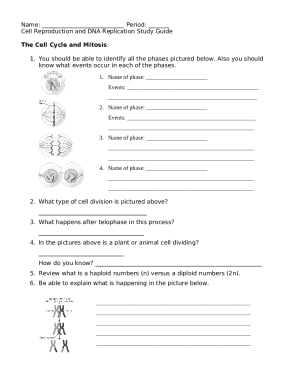
Get Comparing Mitosis And Meiosis Lab Answer Key
How it works
-

Open form follow the instructions
-

Easily sign the form with your finger
-

Send filled & signed form or save
How to fill out the Comparing Mitosis And Meiosis Lab Answer Key online
Filling out the Comparing Mitosis And Meiosis Lab Answer Key online can streamline your study process and improve your understanding of cell reproduction concepts. This guide offers a clear, step-by-step approach to complete the form efficiently, ensuring you capture all necessary information accurately.
Follow the steps to complete your lab answer key effectively.
- Click ‘Get Form’ button to acquire the form and open it in your editing application.
- Begin by entering your name in the specified area at the top of the form.
- In the 'Period' section, indicate the time frame of your class or lab period.
- Proceed to the first section concerning the cell cycle and mitosis. Carefully identify and label each mitosis phase as per the illustrations provided.
- For each phase, clearly articulate the key events that occur.
- Verify the type of cell division depicted in the illustrations and answer the corresponding questions on the form.
- Complete the sections on haploid versus diploid cells and explain the significance of the images presented.
- Move on to the next section that covers meiosis. Familiarize yourself with the phases of meiosis I and II, documenting them sequentially.
- Detail the outcomes of both mitosis and meiosis regarding the type of cells produced.
- In the final sections, summarize the essential components of DNA structure and replication as outlined in the guide.
- After filling out all sections, carefully review your entries for accuracy.
- Once completed, save your changes, and choose to download, print, or share the form as needed.
Complete your Comparing Mitosis And Meiosis Lab Answer Key online for efficient learning and accurate results.
Related links form
What's the Difference? Mitosis produces two genetically identical “daughter” cells from a single “parent” cell, whereas meiosis produces cells that are genetically unique from the parent and contain only half as much DNA. Most cells in the body regularly go through mitosis, but some do so more often than others.