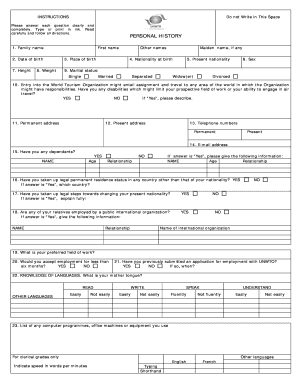
Mily name PERSONAL HISTORY First name 2. Date of birth 3. Place of birth 7. Height Other names Maiden name, if any 9. Marital status: 8. Weight Single 4. Nationality at birth Married Separated 5. Present nationality Widow(er) 6. Sex Divorced 10. Entry into the World Tourism Organization might entail assignment and travel to any area of the world in which the Organization might have responsibilities. Have you any disabilities which might limit your prospective field of work or yo.
Open form follow the instructions
Easily sign the form with your finger
Send filled & signed form or save
How to fill out the UNWTO Personal History online
Completing the UNWTO Personal History form is an essential step in your application process. This guide will provide you with clear instructions and insights on how to accurately fill out the form online.
Follow the steps to successfully complete your UNWTO Personal History form.
- Press the ‘Get Form’ button to acquire the document and open it in your preferred editing tool.
- Begin by filling out your family name and first name. Ensure that these are entered clearly, using correct spelling.
- Enter your date of birth in the specified format. This helps to verify your age for application processing.
- Provide your place of birth, including the city and country, to establish your origins.
- List your nationality at birth and your present nationality. This is vital for assessing your eligibility.
- Indicate your sex as required in the designated section, ensuring to respect the phrasing.
- If applicable, note any disabilities that may affect your work capabilities or travel. This information is essential for organizational planning.
- Fill in both your permanent and present address details. This allows the organization to contact you as needed.
- List your telephone numbers, providing both permanent and current numbers to ensure communication reliability.
- Enter your email address for electronic correspondence.
- Indicate whether you have any dependents, and if yes, provide their names, ages, and relationships.
- If you hold permanent residence in another country, specify which country and provide details if you've taken steps to change nationality.
- State if any of your relatives work for a public international organization and provide corresponding details.
- Describe your preferred field of work that aligns with the positions available within the organization.
- Specify your willingness to accept employment for less than six months if applicable.
- Indicate if you have previously submitted an application for employment with the UNWTO along with the pertinent details.
- Identify your mother tongue and rate your proficiency in other languages in reading, writing, speaking, and understanding.
- List relevant computer programs or office technologies you are proficient in, noting typing speeds if applicable.
- Detail your educational background, including institutions attended and degrees earned, in the original language.
- List any professional memberships or civic activities, showcasing your involvement in relevant sectors.
- Outline any significant publications you have authored; do not attach documents at this stage.
- Compile your employment history in reverse chronological order, noting each position's details, including responsibilities and reasons for leaving.
- State if you have any objections to inquiries being made regarding your current employer.
- Indicate if you have ever been a permanent civil servant in your government’s employ.
- Provide three references who can attest to your qualifications, ensuring they are not former supervisors.
- Mention any relevant facts that could assist in your application review, including residence outside your country.
- Declare any legal issues you have faced, providing details if applicable, but focus only on significant matters.
- Verify your understanding of the statements made in the form and confirm the truthfulness of your responses by signing and dating the form.
- Once all sections are filled, review the form for accuracy, save all changes, and utilize options to download, print, or share the completed document.
Complete your UNWTO Personal History form online to take the next step in your application process.
Experience a faster way to fill out and sign forms on the web. Access the most extensive library of templates available.
Related content
UNWTO and ETC encourage dissemination of their work and is pleased to consider...
Sep 8, 2021 — Both Centennials and Generation Z (those born between 1996 and 2010) are...
Collaboration with the World Tourism Organization (UNWTO). ICAO continued its...
Get answers to your most pressing questions about US Legal Forms API.
What is IUOTO?
IUOTO stands for the International Union of Official Travel Organizations, which was the original name of what is now the UNWTO. It was rebranded in 1975 to better reflect its global mission in tourism development. Understanding IUOTO is crucial for grasping the evolution and significance of UNWTO Personal History.
What is the history of the UNWTO?
The UNWTO was established in 1975, aiming to promote and develop tourism worldwide as a means of fostering economic growth and cultural exchange. Over the years, it has evolved to address emerging challenges, always focusing on sustainable tourism practices. This historical perspective is important for anyone studying their UNWTO Personal History.
How do you become a member of UNWTO?
Becoming a member of UNWTO requires submitting an application that meets eligibility standards. The organization reviews applications carefully to ensure alignment with its mission for sustainable tourism. By securing membership, you enhance your connections and knowledge through your UNWTO Personal History.
Who are the associate members of the UNWTO?
Associate members of the UNWTO include various organizations, businesses, and destinations involved in tourism but do not fit the criteria of full member states. These members benefit from the UNWTO's resources while contributing to the larger tourism conversation. Engaging with these associates can enrich your understanding of UNWTO Personal History.
What is the new name of the UNWTO?
The UNWTO has not adopted a new name; it continues to operate under its established title, the United Nations World Tourism Organization. This consistent branding reinforces its mission to promote sustainable tourism worldwide, an aspect crucial for anyone interested in their UNWTO Personal History.
How many member states have membership with the UNWTO?
Currently, there are 159 member states within the UNWTO. This diverse membership reflects a wide range of tourism interests and policies. As part of your UNWTO Personal History, understanding this global network can aid in establishing fruitful collaborations.
How to become a member of UNWTO?
To become a member of UNWTO, you need to submit a formal application through their official website. Each applicant must meet specific criteria and demonstrate a commitment to tourism development. By joining, you not only enhance your portfolio but also tap into the rich knowledge base associated with UNWTO Personal History.
What are the benefits of being a member of UNWTO?
Membership in UNWTO offers several advantages, including access to valuable resources and networking opportunities. Members can participate in global discussions on tourism policies and best practices, enhancing their influence in the industry. With UNWTO Personal History, you can gain insights from experienced professionals, helping you to drive sustainable tourism development.
What are the 5 pillars of the sustainable development goals?
The 5 pillars of the sustainable development goals are people, planet, prosperity, peace, and partnership. These goals, adopted by the UN, aim to address global challenges and promote sustainable development. They resonate deeply with the initiatives highlighted in the UNWTO Personal History, illustrating how tourism can contribute to a better world.
What are the 5 pillars of sustainable tourism in order?
The 5 pillars of sustainable tourism include environmental sustainability, economic viability, social and cultural sustainability, equity, and long-term commitment. These pillars emphasize a holistic approach to tourism that benefits communities, cultures, and the planet. Recognizing these elements is essential for understanding the narrative captured in the UNWTO Personal History.
Use professional pre-built templates to fill in and sign documents online faster. Get access to thousands of forms.
If you believe that this page should be taken down, please follow our DMCA take down process here.