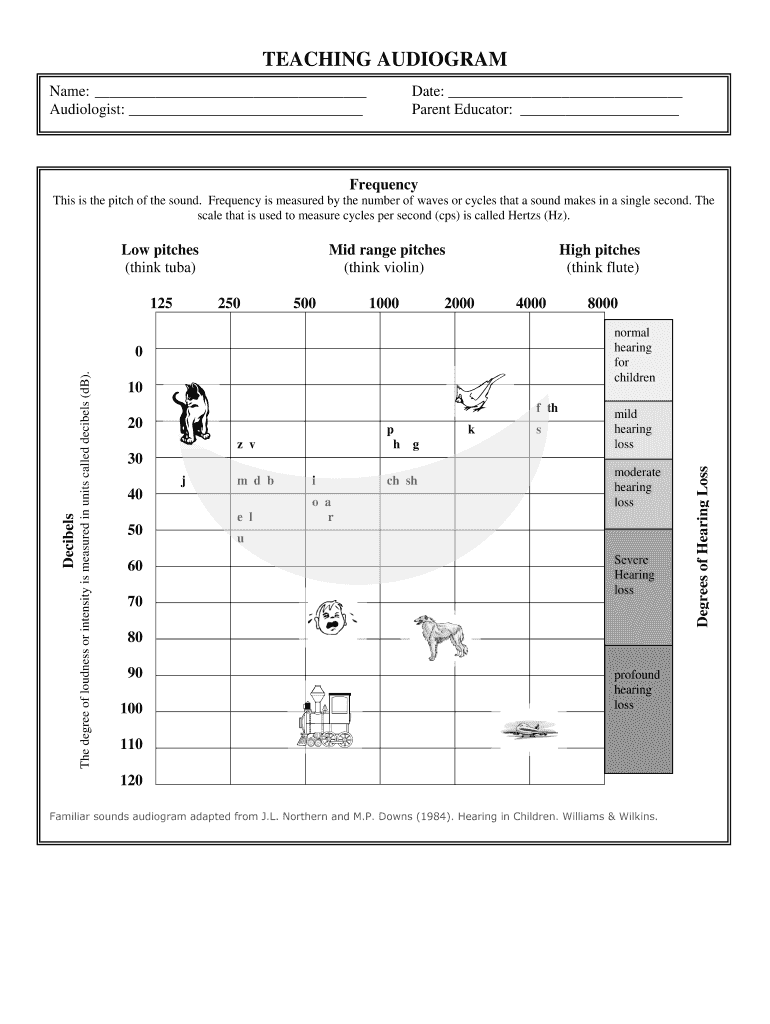
TEACHING AUDIOGRAM Name Audiologist Parent Educator Frequency This is the pitch of the sound. Frequency is measured by the number of waves or cycles that a sound makes in a single second. The scale that is used to measure cycles per second cps is called Hertzs Hz. Low pitches think tuba Mid range pitches think violin High pitches think flute normal hearing for children f th p h z v k g s mild loss j m d b i e l o a r ch sh moderate u Severe profound Familiar sounds audiogram adapted from J*L* Northern and M. P. Downs 1984. Hearing in Children* Williams Wilkins. Degrees of Hearing Loss Decibels The degree of loudness or intensity is measured in units called decibels dB. The scale that is used to measure cycles per second cps is called Hertzs Hz. Low pitches think tuba Mid range pitches think violin High pitches think flute normal hearing for children f th p h z v k g s mild loss j m d b i e l o a r ch sh moderate u Severe profound Familiar sounds audiogram adapted from J*L* Northern and....
Loading

Open form follow the instructions

Easily sign the form with your finger

Send filled & signed form or save
How to fill out the Teaching Audiogram online
Filling out the Teaching Audiogram is a straightforward process that helps assess the hearing abilities of children. This guide provides clear, step-by-step instructions for completing the form effectively online.
Follow the steps to successfully complete your Teaching Audiogram
- Press the ‘Get Form’ button to access the Teaching Audiogram form and open it in the editing space.
- Begin by entering the name of the child in the designated field at the top of the form. Ensure accuracy for proper identification.
- Next, fill in the audiologist's name in the corresponding space provided. This helps in maintaining clear communication among all parties involved.
- Enter the date on which the audiogram is being filled out. This is important for documentation and tracking the child's hearing progress over time.
- In the section labeled 'Parent Educator,' provide the name of the person responsible for educating the child. This could be a parent, guardian, or educator.
- Move on to the frequency section, where you will note the child's hearing capabilities at different pitches, such as low, mid-range, and high. Use the provided fields to indicate the frequencies tested.
- Assess the degree of hearing loss by reviewing the decibel measurements. Mark the appropriate levels of hearing ability as outlined on the form, from normal hearing to profound hearing loss.
- After all sections are completed, review the form for any errors or missing information to ensure it is accurate.
- Finally, save your changes, and you may choose to download, print, or share the completed Teaching Audiogram form as needed.
Start filling out your Teaching Audiogram online today for a comprehensive assessment of hearing abilities.
Experience a faster way to fill out and sign forms on the web. Access the most extensive library of templates available.
Related content
by MK Salmon · 2023 · Cited by 22 — Audiograms are most useful for objectively...
Speech Banana Audiogram. The audiogram graph below is a tool that can be used to...
by F Edition — Increasing the number of hearing aid channels will increase the ability...
Get answers to your most pressing questions about US Legal Forms API.
How do you administer a hearing test?
Administering a hearing test involves preparing the testing area, explaining the procedure to the patient, and utilizing audiometric equipment to evaluate their hearing. It is vital to ensure the patient understands the instructions and feels comfortable throughout the process. For more guidance, our Teaching Audiogram section offers useful tips for administering hearing tests effectively.
How do you administer an audiogram?
To administer an audiogram, start by ensuring a quiet testing environment, then place headphones on the patient and present various tones at different frequencies. Make sure to record the responses accurately, marking the thresholds on the audiogram. Our Teaching Audiogram materials provide step-by-step instructions that will guide you through the administration process seamlessly.
How do you read an audiogram for dummies?
Reading an audiogram involves interpreting the plotted symbols that represent hearing thresholds at various frequencies. The horizontal axis shows frequency, while the vertical axis indicates the intensity of sounds. To understand it easily, remember that lower thresholds indicate better hearing, and our Teaching Audiogram resources simplify this concept further.
What is the rule 3 of masking?
The rule 3 of masking states that when conducting a hearing test, masking is necessary if the difference between the air conduction threshold of the test ear and the bone conduction threshold of the non-test ear exceeds 40 dB. This ensures that the test results remain accurate and reliable. Understanding this rule is crucial for anyone involved in administering audiograms and is an integral part of our Teaching Audiogram curriculum.
How do you perform an audiogram?
Performing an audiogram involves using specialized equipment to test a patient's ability to hear sounds at various frequencies and volumes. The process typically includes calibrating the audiometer, presenting sounds, and recording the hearing thresholds on an audiogram. With the right training materials from our Teaching Audiogram section, you can become proficient in performing these tests.
Who administers an audiogram?
Audiograms are typically administered by licensed audiologists or qualified hearing care professionals. These individuals have the training necessary to conduct hearing tests accurately and interpret the results effectively. If your goal is to learn more about conducting audiograms, consider our Teaching Audiogram resources that provide valuable insights into best practices.
How do I document hearing test results?
To document hearing test results effectively, you should clearly record the patient's name, date of the test, and a detailed summary of the findings in a designated audiogram format. Including thresholds at various frequencies is essential, as well as any specific observations or recommendations. When utilizing the US Legal platform, you can find templates that guide you through documenting these results accurately, ensuring compliance with relevant regulations.
What is the rule 2 of masking?
Rule 2 of masking states that masking should be applied when there is a significant difference between the air conduction threshold of one ear and the bone conduction threshold of the other ear. This rule is vital in ensuring accurate test results and preventing cross hearing. Teaching audiogram principles, including these rules, enhances the diagnostic accuracy in hearing assessments.
How do you explain an audiogram?
To explain an audiogram, start by highlighting the layout, focusing on the axes for frequency and intensity. Use relatable terms to describe how different thresholds indicate varying degrees of hearing loss. Teaching audiogram concepts in simple language makes it accessible for patients, enabling them to grasp their hearing health.
How do you read an audiogram practice?
Reading an audiogram practice involves familiarization with various audiogram layouts and practicing interpretation of symbols and thresholds. Regular practice enhances your ability to quickly identify hearing levels and the degree of loss. Teaching audiograms through practical exercises can greatly improve one's skills in understanding these important diagnostics.
Use professional pre-built templates to fill in and sign documents online faster. Get access to thousands of forms.
If you believe that this page should be taken down, please follow our DMCA take down process here.