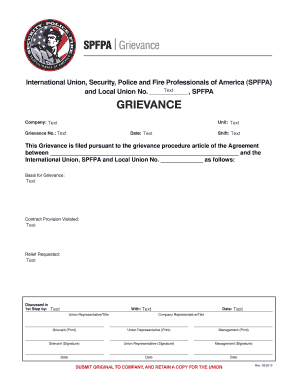
SPFPA Grievance Text Text Text Text Text Text This Grievance is filed pursuant to the grievance procedure article of the Agreement between and the International Union, SPFPA and Local Union No. as.
Open form follow the instructions
Easily sign the form with your finger
Send filled & signed form or save
How to fill out the SPFPA Grievance online
Filing a grievance is an important process for addressing workplace concerns. This guide provides clear, step-by-step instructions on how to effectively fill out the SPFPA Grievance online, ensuring that your voice is heard and your issues are presented clearly.
Follow the steps to fill out the SPFPA Grievance online effectively.
- Press the ‘Get Form’ button to access the grievance form and open it in your document editor.
- Begin by entering your name and contact details in the designated fields. Ensure that the information is accurate to facilitate communication.
- Identify the parties involved in the grievance by filling in the blanks for the organization and local union. This is critical for ensuring that your grievance is directed to the correct representatives.
- Clearly describe the nature of the grievance in the provided text area. Be specific about the history and context of the issue, using concise language to convey your message.
- If applicable, list any additional evidence or information that supports your grievance. This may include dates, witnesses, or documents relevant to your case.
- Review all entered information carefully to check for any errors or omissions. Accurate details are essential for processing your grievance.
- Once you are satisfied with the information you have provided, you can choose to save changes, download, print, or share the completed grievance form as needed.
Complete your grievance form online today to ensure your concerns are acknowledged.
Experience a faster way to fill out and sign forms on the web. Access the most extensive library of templates available.
Related content
It is further agreed that the resolution of such grievance in accordance with the...
The grievance shall be reduced to writing on the. SPFPA Grievance Form. This form shall be...
Get answers to your most pressing questions about US Legal Forms API.
What are the three types of grievances?
The three main types of grievances are individual grievances, group grievances, and policy grievances. Individual grievances are raised by one employee, while group grievances represent issues affecting multiple employees. Policy grievances address broader organizational policies that may be detrimental. Understanding these types enriches your understanding of the SPFPA Grievance process.
What qualifies as a grievance?
A grievance qualifies as any complaint related to terms of employment that an employee believes are unfair or unjust. Common examples include wage disputes, discrimination, or violations of workplace policies. If you feel your rights have been compromised, you may have a valid SPFPA Grievance on your hands. Identifying these issues promptly is vital to achieve a resolution.
What is a stage 3 grievance?
A stage 3 grievance typically refers to the final step in a grievance process where unresolved issues reach a higher-level review. At this stage, a hearing may occur involving management representatives and union officials. This escalation is critical as it ensures all voices are heard, ultimately leading to a resolution. Navigating an SPFPA Grievance may require understanding the implications of a stage 3 grievance.
What were the three grievances?
The three primary grievances often discussed in labor relations include unfair treatment, unsafe work conditions, and violation of personal rights. Employees have the right to raise these issues through the grievance process. This process is essential for maintaining workforce morale and addressing concerns properly. Knowing these grievances can help you better navigate the SPFPA Grievance system.
What are the different types of grievances?
There are several types of grievances related to labor and employment issues. Primarily, you may encounter contractual grievances, which arise from violations of a labor agreement. Additionally, there are disciplinary grievances that stem from actions taken against employees for misconduct. Understanding these types of grievances is crucial when addressing an SPFPA Grievance.
What are the steps to filing a grievance?
The steps to filing an SPFPA grievance include identifying the issue, gathering supporting evidence, and completing the grievance form. After filing, be prepared to present your case during any meetings or hearings. Following the union's process can ultimately guide you to a satisfactory resolution.
Is it worth filing a grievance?
Filing an SPFPA grievance can be worthwhile if you face legitimate issues at work that violate your rights. It helps you address unfair treatment and can lead to positive changes in your workplace. If you believe your claim is valid, taking action through a grievance can provide a path to resolution.
What are the grounds to file a grievance?
You can file an SPFPA grievance on various grounds such as contract violations, discriminatory practices, and failure to adhere to workplace safety standards. Each ground must be factual and backed by evidence. Understanding your rights is imperative for a successful grievance file.
How do I claim a grievance?
To claim an SPFPA grievance, first read through your union's grievance policy. Next, compile evidence, including witness statements and documents that demonstrate your claim. Finally, submit your grievance through the official channels, ensuring you follow every guideline and procedure provided.
How do I file a grievance and win?
Winning an SPFPA grievance requires clear documentation of your issue and a strong presentation of facts. Ensure you include all evidence, follow the union's procedures, and adhere to deadlines. Building a solid case can significantly improve your chances of a favorable outcome.
Use professional pre-built templates to fill in and sign documents online faster. Get access to thousands of forms.
If you believe that this page should be taken down, please follow our DMCA take down process here.