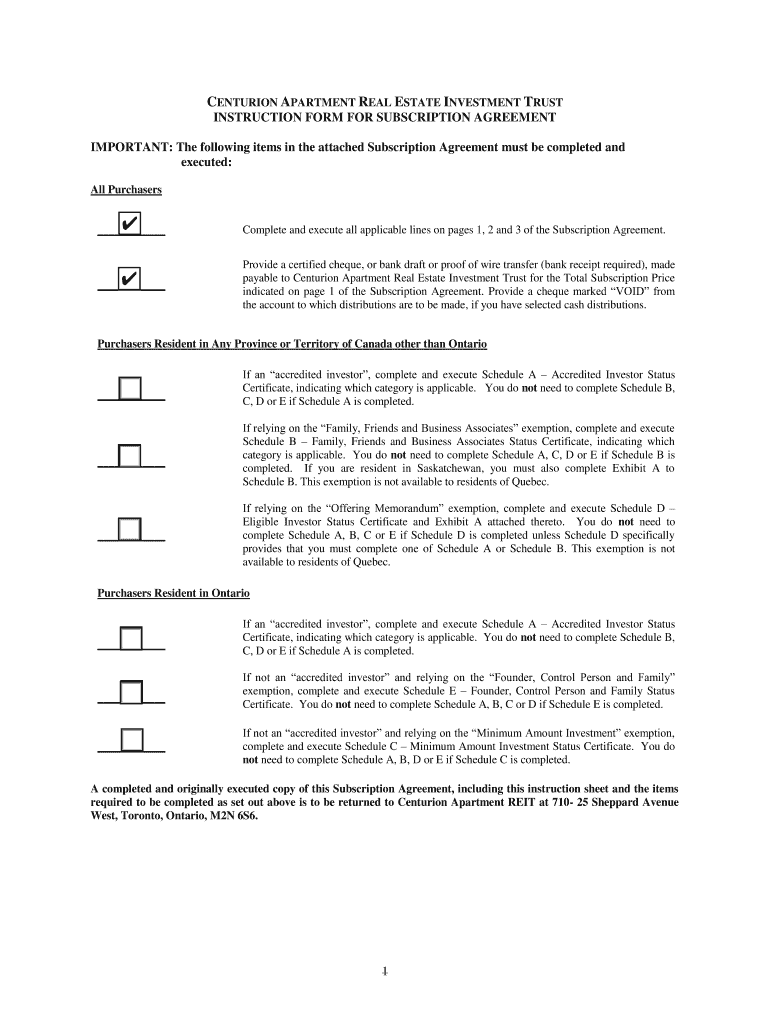
CENTURION APARTMENT REAL ESTATE INVESTMENT TRUST INSTRUCTION FORM FOR SUBSCRIPTION AGREEMENT IMPORTANT: The following items in the attached Subscription Agreement must be completed and executed: All.
Loading

Open form follow the instructions

Easily sign the form with your finger

Send filled & signed form or save
How to fill out the Centurion Reit Review online
This guide provides a step-by-step approach to filling out the Centurion Reit Review online. By following these instructions, users can complete the Subscription Agreement accurately and efficiently.
Follow the steps to successfully complete the Centurion Reit Review.
- Use the 'Get Form' button to access the Centurion Reit Review form. This will allow you to view and fill out the necessary fields in a suitable format.
- Begin by providing your personal information, including your name, address, and contact details in the designated fields. Ensure that all information is accurate and presented clearly.
- Complete all applicable lines on pages 1, 2, and 3 of the Subscription Agreement. Carefully check that you have filled in all required information.
- Indicate your Selection of Purchase Option by marking the corresponding box for either Class 'A' or Class 'F' Units. Choose the appropriate plan, such as Plan A, B, or C for Class 'A' Units.
- Provide your Total Subscription Amount in the space provided. Make sure this reflects your intended investment.
- If you are an accredited investor or relying on exemptions like Family, Friends, and Business Associates, complete and attach the relevant Schedule (A, B, C, or D) as required.
- Attach a certified cheque, bank draft, or proof of wire transfer, made payable to Centurion Apartment Real Estate Investment Trust for the total amount indicated.
- Once all fields are completed, save your changes to the form. You can then download the form, print it, or share it as needed.
Complete your Centurion Reit Review online today for a seamless investment experience.
Experience a faster way to fill out and sign forms on the web. Access the most extensive library of templates available.
Related content
REITs have limited diversification because they may invest in a limited number of...
Jun 8, 2016 — Plaintiffs' information and belief are based upon, among other things...
Jan 4, 2021 — has reviewed this Offering Memorandum or has in any way passed upon...
Get answers to your most pressing questions about US Legal Forms API.
What is the bad side of REITs?
REITs don't have to pay a corporate tax, but the downside is that REIT dividends are typically taxed at a higher rate than other investments. Oftentimes, dividends are taxed at the same rate as long-term capital gains, which for many people, is generally lower than the rate at which their regular income is taxed.
Why not to invest in REITs?
Summary of Why Investors May Not Want to Invest in REITs But, REITs are not risk free. They may have highly variable returns, are sensitive to changes in interest rates, have income tax implications, may not be liquid, and fees can impact total returns.
Are REITs a good investment now?
The FTSE Nareit All Equity REIT index has slid 23% this year amid surging interest rates and economic sluggishness.
Is Centurion REIT a good investment?
Investing in Centurion Units can involve significant risks and the value of an investment may go down as well as up. There is no guarantee of performance. An investment in Centurion is not intended as a complete investment program and should only be made after consultation with independent investment and tax advisors.
Are REITs a good investment in 2023?
Are real estate stocks good investments in 2023? The answer is probably if the basis is the sector's year-to-date performance (+10.52%). Real estate investment trusts (REITs) took a beating last year due to rising interest rates. However, if you want exposure to the real estate market, evaluate the prospects carefully.
Are REITs riskier than bonds?
While both REITs and bonds have enjoyed lower volatility compared to stocks, bonds are the lower volatility asset class due to their much lower correlation with stocks. Meanwhile, REITs can experience significant share price volatility, especially over short periods of time.
What is the problem with REITs?
Compared to other investments such as stocks and bonds, REITs are subject to various risk factors that affect the investor's returns. Some of the main risk factors associated with REITs include leverage risk, liquidity risk, and market risk.
Who owns Centurion property?
Centurion is founded by President and CEO Greg Romundt.
Use professional pre-built templates to fill in and sign documents online faster. Get access to thousands of forms.
If you believe that this page should be taken down, please follow our DMCA take down process here.