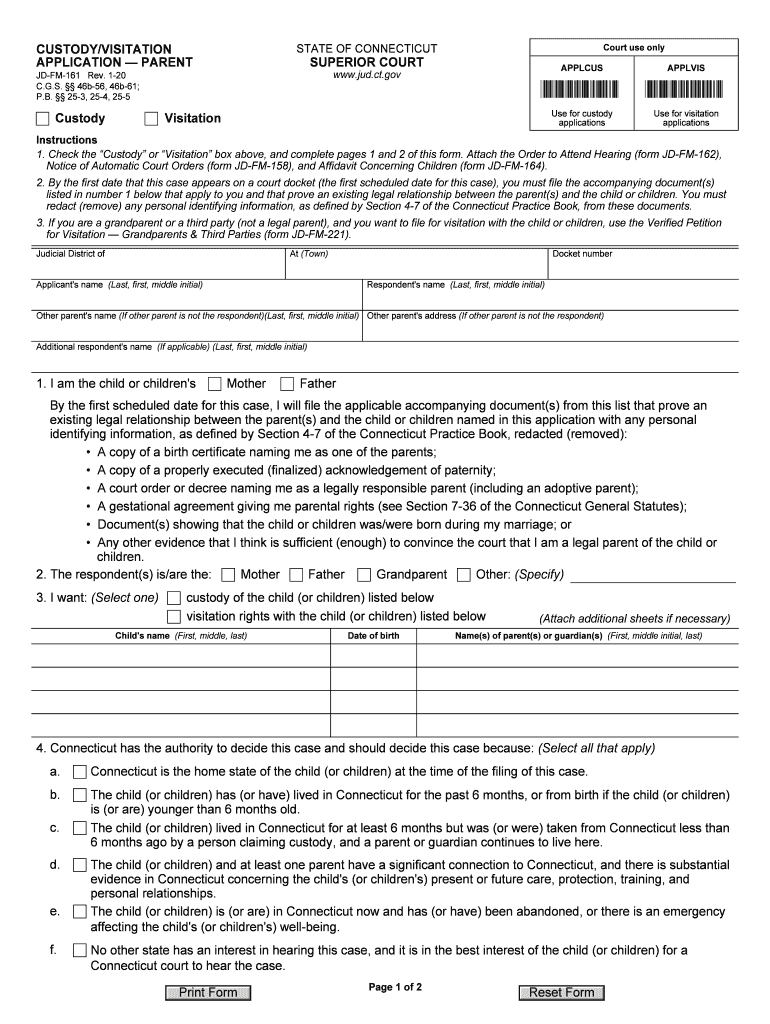
CUSTODY/VISITATION APPLICATION PARENTSTATE OF CONNECTICUT www.jud.ct.govJDFM161 Rev. 120 C.G.S. 46b56, 46b61; P.B. 253, 254, 255CustodyCourt use onlySUPERIOR COURTAPPLCUSAPPLVIS*APPLCUS**APPLVIS*Use.
Loading

Open form follow the instructions

Easily sign the form with your finger

Send filled & signed form or save
How to use or fill out the JD-FM-161 Rev online
The JD-FM-161 Rev is a crucial form for applying for custody or visitation rights in Connecticut. This guide provides clear and actionable steps to help users complete the form accurately and efficiently.
Follow the steps to fill out the JD-FM-161 Rev online.
- Click ‘Get Form’ button to obtain the form and open it in the editor.
- Indicate whether you are applying for custody or visitation by checking the appropriate box at the top of the form. Complete pages 1 and 2 as instructed.
- Attach required documents such as the Order to Attend Hearing (JD-FM-162), Notice of Automatic Court Orders (JD-FM-158), and the Affidavit Concerning Children (JD-FM-164) to your application.
- Make sure to file any necessary accompanying documents that prove a legal relationship between the parent(s) and the child. Redact personal identifying information as defined in Section 4-7 of the Connecticut Practice Book.
- Complete the sections about your identity and relation to the children, including names and birth dates. Ensure you provide your legal status (mother, father, etc.) and select your reason for filing.
- Select the appropriate reasons for Connecticut’s jurisdiction over your case from the provided options.
- If applying for financial support or HUSKY, answer the respective questions and send copies of necessary documents to the Office of the Attorney General or the City or Town Clerk as required.
- If you are applying for custody, specify the type of custody you are seeking and any related child support. If applying for visitation, outline your requests clearly.
- After completing the form, review all details for accuracy. Save changes, download the completed form, print it if needed, or share it as required.
Complete your JD-FM-161 Rev application online today to ensure timely processing.
Experience a faster way to fill out and sign forms on the web. Access the most extensive library of templates available.
Related content
Check the “Custody” or “Visitation” box above, and complete pages 1 and 2 of this...
JD-FM-161. ... the father of an illegitimate child need no longer be limited to...
PN 100004071, Rev 6. Page 1. TransMedics® Organ Care System™. Clinical User Guide:...
Get answers to your most pressing questions about US Legal Forms API.
How is custody decided in CT?
It is not intended to be and should not be construed as legal advice. In Connecticut, child custody, in cases of dissolution of a marriage, is determined by a judge in the Family Division of Superior Court. Judges use the “best interests of the child” standard in awarding custody of minor children.
At what age can a child decide which parent to live with in CT?
Connecticut custody laws only require that the child is "of sufficient age" to have his or her wishes considered. Connecticut case law generally treats 12 as a reasonable age to express a custody preference.
How do I get sole custody of my child in CT?
Sole physical and/or sole legal custody is generally awarded when one parent is deemed unfit typically for drug, financial, alcohol, or abuse issues. Courts are not fond of granting sole custody; Courts ideally want both parents to be involved in each child's life.
How do I get full custody of my child in CT?
To obtain sole legal and primary physical custody with limited or supervised visitation, a Connecticut parent would have to prove the other party is completely unfit to parent. Potential issues that may demonstrate an inability to raise a child include: Substance abuse problems. A history of violent criminal offenses.
What are the grounds for full custody in CT?
To obtain sole legal and primary physical custody with limited or supervised visitation, a Connecticut parent would have to prove the other party is completely unfit to parent. Potential issues that may demonstrate an inability to raise a child include: Substance abuse problems. A history of violent criminal offenses.
Use professional pre-built templates to fill in and sign documents online faster. Get access to thousands of forms.
If you believe that this page should be taken down, please follow our DMCA take down process here.