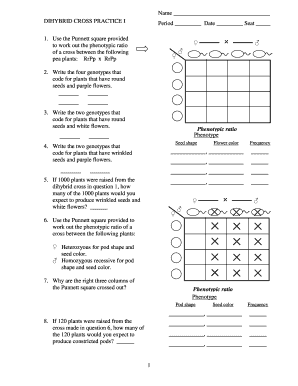
Name DIHYBRID CROSS PRACTICE I Period Date Seat 1. Use the Punnett square provided to work out the phenotypic ratio of a cross between the following pea plants: RrPp x RrPp 2. Write the four genotypes.
Open form follow the instructions
Easily sign the form with your finger
Send filled & signed form or save
How to fill out the Rrpp X Rrpp online
This guide provides comprehensive instructions on how to effectively fill out the Rrpp X Rrpp form online. Whether you are familiar with genetic crosses or new to the topic, this user-friendly guide will walk you through each section in a clear and detailed manner.
Follow the steps to complete the Rrpp X Rrpp form online
- Click the ‘Get Form’ button to retrieve the Rrpp X Rrpp form and open it in your browser.
- Begin by filling in your name at the designated section at the top of the form. Make sure to enter your first and last names clearly for identification purposes.
- Indicate your period, date, and seat number in the corresponding fields to maintain organization and submission tracking.
- Use the provided Punnett square to calculate the phenotypic ratio of the cross between RrPp x RrPp. Take your time to ensure all squares are filled correctly before moving on.
- Complete the specific genotype and phenotype questions related to seed and flower characteristics as provided in each item on the form.
- Design additional Punnett squares as requested to analyze further genetic crosses, ensuring to summarize each phenotypic ratio clearly in the designated fields.
- Upon completing all sections, review the entire form for accuracy, ensuring all calculations and details reflect your findings.
- Finally, save your changes, and choose to download, print, or share the completed form as needed.
Start completing your Rrpp X Rrpp form online today!
Experience a faster way to fill out and sign forms on the web. Access the most extensive library of templates available.
Related content
by ML Collyer · 2015 · Cited by 272 — RRPP is a procedure that uses a resampling...
Rose comb (Wyandotte) x Pea Comb (Brahmas) (both parents were pure lines) ... Parental...
24 x 10/100/1000Base-T Ethernet ports, 4 x 10GE SFP+ ports. ○. 1+1 power backup ... RRPP...
Get answers to your most pressing questions about US Legal Forms API.
What is the 12 3 1 ratio in genetics?
Dominant Epistasis In some cases, a dominant allele at one locus may mask the phenotype of a second locus. This is called dominant epistasis. This produces a segregation ratio of 12:3:1, which can be viewed as a modification of the 9:3:3:1 ratio.
What is 9 3 3 1 epistasis?
This type of epistasis is sometimes called dominant suppression, because the deviation from 9:3:3:1 is caused by a single allele that produces a dominant phenotype, and the action of this allele is to suppress the expression of some other gene.
What is the 9 3 3 1 ratio in genetics?
This 9:3:3:1 phenotypic ratio is the classic Mendelian ratio for a dihybrid cross in which the alleles of two different genes assort independently into gametes. Figure 1: A classic Mendelian example of independent assortment: the 9:3:3:1 phenotypic ratio associated with a dihybrid cross (BbEe × BbEe).
What is the genotype of the walnut comb chicken?
A chicken with a walnut comb has one of four possible gene combinations: RRPP, RrPP, RRPp, or RrPp. When both genes are absent, the result is a single comb. A chicken with a single comb has the only possible gene combination: rrpp.
What is the phenotypic ratio of recessive epistasis?
The phenotypic ratio is 9:3:4.
What is 9 3 3 1 Punnett square ratio?
A 9:3:3:1 Ratio is at ratio of phenotypes among offspring (progeny) that results when two dihybrids mate, e.g., AaBa × AaBa, where allele A is dominant to allele a, allele B is dominant to allele b, and the A and B loci otherwise have no impact on each other phenotypically (no epistasis) nor genotypically (no linkage).
What is the phenotypic ratio of 9 3 3 1 justify?
The hypothesis that color and shape genes assort independently thus predicts that the F2 generation will display a 9:3:3:1 phenotypic ratio: nine individuals with round, yellow seeds, three with round, green seeds, three with wrinkled, yellow seeds, and one with wrinkled, green seeds.
Under what conditions does one expect a 9 3 3 1 ratio?
Answer and Explanation: In the case of complete dominance of one allele over the other and no genetic linkage (i.e., independent assortment), a cross of two F1 dihybrid individuals will produce F2 offspring with a 9:3:3:1 ratio of phenotypes.
Use professional pre-built templates to fill in and sign documents online faster. Get access to thousands of forms.
If you believe that this page should be taken down, please follow our DMCA take down process here.