Loading
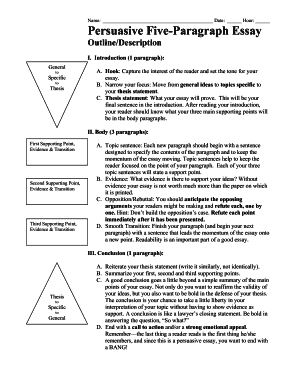
Get Argumentative Essay Outline (claim) Directions: Use This ...
How it works
-

Open form follow the instructions
-

Easily sign the form with your finger
-

Send filled & signed form or save
How to use or fill out the Argumentative Essay Outline (Claim) Directions: Use This ... online
Filling out an argumentative essay outline can seem overwhelming, but following a structured approach makes it manageable and rewarding. This guide provides step-by-step instructions on how to effectively complete the outline, ensuring you cover all essential components for a compelling argumentative essay.
Follow the steps to successfully fill out your essay outline.
- Click the ‘Get Form’ button to access the form and open it in your preferred editor.
- Begin with the introduction section. In the first field, provide a catchy hook that captures your reader's interest. Follow up with narrowing your focus to specific ideas that relate to your thesis statement. Finally, clearly articulate your thesis statement, outlining the three main supporting points that will be discussed in the body paragraphs.
- Move to the body section. For each of the three paragraphs, start with a strong topic sentence that specifies the point of the paragraph. Follow this with evidence supporting your argument, addressing any opposing viewpoints, and smoothly transitioning to the next point, ensuring that your essay flows logically.
- Conclude by reiterating your thesis statement in a similar manner but not identical. Summarize your supporting points and extend the conclusion with a persuasive call to action or emotional appeal, leaving a lasting impression on your reader.
- Once all sections are completed, review your outline for clarity and coherence. Finally, save any changes you’ve made, and choose whether to download, print, or share your completed form.
Begin creating your persuasive argumentative essay outline online today and elevate your writing!
Information is used, but it is organized based on these major components of an argument: claim, reason, evidence, counter-claim, and rebuttal.