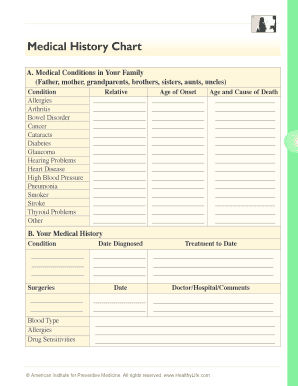
Medical History Chart A. Medical Conditions in Your Family (Father, mother, grandparents, brothers, sisters, aunts, uncles) Condition Allergies Arthritis Bowel Disorder Cancer Cataracts Diabetes Glaucoma.

How it works
  • Open form

    Open form follow the instructions

  • Easily sign form

    Easily sign the form with your finger

  • Share form

    Send filled & signed form or save

How to fill out the Medical History Chart - Healthylearncom online

Completing the Medical History Chart is an essential step in managing your health information. This guide provides a comprehensive overview of how to accurately fill out the form online, ensuring all relevant details are captured for your medical records.

Follow the steps to complete your Medical History Chart effectively.

  1. Click ‘Get Form’ button to obtain the document and open it in the designated editor.
  2. Begin by entering information about medical conditions in your family. Document any relevant conditions such as allergies, diabetes, heart disease, or cancer next to each corresponding relative.
  3. Indicate the age of onset for each condition listed and provide the age and cause of death for deceased relatives, where applicable.
  4. Next, proceed to your medical history section. Fill in your medical conditions, any surgeries you have undergone, and indicate your blood type.
  5. List any known allergies and drug sensitivities, along with the dates these conditions were diagnosed.
  6. In the treatment section, provide details regarding any current treatment you have received to date, including the names of doctors or hospitals involved.
  7. Carefully review all the information to ensure accuracy and completeness before finalizing your form.
  8. At the end of the process, you can save your changes, download the completed form, print it for your records, or share it as necessary.

Ensure that your health information is complete—start filling out your Medical History Chart online today!

Get form

Experience a faster way to fill out and sign forms on the web. Access the most extensive library of templates available.

Questions & Answers

Get answers to your most pressing questions about US Legal Forms API.

Contact support

What are the 3 types of patients?

Being able to understand these types of patients and finding ways to work with them is essential to building a healthcare worker/patient relationship. There are 3 patients that you are sure to see in your career – the inconsistent patient, the anxious patient, and the quiet patient.

Obtain a detailed history of the pertinent and. necessary information regarding the patient. ... Provide an accurate description of the. relevant symptoms and events in the. ... Interpret the information obtained in terms of. ... Present the patient history and generate a. ... Summarize the history emphasizing the mos.

History of Present Illness Chief complaint (CC) History of present illness (HPI) Review of systems (ROS) Past, family and/or social history (PFSH)

Interview the patient for a past medical history. Allergies and drug reactions. Current medications, including over-the-counter drugs. Current and past medical or psychiatric illnesses or conditions. Past hospitalizations. Immunization status. Use of tobacco, alcohol or recreational drugs.

5 Types of Patients (and How They've Changed in the Last 15 Years... The Independent Skeptic. One of the toughest to deal with, this type of patient is naturally skeptical about expert advice. ... The Researcher. ... The Passive Dependent. ... “I'm flexible” ... The Open-minded “Explorer”

“OLD CARTS” is a mnemonic device used by providers to guide their interview of a patient while documenting a history of present illness. The letters stand for onset; location; duration; characteristic; alleviating and aggravating factors; radiation or relieving factors; timing; and severity.

In general, a medical history includes an inquiry into the patient's medical history, past surgical history, family medical history, social history, allergies, and medications the patient is taking or may have recently stopped taking.

The anamnesis can be divided into two large groups ing to who the anamnestic data are obtained from. Direct anamnesis - is taken directly from the patient. Indirect anamnesis - is taken, for example, from the patient's escort.

Get This Form Now!

Use professional pre-built templates to fill in and sign documents online faster. Get access to thousands of forms.

If you believe that this page should be taken down, please follow our DMCA take down process here.

Get Medical History Chart - Healthylearncom