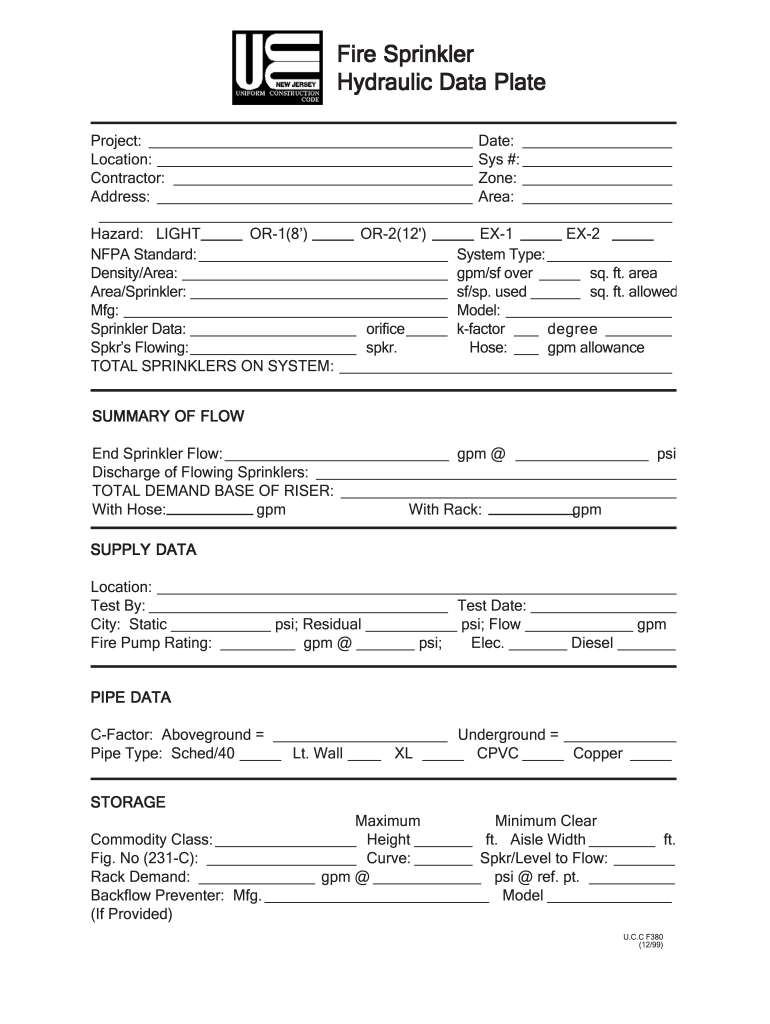
Fire Sprinkler Hydraulic Data Plate Project: Date: Location: Sys #: Contractor: Zone: Address: Area: Hazard: LIGHT OR1(8) OR2(12 ') EX1 EX2 NFPA Standard: System Type: Density/Area: gpm/sf over sq.
Loading

Open form follow the instructions

Easily sign the form with your finger

Send filled & signed form or save
How to fill out the Hydraulic Data Plate online
The Hydraulic Data Plate is a crucial document that provides essential information about fire sprinkler systems. Completing this form accurately is vital for ensuring the safety and compliance of the system being installed or maintained.
Follow the steps to correctly fill out the Hydraulic Data Plate.
- Click ‘Get Form’ button to access the Hydraulic Data Plate, which you can then open in your preferred editing tool.
- Begin by filling in the project name and date at the top of the form. Ensure to enter the relevant project details clearly.
- Next, provide the location and the system number, indicating where the sprinkler system is installed and its unique identifier.
- Fill out the contractor's name, zone, and address, ensuring that the details correspond to the installation site.
- Specify the area and hazard classification, detailing whether it is light, ordinary, or extra hazard as applicable.
- Input the NFPA standard reference and the system type; provide the density/area calculation using the specified gallons per minute per square foot over the indicated area.
- Record the area per sprinkler, making sure to specify the actual square footage utilized versus the allowed square footage.
- Complete the manufacturer and model fields for the sprinkler, as well as all relevant sprinkler data, including orifice size, k-factor, and degrees.
- Document the amount of sprinklers flowing and their corresponding flow rates in gallons per minute as required.
- Summarize the flow by recording details for the end sprinkler flow, including the gpm and psi information.
- Include the total demand base of the riser, providing details with and without hose and rack allowances.
- Fill out the supply data, entering the location of the supply, testing person’s name, test date, and pressure information.
- Next, input necessary pipe data, including the C-factor, pipe type, and any relevant specifications.
- Finally, complete the storage section by detailing commodity class, maximum and minimum clear heights, aisle width, and backflow preventer information if applicable.
- After ensuring all sections are filled accurately, save your changes, and choose to download, print, or share the Hydraulic Data Plate as needed.
Complete your Hydraulic Data Plate online to ensure compliance and safety.
Experience a faster way to fill out and sign forms on the web. Access the most extensive library of templates available.
Related content
Jul 31, 2017 — This Coffee Break Bulletin explains what information is required by...
Additionally, data from this PLT test can be combined with other soil data to ... a...
Weirs are generally used as measuring and hydraulic control devices. Emergency spillways...
Get answers to your most pressing questions about US Legal Forms API.
What is identification of sprinkler?
Let's get to it: a sprinkler identification number consists of one or two letters followed by three or four numbers. That code is imprinted on each sprinkler's deflector—the thin metallic part furthest away from a sprinkler's threaded inlet.
What is a sprinkler placard?
This sign is used to post the hydraulic data for your fire sprinkler system. The sign is silk-screened and then oven baked for added durability. These signs feature smooth, finished edges and predrilled mounting holes.
What is a riser placard?
The Requirement – For antifreeze sprinkler systems, every system riser must have a placard mounted on it to indicate the number and location of any remote antifreeze systems supplied by that riser.
How do you read a fire sprinkler hydraulic calculation?
How to Calculate Sprinkler Flow Requirements? The flow calculation is relatively simple, since design engineers only have to multiply the covered area and the flow density that was previously determined: Q (flow) = Coverage Area x Flow Density.
What is a hydraulic calculation plate for sprinkler system?
Almost all automatic sprinkler systems designed today are hydraulically calculated — an engineered approach that matches the potential fire hazard to the pressure and volume of the available water supply.
What OSHA standards require sprinkler systems?
1910.159 - Automatic sprinkler systems.
Are sprinkler systems required in Maryland?
Currently, the state requires all new high rise residential buildings - apartments and condominiums - to be built with sprinklers in each unit. However, buildings constructed before that state code was put in place were given until January 1, 2033 to retrofit their buildings and add sprinklers in each unit.
What is a sprinkler system placard?
The Requirement – Every hydraulically calculated system is required to have a Hydraulic Design Information sign (more commonly known as the Hydraulic Data Plate or Placard). This sign must be located in four places in your system – at the alarm valve, the dry pipe valve, the preaction valve, and the deluge valve.
Use professional pre-built templates to fill in and sign documents online faster. Get access to thousands of forms.
If you believe that this page should be taken down, please follow our DMCA take down process here.