Loading
Get Counselling Session Plan Template
How it works
-

Open form follow the instructions
-

Easily sign the form with your finger
-

Send filled & signed form or save
How to fill out the Counselling Session Plan Template online
Filling out the Counselling Session Plan Template can streamline the process of planning effective counseling sessions. This guide provides detailed, step-by-step instructions for completing each section of the form online, ensuring a user-friendly experience for all.
Follow the steps to successfully complete the Counselling Session Plan Template.
- Click ‘Get Form’ button to obtain the form and open it in the editor.
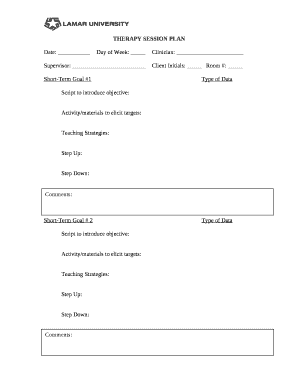
- Begin by entering the date of the session in the designated field. Ensure that the date accurately reflects the scheduled session to maintain proper records.
- Specify the day of the week in the next field. This information helps in organizing the sessions and tracking progress over time.
- Fill in the clinician's name in the provided space. This identifies the professional responsible for the session and documents accountability.
- Indicate the name of the supervisor overseeing the session, if applicable. This ensures that there is a point of contact for any follow-ups or questions regarding the session.
- Record the client’s initials in the specified section. This allows for confidentiality while providing a way to reference the client’s progress.
- In the room number field, enter the location where the counseling session will take place. This is important for logistical purposes.
- For each short-term goal, fill out the corresponding sections. Start with Short-Term Goal #1 by providing a script to introduce the objective of the goal.
- List the activity or materials needed to elicit targets for Short-Term Goal #1. Be specific to ensure clarity in execution.
- Outline the teaching strategies you plan to use to achieve Short-Term Goal #1. These strategies help to define the approach taken during the session.
- Document any modifications for participants in the 'Step Up' and 'Step Down' sections. This ensures adaptability to meet diverse needs.
- Add any relevant comments that may assist in understanding the context or providing further clarification about Short-Term Goal #1.
- Repeat steps 8 through 12 for Short-Term Goal #2, ensuring consistency in detail and format.
- In the final section, summarize the type of data that will be collected during the session. This helps to monitor progress and outcomes effectively.
- Once all sections are complete, save your changes, and consider downloading, printing, or sharing the form as necessary.
Get started on completing your documents online today!
There are five major stages that we will look at today: Stage 1: Initial disclosure. Stage 2: In-depth exploration. Stage 3: Commitment to action. Stage 4: Counseling intervention. Stage 5: Evaluation, termination, or referral.