Loading
Form preview
  • US Legal Forms
  • Other Templates
  • More Forms
  • More Multi-State Forms
  • 3: Organic Vs Inorganic Worksheet

Get 3: Organic Vs Inorganic Worksheet

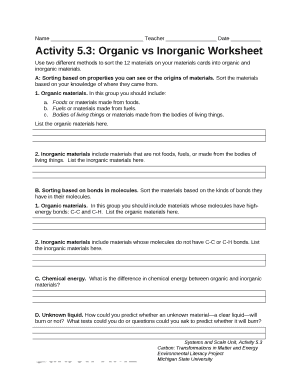
Name Teacher Date Activity 5.3: Organic vs Inorganic Worksheet Use two different methods to sort the 12 materials on your materials cards into organic and inorganic materials. A: Sorting based on.

How it works

  1. Open form

    Open form follow the instructions

  2. Easily sign form

    Easily sign the form with your finger

  3. Share form

    Send filled & signed form or save

How to fill out the 3: Organic Vs Inorganic Worksheet online

Filling out the 3: Organic Vs Inorganic Worksheet online can be a straightforward process if you follow the steps carefully. This guide will help you navigate each section of the worksheet to ensure you provide accurate and organized information.

Follow the steps to complete the worksheet accurately.

  1. Click ‘Get Form’ button to obtain the worksheet and open it in the designated online editor.
  2. Begin by identifying the materials you have on your materials cards. Sort these materials into two categories: organic and inorganic. You can choose to sort based on visible properties or the origins of the materials.
  3. In the 'Organic materials' section, include foods, materials made from foods, fuels, or materials derived from fuels, as well as bodies of living things. List all identified organic materials here.
  4. Proceed to the 'Inorganic materials' section. List materials that do not fall under the categories of food, fuel, or those derived from living bodies.
  5. Next, sort the materials based on the types of bonds in their molecules. In the second 'Organic materials' section, note down materials with high-energy bonds such as C-C and C-H.
  6. For the 'Inorganic materials' section based on bonds, list those whose molecules do not contain C-C or C-H bonds.
  7. In section C labeled 'Chemical energy,' describe the differences in chemical energy between the organic and inorganic materials you identified.
  8. Finally, in section D about the unknown liquid, provide your predictions on whether a clear liquid will burn. Detail the tests you could conduct or the inquiries you would make to reach your conclusion.
  9. After completing all sections of the worksheet, make sure to save your changes. You can then download, print, or share the completed form as needed.

Complete your 3: Organic Vs Inorganic Worksheet online today and enhance your understanding of material classification.

Get form

Experience a faster way to fill out and sign forms on the web. Access the most extensive library of templates available.
Get form

Related content

Trash Corners: Organic, Inorganic, or Toxic?...
Gather the kids and explain that there are three types of garbage. Ask if they know what...
Learn more
Distinguish between organic and inorganic...
up living organisms along with some of the properties and functions of these molecules. 2...
Learn more
The Scenarios Approach to Attenuation-Based...
by SRN Solutions · 2011 — contaminated with inorganic or radionuclide contaminants....
Learn more

Related links form

LETTER OF CREDIT FINANCIAL GUARANTEE Contact Information For MetLife Resources - Waterbury - Waterburyct REQUEST FOR RESIDENCY POINTS UK Operating Agreement

Questions & Answers

Get answers to your most pressing questions about US Legal Forms API.

Contact support

Inorganic substances Antimony. Arsenic. Barium. Beryllium. Boron. Cadmium. Chlorine. Chromium.

Inorganic compounds essential to human functioning include water, salts, acids, and bases.

The primary difference that lies between these organic compounds and inorganic compounds is that organic compounds always have a carbon atom, while most of the inorganic compounds do not contain a carbon atom in them. Almost all organic compounds contain carbon-hydrogen or a simple C-H bond in them.

The majority of inorganic substances lack carbon atoms (some exceptions do exist). Organic substances made up of carbon, oxygen, hydrogen, and their derivatives. They lack both hydrogen and oxygen, as well as their derivatives. Organic substances are more flammable and volatile.

Examples of common everyday inorganic compounds are water, sodium chloride (salt), sodium bicarbonate (baking soda), calcium carbonate (dietary calcium source), and muriatic acid (industrial-grade hydrochloric acid). Inorganic compounds typically have high melting points and variable degrees of electrical conductivity.

In general, there are four groups of inorganic compound types. They are divided into bases, acids, salts, and water. Note that these are the broadest categories of inorganic compounds.

However, elementary carbon (C) (as graphite or diamond) and compounds of carbon and, for example, nitrogen, oxygen, or silicon are also classified as inorganic. Examples of such inorganic compounds include carbon monoxide (CO), silicon carbide (SiC), and carbonic acid (H2CO3), and salts thereof.

All living organisms contain carbon-based compounds, making them organic. Our bodies are composed mostly of water, H2O, and it is necessary for us to survive. However, water is an example of an inorganic compound because it does not contain carbon and it was not formed by a living organism.

Get This Form Now!

Use professional pre-built templates to fill in and sign documents online faster. Get access to thousands of forms.
Get form
If you believe that this page should be taken down, please follow our DMCA take down processhere.
Get 3: Organic Vs Inorganic Worksheet
Get form
  • Adoption
  • Bankruptcy
  • Contractors
  • Divorce
  • Home Sales
  • Employment
  • Identity Theft
  • Incorporation
  • Landlord Tenant
  • Living Trust
  • Name Change
  • Personal Planning
  • Small Business
  • Wills & Estates
  • Packages A-Z
  • Affidavits
  • Bankruptcy
  • Bill of Sale
  • Corporate - LLC
  • Divorce
  • Employment
  • Identity Theft
  • Internet Technology
  • Landlord Tenant
  • Living Wills
  • Name Change
  • Power of Attorney
  • Real Estate
  • Small Estates
  • Wills
  • All Forms
  • Forms A-Z
  • Other Templates
  • Legal Hub
  • About Us
  • Help Portal
  • Legal Resources
  • Blog
  • Affiliates
  • Contact Us
  • Delete My Account
  • Site Map
  • Industries
  • Forms in Spanish
  • Localized Forms
  • State-specific Forms
  • Forms Kit
  • Real Estate Handbook
  • All Guides
  • Notarize
  • Incorporation services
  • For Consumers
  • For Small Business
  • For Attorneys
  • USLegal
  • FormsPass
  • pdfFiller
  • signNow
  • altaFlow
  • DocHub
  • Instapage
Form Packages
  • Adoption
  • Bankruptcy
  • Contractors
  • Divorce
  • Home Sales
  • Employment
  • Identity Theft
  • Incorporation
  • Landlord Tenant
  • Living Trust
  • Name Change
  • Personal Planning
  • Small Business
  • Wills & Estates
  • Packages A-Z
Form Categories
  • Affidavits
  • Bankruptcy
  • Bill of Sale
  • Corporate - LLC
  • Divorce
  • Employment
  • Identity Theft
  • Internet Technology
  • Landlord Tenant
  • Living Wills
  • Name Change
  • Power of Attorney
  • Real Estate
  • Small Estates
  • Wills
  • All Forms
  • Forms A-Z
  • Other Templates
Customer Service
  • Legal Hub
  • About Us
  • Help Portal
  • Legal Resources
  • Blog
  • Affiliates
  • Contact Us
  • Delete My Account
  • Site Map
  • Industries
  • Forms in Spanish
  • Localized Forms
  • State-specific Forms
  • Forms Kit
Legal Guides
  • Real Estate Handbook
  • All Guides
Prepared for you
  • Notarize
  • Incorporation services
Our Customers
  • For Consumers
  • For Small Business
  • For Attorneys
Our Sites
  • USLegal
  • FormsPass
  • pdfFiller
  • signNow
  • altaFlow
  • DocHub
  • Instapage
Social Media
Call us now toll free:
+1 833 426 79 33
As seen in:
© Copyright 1999-2026 airSlate Legal Forms, Inc. 17 Station Street, Ste. 203, Brookline, MA 02445
  • Your Privacy Choices
  • Terms of Service
  • Privacy Notice
  • Content Takedown Policy
  • Bug Bounty Program