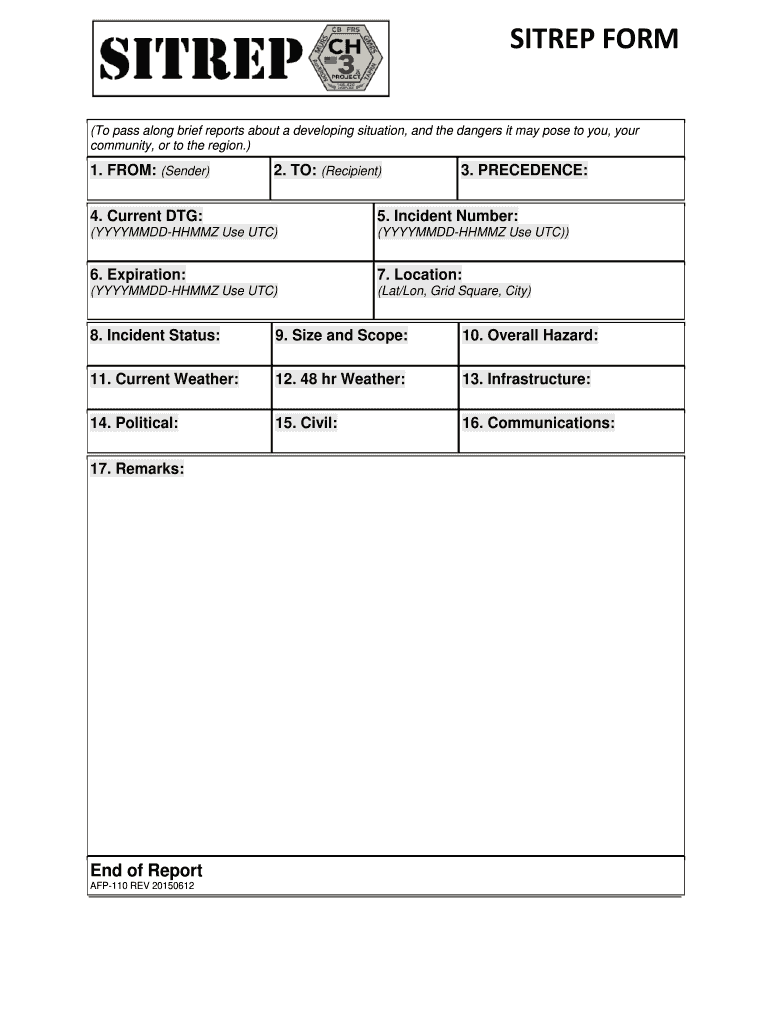
4. Current DTG: 5. Incident Number: (YYYYMMDD-HHMMZ Use UTC) (YYYYMMDD-HHMMZ Use UTC)) 6. Expiration: 7. Location: (YYYYMMDD-HHMMZ Use UTC) (Lat/Lon, Grid Square, City) 8. Incident Status: 9. Size and Scope: 10. Overall Hazard: 11. Current Weather: 12. 48 hr Weather: 13. Infrastructure: 14. Political: 15. Civil: 16. Communications: 17. Remarks: End of Report AFP-110 REV 20150612 INSTRUCTIONS: 1. FROM (Sender): 2. 3. 4. 5. 6. 7. 8. 9. 10. 11. 12. 13. 14. 15. 16. 17. Ent.
Loading

Open form follow the instructions

Easily sign the form with your finger

Send filled & signed form or save
How to fill out the AmRRON AFP-110 online
The AmRRON AFP-110 form is designed to facilitate the reporting of critical situations and their potential dangers to communities or regions. This comprehensive guide will help you understand each component of the form and how to fill it out effectively online.
Follow the steps to complete the form successfully.
- Press the ‘Get Form’ button to access the form and open it in the designated editor.
- In the 'FROM' field, enter your Ham Call Sign, AmRRON Call Sign, or another means of identification based on the transmission mode and FCC regulations.
- For the 'TO' field, input the intended recipient’s Ham Call Sign, AmRRON Call Sign, or other identification according to the transmission mode and FCC regulations.
- In the 'PRECEDENCE' section, select the appropriate message precedence: Routine, Priority, Immediate, or Flash.
- Fill in the 'Current DTG' by entering the date and time in the format YYYYMMDDHHMMZ, where 'Z' represents Zulu Time. If local time is used, indicate the time zone.
- In the 'Incident Number' field, enter the same information as in the 'Current DTG' if this is a new incident or provide the existing incident number for updates.
- For 'Expiration', input the date and time when you believe the message will no longer be useful for other stations.
- In the 'Location' section, provide the incident's location details clearly. Use latitude/longitude coordinates, grid square coordinates, cross-streets, or indicate 'see Remarks' if necessary.
- Indicate the 'Incident Status' as either New, Ongoing (if providing an update), or Resolved.
- Specify the 'Size and Scope' of the incident, indicating if it is Local, Regional, or National.
- For 'Overall Hazard', choose from the options Green, Yellow, or Red to describe the overall hazard status.
- Indicate 'Current Weather' status by selecting Green, Yellow, or Red.
- Provide the anticipated '48 hr Weather' status using Green, Yellow, or Red.
- In the 'Infrastructure' section, indicate the status with Green, Yellow, or Red, reflecting the availability of utilities and services.
- Select Green, Yellow, or Red for the 'Political' status based on the level of political stability.
- For 'Civil', indicate the status by using Green, Yellow, or Red, considering civil unrest or stability.
- Describe the 'Communications' status with Green, Yellow, or Red regarding communication capabilities.
- In the 'Remarks' section, include any additional relevant information, ensuring to cite your sources and remain factual.
- Once you have completed all sections of the form, you can save changes, download, print, or share the form as needed.
Complete your submission of the AmRRON AFP-110 form online to ensure timely communication of your observations.
Experience a faster way to fill out and sign forms on the web. Access the most extensive library of templates available.
Related content
by TF Greten · Cited by 75 — The GALAD score, which determines risk of HCC based on...
Aug 15, 2020 — AFP = Anti-Fingerprint | Anti Finger Print | Antihuellas. * auch als...
Use professional pre-built templates to fill in and sign documents online faster. Get access to thousands of forms.
If you believe that this page should be taken down, please follow our DMCA take down process here.