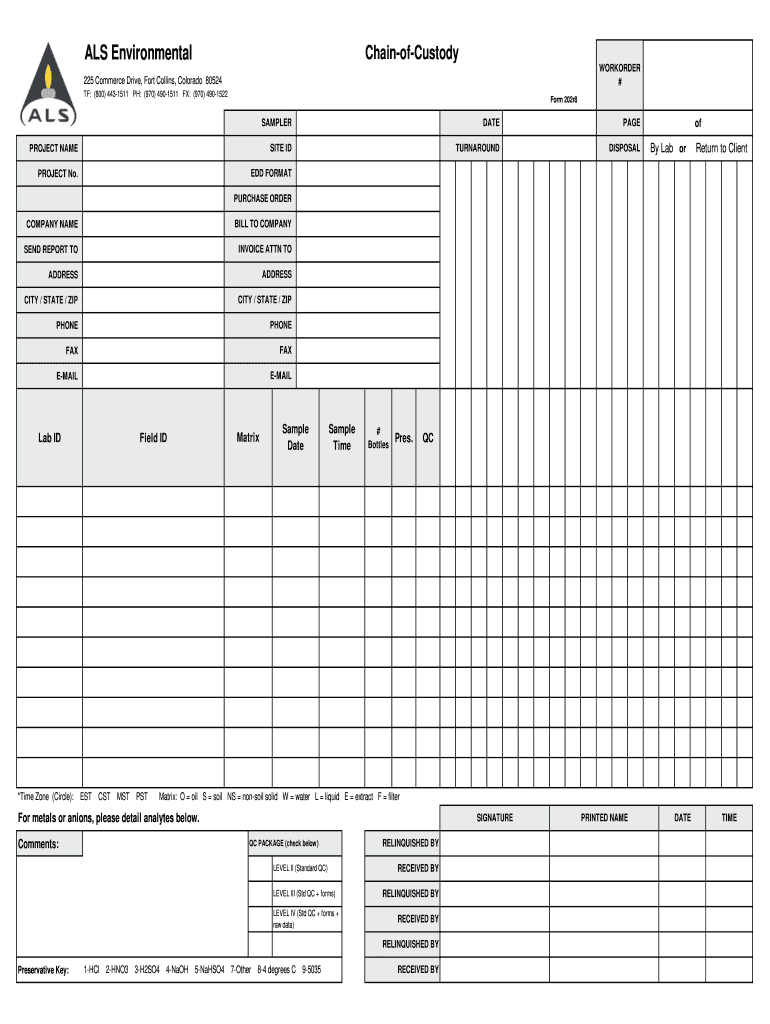
NAME SITE ID TURNAROUND DISPOSAL PROJECT No. EDD FORMAT of By Lab or Return to Client PURCHASE ORDER COMPANY NAME BILL TO COMPANY SEND REPORT TO INVOICE ATTN TO ADDRESS ADDRESS CITY / STATE / ZIP CITY / STATE / ZIP PHONE PHONE FAX FAX E-MAIL E-MAIL Lab ID *Time Zone (Circle): Matrix Field ID EST CST MST PST Sample Date Sample Time # Bottles Pres. QC Matrix: O = oil S = soil NS = non-soil solid W = water L = liquid E = extract F = filter For metals or anions, .
Loading

Open form follow the instructions

Easily sign the form with your finger

Send filled & signed form or save
How to fill out the ALS Environmental Chain-of-Custody online
Filling out the ALS Environmental Chain-of-Custody form is a crucial step in ensuring the integrity and traceability of samples. This guide provides clear, step-by-step instructions for users to effectively complete the form online.
Follow the steps to successfully complete the ALS Environmental Chain-of-Custody form.
- Click ‘Get Form’ button to obtain the form and open it in the editor.
- Begin by entering the Work Order number in the designated field at the top of the form. This number helps track your project throughout the testing process.
- Fill in the date of sample collection and the page number in the respective fields to maintain records accurately.
- Complete the project name and site ID fields. This information identifies the specific project and location associated with the samples being collected.
- Indicate the desired turnaround time for the sample analysis in the applicable section.
- List the project number and specify the electronic data deliverable format being requested.
- Provide the purchase order number and company name related to the analysis.
- Fill in billing company information, including the address, city, state, zip code, phone, fax, and email addresses for invoicing.
- Enter the lab ID in the appropriate field, and select the time zone affected by your project.
- Document the sample collection date and time. Ensure that these entries are accurate to avoid any discrepancies in the analysis.
- Specify the quantity of bottles used for sample collection and indicate the preservatives used according to the provided key.
- If required for metals or anions, detail the analytes being tested in the comments section.
- Gather all signatures as needed, including fields for both relinquished by and received by personnel.
- Finally, review all the completed information on the form. You can then save changes, download, print, or share the form as necessary.
Complete your documents online with confidence and ensure accurate sample tracking.
Experience a faster way to fill out and sign forms on the web. Access the most extensive library of templates available.
Related content
Relinquished By: (. ' Time/ Date. Received By: ,J. /. Time/ Date. CUSTODY SEALS: \.. NONE...
... [ALS Laboratories, Fort Collins, Colorado]. All soil samples were submitted...
Jun 5, 1997 — chain of custody. • initial and continuing calibration. • analyte...
Get answers to your most pressing questions about US Legal Forms API.
What is the chain of custody for labs?
The chain of custody for labs refers to the comprehensive procedure that maintains the integrity and security of samples during testing and analysis. It involves detailed record-keeping and accountability for every person who handles the samples. By utilizing ALS Environmental Chain-of-Custody procedures, laboratories can ensure accurate and trustworthy results, reinforcing the confidence in their findings.
How to fill out a coc form?
Filling out a COC form involves providing specific information about the samples, such as their origin, type, and the date they were collected. Additionally, all individuals who come into contact with the samples must sign and date the form. This process is vital for maintaining the reliability of results in accordance with ALS Environmental Chain-of-Custody practices.
What is the correct order for chain of custody?
The correct order for chain of custody entails documenting each individual who handles the samples, from collection to analysis. It typically begins with the sample collector, then moves to the laboratory personnel conducting the tests. Adhering to the ALS Environmental Chain-of-Custody structure guarantees that your samples maintain their authenticity throughout the process.
What are examples of chain of custody?
Examples of chain of custody include the documentation process for criminal evidence and environmental samples collected during fieldwork. Both scenarios require meticulous record-keeping to ensure reliable results. By employing the ALS Environmental Chain-of-Custody, you benefit from a proven framework that enhances data integrity and trustworthiness.
How to properly fill out a chain of custody form?
To properly fill out a chain of custody form, ensure that all required fields are completed accurately. This includes details about the samples, personnel, and transfer times. By following these guidelines, you align with ALS Environmental Chain-of-Custody protocols, which safeguard the authenticity of your samples.
How to fill a chain of custody form?
Filling a chain of custody form requires careful attention to detail. Begin by entering the sample information, including type, collection date, and time. Next, you should include signatures and dates from all individuals who handle the samples, ensuring compliance with ALS Environmental Chain-of-Custody standards.
What does ALS geochemistry do?
ALS geochemistry offers a wide range of laboratory services aimed at analyzing geological samples. Their expertise includes element analysis, contamination assessment, and environmental monitoring. By utilizing the ALS Environmental Chain-of-Custody, they ensure your samples undergo rigorous testing while maintaining complete traceability.
What is the chain of custody for samples?
The chain of custody for samples refers to the process that ensures samples remain in a secure and documented state from the moment of collection to analysis. This systematic tracking helps maintain integrity and traceability. With ALS Environmental Chain-of-Custody, you can trust that your samples are handled with the utmost care throughout the testing process.
What is the chain of custody in a lab sample?
The chain of custody in a lab sample is a comprehensive method designed to track and document the handling of samples throughout their lifecycle in the lab. It confirms that samples have not been tampered with and that they are analyzed under controlled conditions. The ALS Environmental Chain-of-Custody offers a reliable system that ensures your lab samples are handled with the utmost care and respect for legal standards.
What is the chain of custody for blood samples?
The chain of custody for blood samples is a critical procedure to ensure that samples remain uncontaminated and are correctly attributed to the source. Each step, from collection through analysis, must be documented and secure to avoid any legal issues. Utilizing the ALS Environmental Chain-of-Custody provides a robust framework for managing blood samples with integrity.
Use professional pre-built templates to fill in and sign documents online faster. Get access to thousands of forms.
If you believe that this page should be taken down, please follow our DMCA take down process here.