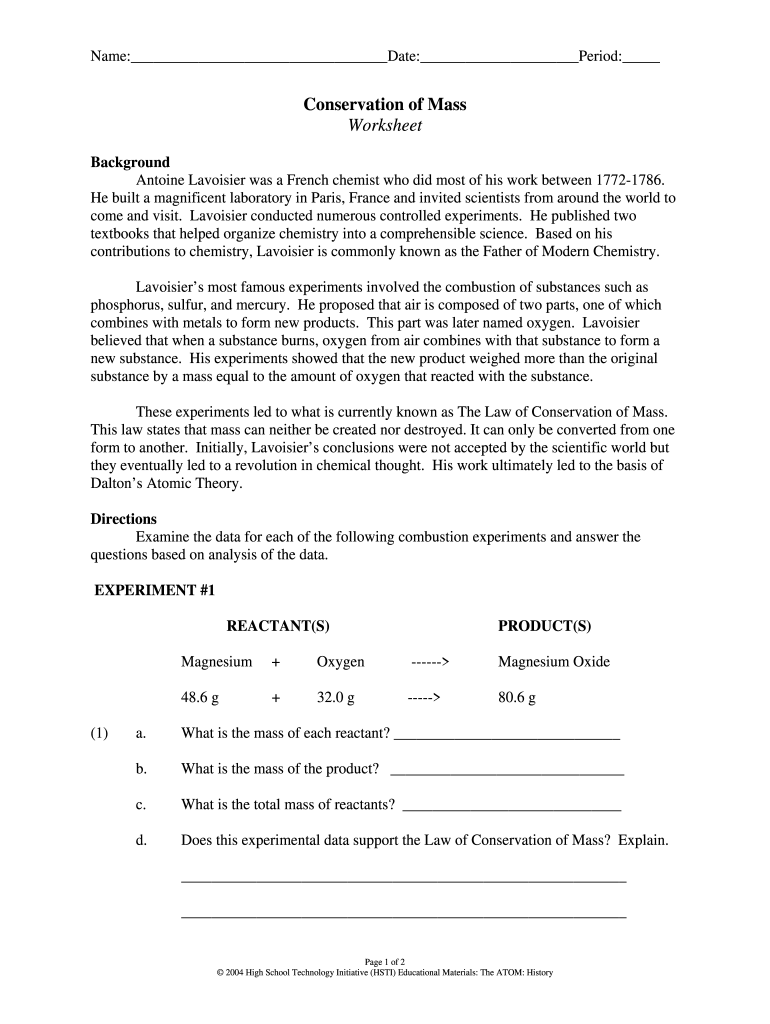
Name: Date: Period: Conservation of Mass Worksheet Background Antoine Lavoisier was a French chemist who did most of his work between 17721786. He built a magnificent laboratory in Paris, France and.

Open form follow the instructions

Easily sign the form with your finger

Send filled & signed form or save
How to fill out the Conservation Of Mass Worksheet online
The Conservation Of Mass Worksheet is an essential tool for understanding the fundamental principles of chemistry as demonstrated by Antoine Lavoisier. This guide will help users navigate the process of filling out this worksheet online with ease.
Follow the steps to complete the Conservation Of Mass Worksheet online.
- To begin, press the ‘Get Form’ button to access the Conservation Of Mass Worksheet and open it in your preferred online editor.
- In the first section, input your name, date, and period in the designated fields. Ensure that you provide accurate information as these details help in identifying your work.
- Next, review the background information provided about Antoine Lavoisier. This section may serve as context for the subsequent experiments and questions.
- Move to the experiments listed. For Experiment #1, record the mass of each reactant and product in the spaces provided. Be sure to use correct units of measurement when entering your data.
- For each experiment, answer the questions that follow. These include calculating total mass and evaluating whether the data supports the Law of Conservation of Mass. Take your time to think critically about each response.
- Continue filling in the worksheet for Experiments #2, #3, and #4, predicting values where indicated and providing explanations based on your analysis.
- Once you have completed all sections of the worksheet, review your responses for accuracy. You may need to make edits before finalizing your submission.
- Lastly, save your changes, and choose the option to download, print, or share the completed worksheet as necessary.
Complete your Conservation Of Mass Worksheet online today and deepen your understanding of chemical principles.
Experience a faster way to fill out and sign forms on the web. Access the most extensive library of templates available.
Related content
relationship of these changes to the Law of Conservation of Matter and. Energy. Key...
This law states that mass can neither be created nor destroyed. It can only be converted...
Aug 7, 2017 — Massachusetts Coastal Wetlands Regulations: A Practical Manual for...
Get answers to your most pressing questions about US Legal Forms API.
What is a real life example of conservation of mass?
ing to the law of conservation of mass, mass is neither created nor destroyed during a chemical reaction. For example, when coal is burned, the carbon atom in it changes into carbon dioxide. The carbon atom changes from a solid to a gas, yet its mass remains constant.
How to demonstrate conservation of mass?
The law of conservation of mass states that in a closed chemical reaction system, the total mass of all reactants will be equal to the total mass of all products. This means that 10g of reactant A react with 5 grams of reactant B, product AB will have a mass of 15g. Thus, mass is conserved.
What was an experiment to demonstrate the law of conservation of mass?
One of Lavoisier's experiments entailed placing a burning candle inside a sealed glass jar. As the wick burned down and the candle melted, the weight of the jar and its contents remained the same, thereby proving his pioneering theory.
How do you prove the law of conservation of mass?
The law of conservation of mass states that matter cannot be created or destroyed in a chemical reaction. For example, when wood burns, the mass of the soot, ashes, and gases equals the original mass of the charcoal and the oxygen when it first reacted. So the mass of the product equals the mass of the reactant.
How can the law of conservation of mass be demonstrated?
The law of conservation of mass states that in a chemical reaction mass is neither created nor destroyed. For example, the carbon atom in coal becomes carbon dioxide when it is burned. The carbon atom changes from a solid structure to a gas but its mass does not change.
Use professional pre-built templates to fill in and sign documents online faster. Get access to thousands of forms.
If you believe that this page should be taken down, please follow our DMCA take down process here.