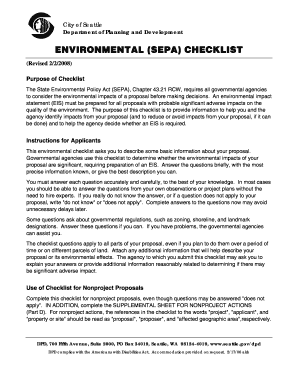
S all governmental agencies to consider the environmental impacts of a proposal before making decisions. An environmental impact statement (EIS) must be prepared for all proposals with probable significant adverse impacts on the quality of the environment. The purpose of this checklist is to provide information to help you and the agency identify impacts from your proposal (and to reduce or avoid impacts from your proposal, if it can be done) and to help the agency decide whether an EIS is requi.

How it works
  • Open form

    Open form follow the instructions

  • Easily sign form

    Easily sign the form with your finger

  • Share form

    Send filled & signed form or save

How to fill out the WA Environmental (SEPA) Checklist online

The WA Environmental (SEPA) Checklist is an essential document for assessing the environmental impacts of proposed projects. This guide provides clear, step-by-step instructions for filling out the checklist online, ensuring users can effectively contribute to the environmental review process.

Follow the steps to successfully complete the WA Environmental (SEPA) Checklist.

  1. Click ‘Get Form’ button to obtain the form and open it in the editor.
  2. In the 'Background' section, fill out the proposed project name, your name as the applicant, contact information, the date you prepare the checklist, the agency requesting the checklist, proposed schedule, and answer questions regarding future plans, environmental information, pending applications, required approvals, and provide a complete description of your proposal.
  3. In the 'Environmental Elements' section, address each environmental factor (earth, air, water, plants, animals, energy and natural resources, health, and transportation). Provide detailed descriptions as required, including information about soil, emissions, water bodies, vegetation types, wildlife, and any expected impacts on these elements.
  4. Complete the 'Housing', 'Aesthetics', and 'Light and Glare' sections by detailing the impact on housing units, aesthetics of structures, and potential light interference you might cause.
  5. In the 'Public Services' section, describe any increased need for public services due to your proposal and any measures you are planning to reduce these impacts.
  6. For the 'Utilities' section, circle the utilities available at the site and describe those proposed for the project, detailing the utility provider and any construction activities required.
  7. In the 'Signature' section, sign and date the form, affirming that all provided answers are true and complete to the best of your knowledge.
  8. Finally, review your completed checklist for accuracy, save your changes, and decide if you want to download, print, or share the form as needed.

Complete the necessary documents online to help streamline your environmental review process.

Get form

Experience a faster way to fill out and sign forms on the web. Access the most extensive library of templates available.

Related content

SEPA templates - Washington State Department of...

The list below provides some sample SEPA document templates that can be downloaded. Please...

Learn more
WAC 197-11-960 Environmental checklist.

WAC 197-11-960 Environmental checklist. ENVIRONMENTAL CHECKLIST. Purpose of checklist: The...

Learn more
Volunteer Stream Monitoring: A Methods Manual

by SH Walk · 1997 · Cited by 23 — Providing volunteers with a checklist of necessary...

Learn more
Questions & Answers

Get answers to your most pressing questions about US Legal Forms API.

Contact support

What does SEPA mean in Washington?

In Washington, SEPA stands for the State Environmental Policy Act, which serves as a framework for assessing environmental effects of proposed projects. This act emphasizes the importance of sustainable development and public involvement in decision-making. Understanding SEPA's role is crucial for developers, agencies, and the public alike, as it sets the groundwork for responsible environmental practices.

An environmental compliance checklist is a broader tool designed to ensure that projects adhere to environmental laws and regulations. This checklist goes beyond the SEPA process by including various aspects of compliance, such as permits and best management practices. Utilizing this checklist can provide peace of mind that all necessary steps are taken for environmental stewardship.

The purpose of the State Environmental Policy Act is to promote the protection of the environment by ensuring informed decision-making. It requires that potential environmental impacts are assessed before any action is taken. By following the guidelines outlined in the WA Environmental (SEPA) Checklist, users can contribute to responsible development practices in Washington.

The SEPA process involves several steps including the submission of a project proposal, completion of an environmental checklist, and conducting a thorough review. Agencies may also hold public comment periods to gather community feedback. This comprehensive process helps ensure that all potential impacts are considered before proceeding with a project.

SEPA is triggered when a government agency is involved in a proposal that might significantly affect the environment. Activities such as land development, construction projects, or changes in land use often initiate this review. Understanding what triggers SEPA is essential for anyone planning projects in Washington state, as it influences the regulatory process.

An environmental checklist is a tool used during the SEPA process to evaluate potential environmental impacts of a proposed project. This checklist helps project proponents and agencies identify relevant environmental considerations. Completing a WA Environmental (SEPA) Checklist is essential to facilitate a thorough review before any project can proceed.

SEPA approval refers to the review process mandated by the State Environmental Policy Act. This process ensures that any proposed project considers its environmental impacts before moving forward. In Washington, obtaining this approval is crucial as it signals that a project aligns with both state and local environmental standards.

Legally separated in Washington State means that couples have decided to live apart while still being legally married. This arrangement allows individuals to resolve issues like property division and support without dissolving the marriage. It's crucial to follow proper legal procedures, and resources such as the WA Environmental (SEPA) Checklist can guide you through the necessary forms and regulations involved in separation.

In Washington State, key causes of environmental damage include urban development, pollution from industrial activities, and inadequate land use practices. These factors lead to habitat destruction, water quality issues, and soil degradation. Addressing these challenges is essential, which is where the WA Environmental (SEPA) Checklist can be beneficial. This checklist helps ensure compliance with environmental regulations, promoting sustainable development.

The Single Euro Payments Area (SEPA) is a payment-integration initiative of the European Union for simplification of bank transfers denominated in euro.

Get This Form Now!

Use professional pre-built templates to fill in and sign documents online faster. Get access to thousands of forms.

If you believe that this page should be taken down, please follow our DMCA take down process here.

Get WA Environmental (SEPA) Checklist