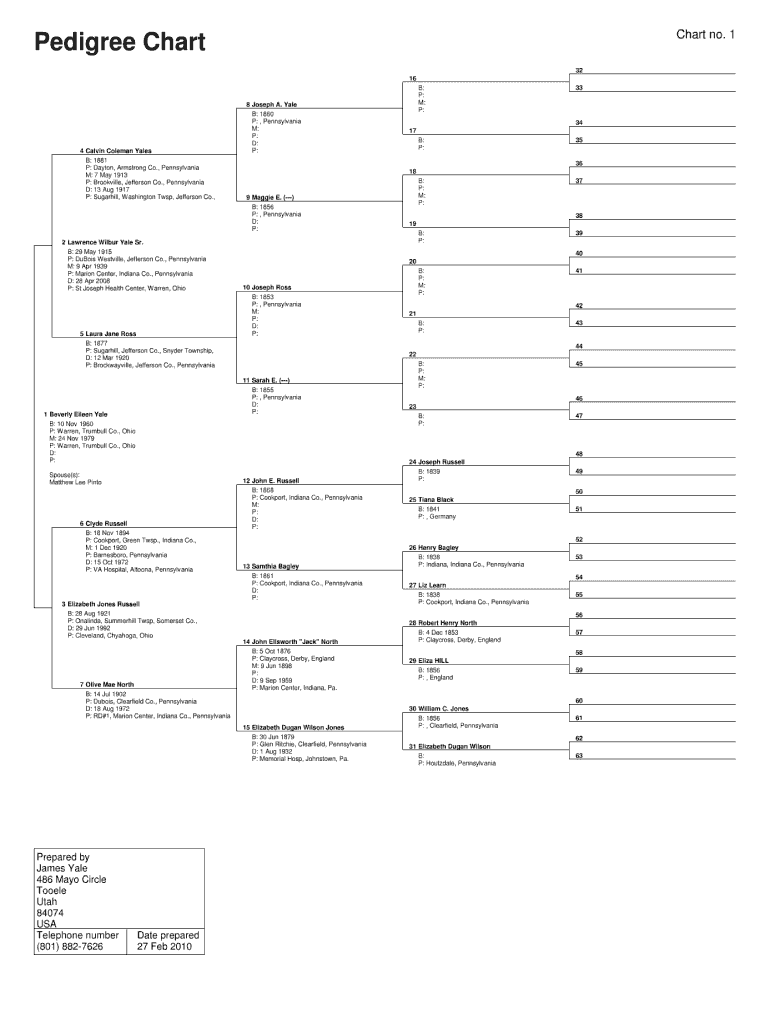
Pedigree Chart 32 16 B: P: M: P: 17 B: P: 35 33 8 Joseph A. Yale B: 1860 P: , Pennsylvania M: P: D: P: Chart no. 1 34 4 Calvin Coleman Yales B: 1881 P: Dayton, Armstrong Co., Pennsylvania M: 7 May.

Open form follow the instructions

Easily sign the form with your finger

Send filled & signed form or save
How to fill out the UT Pedigree Chart online
Filling out the UT Pedigree Chart online can help you organize important genealogical information effectively. This guide provides clear and detailed instructions to help you navigate each section of the form with ease.
Follow the steps to successfully complete the UT Pedigree Chart.
- Click the ‘Get Form’ button to access the UT Pedigree Chart and open it for editing.
- Begin with the top section of the form where you will provide your own details. Enter your full name, date of birth, and any identifiers requested. Ensure your information is accurate.
- Proceed to the 'Parents' section. Enter the information for each parent, including their full names, dates of birth, and any relevant details. Use 'partner' to refer to any co-parent as applicable.
- Fill out the 'Grandparents' section next. Record all available information such as names and birth dates. This will help in creating a more comprehensive family tree.
- Continue down the chart, documenting the details for each generation. Provide accurate information for siblings, aunts, uncles, and cousins where possible.
- Review all the details you have entered for accuracy, ensuring all names are spelled correctly and all necessary fields are completed.
- After verifying the information, save the changes made to the form. You can choose to download, print, or share the completed UT Pedigree Chart online as needed.
Start filling out your UT Pedigree Chart online today to preserve your family's history.
Experience a faster way to fill out and sign forms on the web. Access the most extensive library of templates available.
Related content
by M Velinder · 2020 · Cited by 3 — Pedigree files are ubiquitously used within...
To learn more about the candidate gene approach, visit Discovering Addiction Genes Using...
Recent advances in physical technology have signiticanrly impmved the capabilities of...
Get answers to your most pressing questions about US Legal Forms API.
How do you read a pedigree chart?
Reading a pedigree chart involves recognizing symbols, understanding relationships, and tracing lines across generations. Start by identifying the shapes that indicate gender and then look for connections between individuals. A UT Pedigree Chart simplifies this process, providing a clear visual representation of family relationships and inherited traits that anyone, regardless of experience, can understand.
What is the pedigree for hemophilia?
Hemophilia is typically portrayed on a pedigree chart using specific symbols to highlight affected individuals across generations. In a UT Pedigree Chart, males are often more prominently affected, as the trait is linked to the X chromosome, showcasing the inheritance pattern clearly. Understanding this pedigree structure helps families comprehend the risks and occurrences of hemophilia in their lineage.
What do the signs mean on a pedigree?
Signs on a pedigree chart carry important meanings related to genetic conditions and family relationships. For example, different shapes, lines, and colors help identify whether individuals are affected by a particular trait or condition. By using a UT Pedigree Chart, you can gain a comprehensive understanding of these signs and their implications for your family lineage.
What is the best chart for genealogy?
The best chart for genealogy often depends on your specific needs and the depth of your family history. However, many people find that a UT Pedigree Chart serves as an excellent tool for visualizing ancestral lines. This format allows easy tracking of lineage, relationships, and any genetic traits, making it a valuable asset in genealogical research.
What do the symbols on a pedigree chart mean?
Each symbol on a pedigree chart conveys specific information about an individual's gender and status. For instance, filled shapes indicate affected individuals, while empty shapes represent unaffected ones. Furthermore, dual symbols can illustrate carriers of certain traits. To effectively analyze this data, referencing a UT Pedigree Chart can provide clarity and structure.
What are the symbols used in human pedigree analysis?
In human pedigree analysis, various symbols represent different individuals and their relationships. Circles typically signify females, while squares indicate males. A horizontal line connecting a circle and square shows a mating pair, and vertical lines extend to represent their offspring. Understanding these symbols is crucial when interpreting a UT Pedigree Chart.
How to solve a pedigree chart?
To solve a UT Pedigree Chart, begin by examining the relationships and connections between family members. Identify patterns in inheritance and traits by tracking symbols used for affected individuals. You may also consider using tools like uslegalforms that provide templates and guidance for solving complex pedigree problems. This approach gives clarity and aids in understanding genetic connections.
How do you fill in a pedigree chart?
Filling in a UT Pedigree Chart involves noting essential information for each family member. Start by recording names, birth dates, and relevant health information. Use different symbols to denote males and females, as well as filled shapes to identify individuals with specific traits. This practice creates a detailed chart that can help analyze genetic patterns.
How to draw a pedigree chart step by step?
To draw a UT Pedigree Chart step by step, begin with a blank page. Place the subject individual at the bottom of your chart, then draw connecting lines for each generational level. Next, add parents directly above, grandparents above them, and keep going as needed. By following this clear structure, you will create an organized representation of ancestry and familial connections.
How do you fill out a pedigree chart?
To fill out a UT Pedigree Chart, start by entering the base information. Begin with the individual’s name at the bottom, then add parents' names above, connecting them with a line. As you continue up the chart, include grandparents, great-grandparents, and so on. Ensure each family member is represented clearly to create a comprehensive visual of relationships.
Use professional pre-built templates to fill in and sign documents online faster. Get access to thousands of forms.
If you believe that this page should be taken down, please follow our DMCA take down process here.