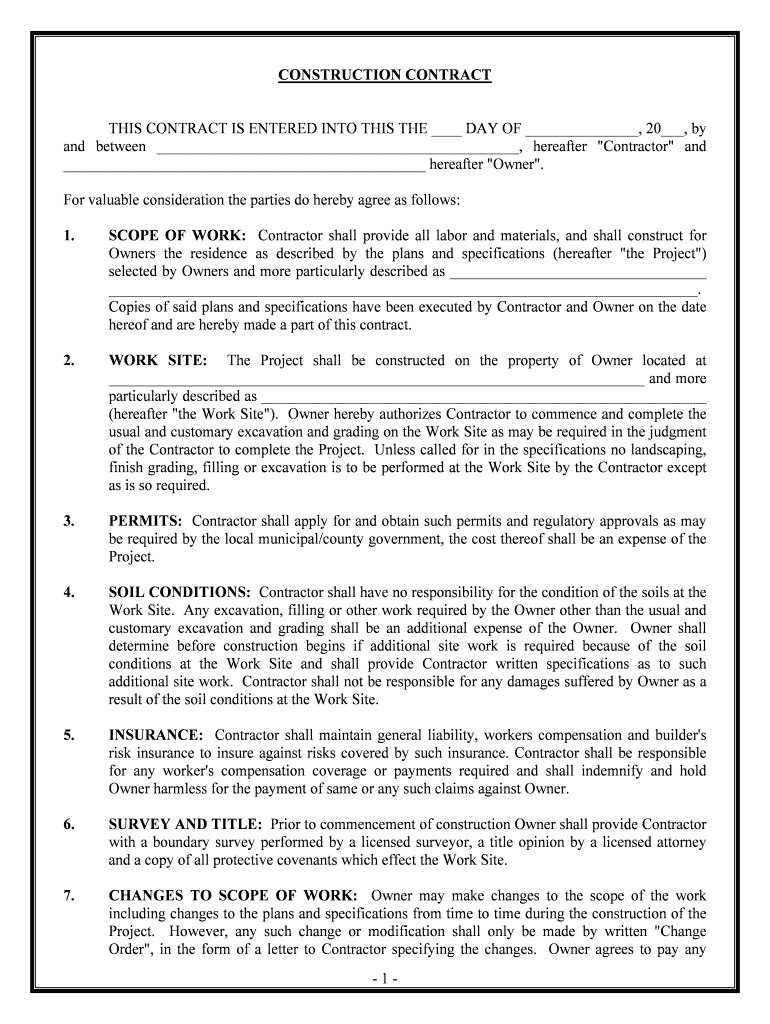
CONSTRUCTION CONTRACT THIS CONTRACT IS ENTERED INTO THIS THE DAY OF , 20 , by and between , hereafter "Contractor " and hereafter "Owner ". For valuable consideration the parties.
Loading

Open form follow the instructions

Easily sign the form with your finger

Send filled & signed form or save
How to fill out the Lump Sum Contract online
Filling out a Lump Sum Contract online can streamline your construction project by clearly defining the obligations between the contractor and the owner. This guide will walk you through the essential components of the contract, ensuring you provide accurate and complete information.
Follow the steps to successfully complete the Lump Sum Contract online.
- Click the ‘Get Form’ button to obtain the Lump Sum Contract form and open it in your preferred editing tool.
- In the first section, enter the date on which the contract is being executed. Fill in the appropriate day, month, and year.
- Next, input the names of both parties involved in the contract: the Contractor and the Owner. Ensure that the names are spelled correctly for legal validity.
- In the Scope of Work section, provide a detailed description of the project. Include specific plans and specifications decided upon by the Owner.
- For the Work Site section, fill in the full address where the project will be constructed, making sure to specify any additional details as necessary.
- Move on to the Permits section, indicating that the Contractor is responsible for obtaining necessary local permits, which will be covered as part of project expenses.
- In the Soil Conditions section, acknowledge that the Contractor does not bear responsibility for existing site conditions and clarify any additional work needed.
- Add the necessary insurance details, ensuring that the Contractor will maintain adequate coverage.
- For Changes to Scope of Work, indicate that any modifications must be authorized in writing, and define how such changes will affect project costs.
- Specify the Contractor's fee in the appropriate section, whether it is cost-plus or fixed fee, clearly detailing payment methods.
- Outline the late payment/default penalties, stating any applicable charges and potential costs associated with collections.
- Finally, in the Warranty section, detail the warranty limitations on workmanship and materials, ensuring that it adheres to the stipulated timeframe.
- Once all sections have been filled out, save your changes, and download, print, or share the completed Lump Sum Contract as needed.
Complete your Lump Sum Contract online today for a smoother construction experience!
Experience a faster way to fill out and sign forms on the web. Access the most extensive library of templates available.
Related content
Contractor Responsible for Expenditures in Excess of Contract Sum ... the construction and...
A lump sum bid represents the total price for which a contractor offers to complete a...
Lump sum turnkey (LSTK) is a combination of the business-contract concepts of lump sum and...
Get answers to your most pressing questions about US Legal Forms API.
What is in fixed price or lump sum contracts?
The term firm fixed price or lump sum contract refers specifically to a type or variety of fixed price contract where the buyer or purchaser pays the seller or provider a fixed total amount for a very well-defined product, however there is the allowance within these for a variance in the event there are incentives ...
What does lump sum contract include?
A lump or stipulated sum is simply a single amount of money for completing the entire scope of work outlined in a construction contract. This sum includes the cost of work, any general condition costs, and the contractor's fee. Payment is tied directly to the percentage of work completed.
What are the 3 types of contracts?
The three most common contract types include: Fixed-price contracts. Cost-plus contracts. Time and materials contracts.
What is the difference between unit price and lump sum contract?
A unit price contract, also known as a measurement or remeasurement contract, bases project costs on the number of units necessary for completion. Costs are accrued incrementally as the project progresses. A lump sum contract, also known as a stipulated sum, reflects a total fixed fee for an entire project.
What is included in a fixed-price contract?
A fixed-price contract is a contractual agreement with a predetermined value for the goods or services provided. A fixed-price contract sets the terms of a project and establishes the price of goods or services. It outlines exactly what the seller is required to do and the seller's obligations for a firm price.
What is the risk of lump sum contract?
Disadvantages of Lump Sum Construction Contract Lump sum contracts pose greater risk to contractor. Quantifying changes is a big challenge. Such contracts demand documentation and record keeping of change orders at all stages that further requires more paperwork. Rejection of change order requested by the employer.
What are the disadvantages of a lump sum contract?
Disadvantages of a Lump Sum Construction Contract A lump sum agreement presents a higher risk to a contractor. Measuring the number of changes is difficult. Such contracts require paperwork and records of change orders from each phase, and this means further documentation is needed.
Use professional pre-built templates to fill in and sign documents online faster. Get access to thousands of forms.
If you believe that this page should be taken down, please follow our DMCA take down process here.