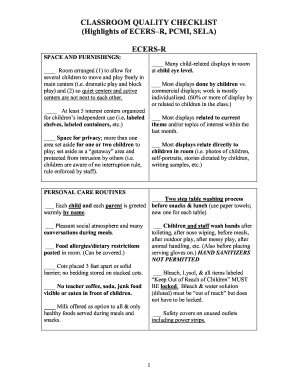
play and block play) and (2) so quiet centers and active centers are not next to each other. ____ At least 5 interest centers organized for children’s independent use (i.e. labeled shelves, labeled containers, etc.) ____ Space for privacy; more than one area set aside for one or two children to play; set aside as a “getaway” area and protected from intrusion by others (i.e. children are aware of no interruption rule, rule enforced by staff). ____ Many child-related displays in room at ch.
Open form follow the instructions
Easily sign the form with your finger
Send filled & signed form or save
How to fill out the NJ Classroom Quality Checklist online
The NJ Classroom Quality Checklist is a vital tool designed to assess the quality of classroom environments in early childhood education settings. This guide provides step-by-step instructions for accurately completing the checklist, ensuring a thorough evaluation of key components.
Follow the steps to effectively complete the NJ Classroom Quality Checklist online.
- Click the 'Get Form' button to obtain the NJ Classroom Quality Checklist and open it in your preferred digital editor.
- Review the checklist components carefully. The checklist includes sections on space and furnishings, personal care routines, language and reasoning, and various activities to ensure all areas are covered.
- Begin with the first section, 'Space and furnishings'. For each item listed, mark whether the criteria are met by checking the appropriate box. Provide specific examples where applicable, such as the arrangement of interest centers or the presence of displays created by children.
- Move on to 'Personal care routines'. As you fill this section out, note how children and staff interact during meals or the organization of health and safety materials. It's important to ensure all items reflect the practices in place.
- Continue to 'Language and reasoning'. Indicate the availability of books, communication activities, and instances where staff extend children’s learning through conversation. Ensure that the checklist accurately represents the environment.
- Fill out each section regarding 'Activities' meticulously, including art and music, blocks, dramatic play, science and nature, math and number, and diversity. Make sure to account for all materials and activities that promote learning and developmental concepts.
- After completing all sections, review your entries for accuracy and completeness. Ensure that you have provided specific details or notes where relevant, as this will enhance the quality of your observations.
- Finally, save your changes. Depending on your needs, you can download, print, or share the completed checklist with relevant stakeholders.
Complete the NJ Classroom Quality Checklist online today to enhance the quality of your educational environment.
Experience a faster way to fill out and sign forms on the web. Access the most extensive library of templates available.
Related content
The purpose of this document is to provide primary educators and administrators with a...
This checklist will serve as notification to Grow NJ Kids Rating of your readiness to...
This guide provides brief explanations of the critical factors affecting the Music Suite...
Get answers to your most pressing questions about US Legal Forms API.
What is the purpose of a checklist in education?
The purpose of a checklist in education is to enhance organization, accountability, and efficient management of tasks. It provides both teachers and students with a clear framework for what needs to be accomplished, improving focus and productivity. With tools like the NJ Classroom Quality Checklist, educators can monitor progress and foster a structured learning environment. This method ultimately supports academic success for all students.
How many students can be in a classroom in NJ?
In New Jersey, the number of students allowed in a classroom can vary based on specific regulations set by the state and school district. Generally, the ideal class size for optimal learning experiences is between 20 to 25 students. However, using the NJ Classroom Quality Checklist can illustrate how to manage classrooms effectively, regardless of size. This checklist helps teachers adapt their approaches to meet diverse needs.
What is a checklist in the classroom?
A checklist in the classroom is a methodical tool that outlines tasks, supplies, or objectives needed for a successful learning experience. It can range from preparation tasks for the teacher to personal organization tools for students. Implementing the NJ Classroom Quality Checklist can streamline operations and ensure that everyone knows their responsibilities. This clarity helps create a conducive learning environment.
What is an example of a checklist?
An example of a checklist is a daily to-do list that includes tasks such as preparing lesson plans, organizing classroom materials, and planning engaging activities for students. The NJ Classroom Quality Checklist serves as an excellent model for educators to use. It covers various aspects of classroom management and instructional delivery. By following such a checklist, teachers can enhance their effectiveness and improve student outcomes.
What is the purpose of a student checklist?
The purpose of a student checklist is to help students stay organized and focused on their assignments and responsibilities. It enables them to track their progress, ensuring they complete tasks on time. The NJ Classroom Quality Checklist can also serve as a guide for teachers to create student checklists that align with classroom goals. Using these tools together fosters a structured and supportive learning atmosphere.
What is a classroom checklist?
A classroom checklist is a comprehensive tool designed to help teachers ensure all essential tasks are completed before, during, and after the school year. It typically includes items related to classroom setup, supplies, and instructional materials. By utilizing the NJ Classroom Quality Checklist, educators can systematically evaluate their classroom's readiness and make necessary adjustments. This checklist can promote efficiency and enhance the learning environment.
How would you get your classroom ready for the first day of school?
To prepare your classroom for the first day of school, start by using the NJ Classroom Quality Checklist. This will help you organize materials, set up your seating arrangements, and ensure that all supplies are ready for students. Additionally, consider creating a welcoming environment with clear labels and decorations that reflect your classroom's theme. A well-prepared classroom sets a positive tone for the school year.
How do you use a checklist in education?
Using a checklist in education involves a systematic approach to evaluate teaching practices, classroom setup, and student interactions. Educators can refer to the NJ Classroom Quality Checklist to ensure they meet established standards and continually improve their teaching methods. This proactive strategy fosters an environment conducive to learning and development.
What is the maximum number of students in a classroom?
The maximum number of students in a classroom in New Jersey varies, but for many grade levels, it is capped at around 25 students. Maintaining lower class sizes is crucial for effective teaching and personalized student interactions. When using the NJ Classroom Quality Checklist, schools can effectively monitor and enforce these limits.
How many students are allowed in a classroom in NJ?
The maximum number of students allowed in a classroom in New Jersey typically aligns with state regulations, often ranging from 15 to 25 students depending on the educational level. This limit is in place to foster a better learning environment. Using the NJ Classroom Quality Checklist enables schools to assess their capacities and ensure quality education delivery.
Use professional pre-built templates to fill in and sign documents online faster. Get access to thousands of forms.
If you believe that this page should be taken down, please follow our DMCA take down process here.