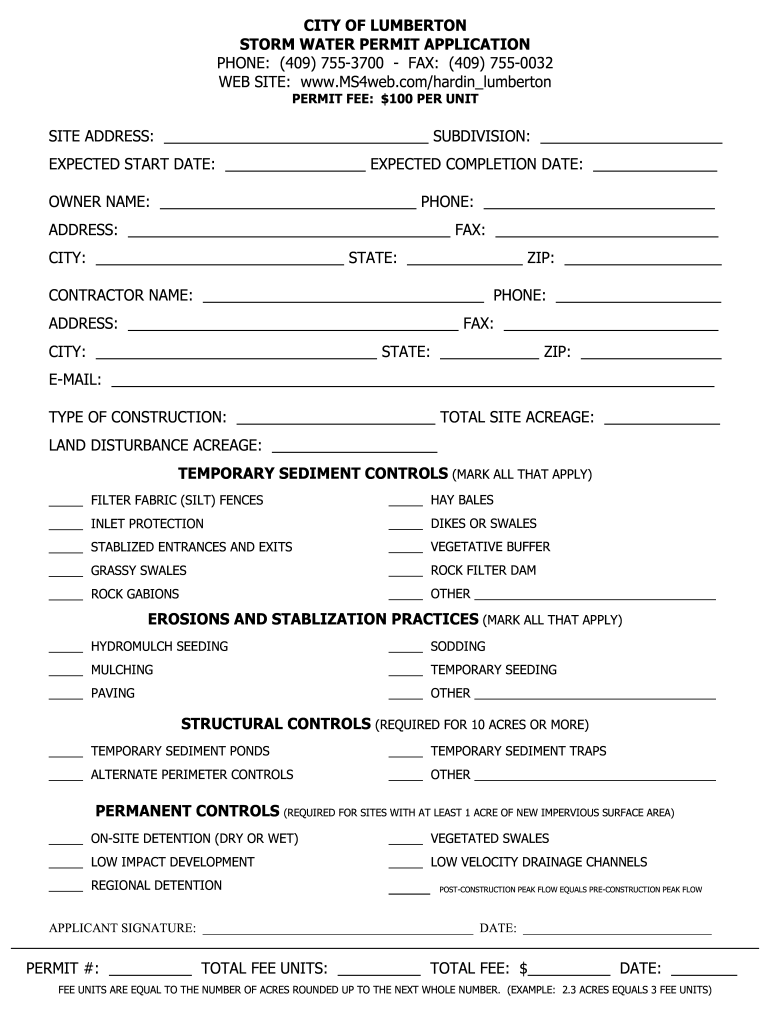
____________ SUBDIVISION: ______________________ EXPECTED START DATE: _________________ EXPECTED COMPLETION DATE: _______________ OWNER NAME: _______________________________ PHONE: ____________________________ ADDRESS: _______________________________________ FAX: ___________________________ CITY: ______________________________ STATE: ______________ ZIP: ___________________ CONTRACTOR NAME: __________________________________ PHONE: ____________________ ADDRESS: ___________________________________.
Loading

Open form follow the instructions

Easily sign the form with your finger

Send filled & signed form or save
How to fill out the NC Storm Water Permit Application online
The NC Storm Water Permit Application is an essential document for managing stormwater during construction projects. This guide provides comprehensive instructions on how to complete the application correctly and efficiently, ensuring compliance with local regulations.
Follow the steps to fill out the application accurately.
- Press the ‘Get Form’ button to access the application and open it in the designated editor.
- Enter the site address and subdivision name where the construction will take place.
- Fill in the expected start and completion dates of the project.
- Provide the owner's name, phone number, address, fax number, city, state, and ZIP code.
- Complete the contractor's information, including their name, phone number, address, fax number, city, state, and ZIP code.
- Enter the contractor's email address.
- Specify the type of construction and indicate the total site acreage.
- Indicate the land disturbance acreage.
- Select applicable temporary sediment controls by marking the options that apply.
- Choose and mark the erosion and stabilization practices that will be used.
- For sites with 10 acres or more, indicate structural controls as required.
- For sites with at least 1 acre of new impervious surface area, select applicable permanent controls.
- Provide the applicant's signature along with the date.
- Fill in the permit number, total fee units, and total fee amount.
- Calculate the fee units by rounding the number of acres up to the next whole number.
- Once all required fields are completed, save changes, download, print, or share the application as necessary.
Complete your NC Storm Water Permit Application online today for a smooth permitting process.
Experience a faster way to fill out and sign forms on the web. Access the most extensive library of templates available.
Related content
New NCG01 Permit Application System! DEQ launched a new NCG01 Construction Stormwater...
The permit requires the implementation of the Stormwater Management Plan. The purpose...
Jul 5, 2018 — (2) Storm water permit number NCG060079 issued by the North Carolina...
Get answers to your most pressing questions about US Legal Forms API.
Who regulates stormwater in North Carolina?
In North Carolina, the Department of Environmental Quality (DEQ) regulates stormwater through the Division of Water Resources. They set rules and guidelines for managing stormwater discharges to protect water quality. By utilizing the NC Storm Water Permit Application, you can request guidance from DEQ, ensuring that your project complies with state laws and contributes positively to the environment.
Who issues most of the stormwater permits in the US?
Most stormwater permits in the US are issued by state environmental agencies. These agencies analyze permit applications based on local needs and standards, ensuring that projects meet essential water quality goals. When you apply for an NC Storm Water Permit Application, you are engaging with these agencies to align your project with legal requirements.
Which agency in Virginia is responsible for construction stormwater permitting and compliance?
In Virginia, the Department of Environmental Quality (DEQ) oversees stormwater permitting for construction projects. They ensure that projects comply with state and federal regulations concerning stormwater management. If you’re working on a project near North Carolina, be aware that both states have stringent requirements similar to those in the NC Storm Water Permit Application process.
How is stormwater regulated in the US?
In the US, stormwater is regulated through a combination of federal, state, and local laws. The Clean Water Act serves as the main framework, while individual states establish specific programs to handle their unique challenges. Understanding how stormwater management works is crucial when completing an NC Storm Water Permit Application, as compliance with these regulations helps protect our water resources.
What is a stormwater permit in NC?
A stormwater permit in NC is a legal authorization required for managing runoff from construction sites and other developments. This permit ensures that stormwater is handled properly to prevent pollution of local water systems. By applying for an NC Storm Water Permit Application, developers and landowners can demonstrate their commitment to responsible environmental practices.
What are the laws for water runoff in North Carolina?
North Carolina has specific laws addressing water runoff to maintain water quality and protect natural resources. These laws require developers to obtain permits, such as the NC Storm Water Permit Application, to ensure compliance with local and state regulations. Additionally, the state encourages the use of best management practices to minimize runoff and enhance water quality. Understanding these laws is vital for responsible property development.
What is the authority in the US that controls the regulation and reduction of stormwater?
At the federal level, the Environmental Protection Agency (EPA) oversees the regulation and reduction of stormwater as part of its enforcement of the Clean Water Act. The EPA provides guidelines and frameworks for states to develop their stormwater management programs. In North Carolina, the NCDEQ implements these federal regulations, making the NC Storm Water Permit Application essential for project developers.
Who is responsible for managing potential issues created by stormwater?
Local governments and developers share the responsibility for managing stormwater issues in North Carolina. They must implement best practices to reduce runoff and protect water quality. Additionally, property owners must comply with regulations set forth in their NC Storm Water Permit Application. By working together, stakeholders can effectively address potential stormwater challenges.
Who regulates water in NC?
In North Carolina, water regulation falls under the authority of the North Carolina Department of Environmental Quality (NCDEQ). This state agency oversees water quality and enforces compliance with various environmental regulations. To ensure proper management, the NCDEQ works closely with local governments and communities. For tasks involving the NC Storm Water Permit Application, consulting the NCDEQ is essential.
What is the NC DEQ common plan of development?
The NC DEQ common plan of development refers to a set of guidelines that streamline the permitting process for projects that disturb land. This plan encourages developers to consider stormwater management comprehensively. Engaging with the NC DEQ common plan can simplify your NC Storm Water Permit Application, enabling you to comply with state regulations while effectively managing stormwater.
Use professional pre-built templates to fill in and sign documents online faster. Get access to thousands of forms.
If you believe that this page should be taken down, please follow our DMCA take down process here.