Loading
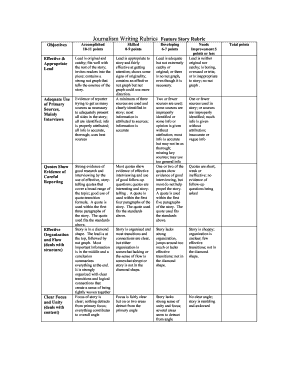
Get Journalism Writing Rubrics Feature Story Rubric
How it works
-

Open form follow the instructions
-

Easily sign the form with your finger
-

Send filled & signed form or save
How to fill out the Journalism Writing Rubrics Feature Story Rubric online
The Journalism Writing Rubrics Feature Story Rubric is an essential tool designed to help users assess their feature stories effectively. This guide provides clear, step-by-step instructions on how to complete the rubric online, ensuring that you can accurately evaluate and improve your writing skills.
Follow the steps to fill out the rubric with clarity and confidence.
- Press the ‘Get Form’ button to access the Journalism Writing Rubrics Feature Story Rubric and open it for online completion.
- Begin by entering all relevant information in the designated fields at the top of the form. This may include your name, date, and the title of the story being evaluated.
- Move to the first evaluation section, 'Effective & Appropriate Lead.' Here, assess your lead by selecting the appropriate score based on how original, catchy, and effective it is according to the provided descriptions.
- Continue to the next section, 'Adequate Use of Primary Sources, Mainly Interviews.' Fill in the score reflecting the number and quality of sources used in your story.
- Proceed to the 'Quotes Show Evidence of Careful Reporting' section. Evaluate and assign a score based on the effectiveness and relevance of quotes utilized in your story.
- Next, assess the overall organization and flow of your piece in the 'Effective Organization and Flow' section. Select the score that best represents how well-structured your story is.
- Evaluate the clarity of focus and unity in your writing under 'Clear Focus and Unity.' Choose a score based on the extent to which your story maintains a clear angle.
- In the following sections, review the 'Interesting & Effective Writing Style,' 'Grammar and Spelling,' and 'Paragraphing' components. Assign scores according to how well your writing aligns with the rubric's criteria.
- Once you have completed all sections, ensure that all scores reflect your evaluations accurately.
- Finally, you can save your changes, download the completed form, print it for your records, or share it with others who may find it useful.
Get started on refining your journalism skills by completing the Journalism Writing Rubrics Feature Story Rubric online.
How to Create a Rubric in 6 Steps Step 1: Define Your Goal. ... Step 2: Choose a Rubric Type. ... Step 3: Determine Your Criteria. ... Step 4: Create Your Performance Levels. ... Step 5: Write Descriptors for Each Level of Your Rubric.