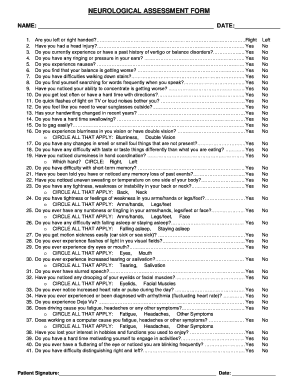
NEUROLOGICAL ASSESSMENT FORM NAME: DATE: 1. 2. 3. 4. 5. 6. 7. 8. 9. 10. 11. 12. 13. 14. 15. 16. 17. 18. 19. 20. 21. 22. 23. 24. 25. 26. 27. 28. 29. 30. 31. 32. 33. 34. 35. 36. 37. 38. 39. 40. 41.
Loading
Open form follow the instructions
Easily sign the form with your finger
Send filled & signed form or save
How to fill out the neurological assessment form - 5028271 - 50 28 27 online
This guide provides comprehensive instructions on how to accurately fill out the neurological assessment form online. Understanding each section ensures you provide the necessary information for a thorough evaluation.
Follow the steps to successfully complete the form.
- Press the ‘Get Form’ button to access the form and open it in your preferred editor.
- Begin filling out the personal information section by entering your name and the current date in the appropriate fields.
- Answer the questions regarding your handedness by indicating if you are left or right-handed.
- Respond to the questions regarding your medical history, such as head injuries and any existing or past conditions related to balance, vertigo, or neurological symptoms.
- Continue working through the assessment by honestly answering the list of questions that inquire about various symptoms, including vision problems, memory issues, and physical sensations.
- For questions that ask you to circle specific options (e.g., side of symptoms), be sure to accurately reflect your experiences.
- Conclude the form by providing your signature and the date. This confirmation is essential for the authenticity of your submission.
- Once all fields are completed, you can save your changes, download or print the form for your records, or share it as needed.
Complete your neurological assessment form online today to ensure an accurate and timely evaluation.
Experience a faster way to fill out and sign forms on the web. Access the most extensive library of templates available.
Related content
by KA Phillips · 2018 · Cited by 3 — The largest market is for tests that sequence >50...
Get answers to your most pressing questions about US Legal Forms API.
How do you document a neurological assessment?
Documentation of a basic, normal neuro exam should look something along the lines of the following: The patient is alert and oriented to person, place, and time with normal speech. No motor deficits are noted, with muscle strength 5/5 bilaterally. Sensation is intact bilaterally.
What are the 5 major components of a neurological examination?
The neurologic examination is typically divided into eight components: mental status; skull, spine and meninges; cranial nerves; motor examination; sensory examination; coordination; reflexes; and gait and station. The mental status is an extremely important part of the neurologic examination that is often overlooked.
What are the 7 areas of documentation of the neurological exam?
What is done during a neurological exam? Mental status. ... Motor function and balance. ... Sensory exam. ... Newborn and infant reflexes. ... Reflexes in the older child and adult. ... Evaluation of the nerves of the brain. ... Coordination exam:
What are the 5 neurological tests?
The neurological examination is divided into five parts: mental status, cranial nerves, motor function, sensory function, and reflexes. In the mental status exam, you are asked questions designed to assess your level of alertness, orientation, mood, and cognition.
What are the 3 components of a basic neurological assessment?
Components of a Neurological Examination Mental Status. This is usually assessed through observation and interaction during routine health questions that are asked. ... Motor Function. The physician may evaluate muscle tone and strength. ... Balance. ... Coordination. ... Sensation. ... Reflexes. ... Results.
What materials are used in a neurological assessment?
For a comprehensive neurological exam, additional supplies may be needed: Snellen chart; tongue depressor; cotton wisp or applicator; and percussion hammer; objects to touch, such as coins or paper clips; substances to smell, such as vanilla, mint, or coffee; and substances to taste such as sugar, salt, or lemon.
What is included in a neurological assessment?
A complete neurologic examination should contain an assessment of sensorium, cognition, cranial nerves, motor, sensory, cerebellar, gait, reflexes, meningeal irritation, and long tract signs. Specific scales are useful to improve interobserver variability.
Use professional pre-built templates to fill in and sign documents online faster. Get access to thousands of forms.
If you believe that this page should be taken down, please follow our DMCA take down process here.