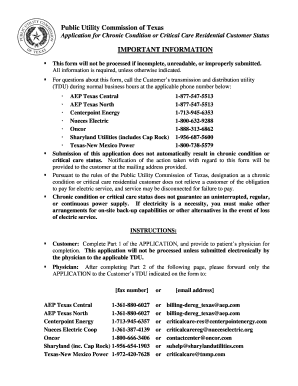
Public Utility Commission of Texas Application for Chronic Condition or Critical Care Residential Customer Status IMPORTANT INFORMATION This form will not be processed if incomplete, unreadable, or.

How it works
  • Open form

    Open form follow the instructions

  • Easily sign form

    Easily sign the form with your finger

  • Share form

    Send filled & signed form or save

How to fill out the Application For Chronic Condition Or Critical Care Residential Customer Status online

Completing the Application For Chronic Condition Or Critical Care Residential Customer Status is an essential step for individuals who require specific protections regarding their electric service. This guide provides clear, step-by-step instructions for filling out the application online, ensuring that users can navigate the process with confidence.

Follow the steps to submit your application effectively.

  1. Click the ‘Get Form’ button to access the application and open it for completion.
  2. Complete Part 1 of the application, which requires personal information such as the customer’s name, service address, and electric service identifier (ESI ID). Ensure all fields are filled out accurately.
  3. Provide the TDU by selecting the appropriate utility company based on the first seven digits of your ESI ID, including options such as AEP Texas North, CenterPoint, and Oncor.
  4. Fill in the mailing address if it differs from the service address, and provide primary and secondary phone numbers, including a secondary contact's information if necessary.
  5. Sign and date the application, confirming that all provided information is accurate and that you understand the implications of your chronic condition or critical care status.
  6. Submit Part 1 to your physician for their completion of Part 2 of the application, which will include their signature and medical verification.
  7. Once your physician has completed Part 2, they must submit the application electronically to the respective TDU using the specified contact methods such as fax or email.
  8. After successful submission, ensure to save changes to your records, and if necessary, download or print the completed application for your reference.

Complete your Application For Chronic Condition Or Critical Care Residential Customer Status online today to ensure the protection of your electric service.

Get form

Experience a faster way to fill out and sign forms on the web. Access the most extensive library of templates available.

Related content

Residential Critical Care Eligibility...

Application for Chronic Condition or Critical Care Residential Customer Status. IMPORTANT...

Learn more
§25.497 - Critical Load Industrial Customers...

(2) A Critical Care Residential Customer or Chronic Condition Residential ... the...

Learn more
CDC Locations and Descriptions and Instructions...

Pediatric Critical Care Units. Operating Rooms. Neonatal Critical Care Units. Chronic...

Learn more
Questions & Answers

Get answers to your most pressing questions about US Legal Forms API.

Contact support

What is considered critical care?

Critical care is medical care for people who have life-threatening injuries and illnesses. It usually takes place in an intensive care unit (ICU). A team of specially-trained health care providers gives you 24-h care. This includes using machines to constantly monitor vital signs.

A statement that a serious illness or medical condition exists which would be seriously aggravated by lack of utility service.

.bmjcareers.com/advicezone Level 1—Ward based care where the patient does not require organ support (for example, they may need an IV, or oxygen by face mask) Level 2—High dependency unit (HDU). ... Level 3—Intensive care.

People with life-threatening illnesses or injuries need critical care, usually in a hospital's intensive care unit (ICU). If they need treatments to help them stay alive (called life support), they can also get those in the ICU. A few types of life support are: A machine that helps you breathe, called a ventilator.

In many cases, a patient in critical condition will be moved to the hospital's intensive care unit (ICU), where that individual may receive certain life-saving medical treatments, such as the use of a ventilator or feeding tubes. While in critical condition, a patient may or may not be conscious.

What are the key differences between an ICU and CCU? There's no difference between intensive care and critical care units. They both specialize in monitoring and treating patients who need 24-hour care. Hospitals with ICUs may or may not have a separate cardiac care unit.

Get This Form Now!

Use professional pre-built templates to fill in and sign documents online faster. Get access to thousands of forms.

If you believe that this page should be taken down, please follow our DMCA take down process here.

Get Application For Chronic Condition Or Critical Care Residential Customer Status