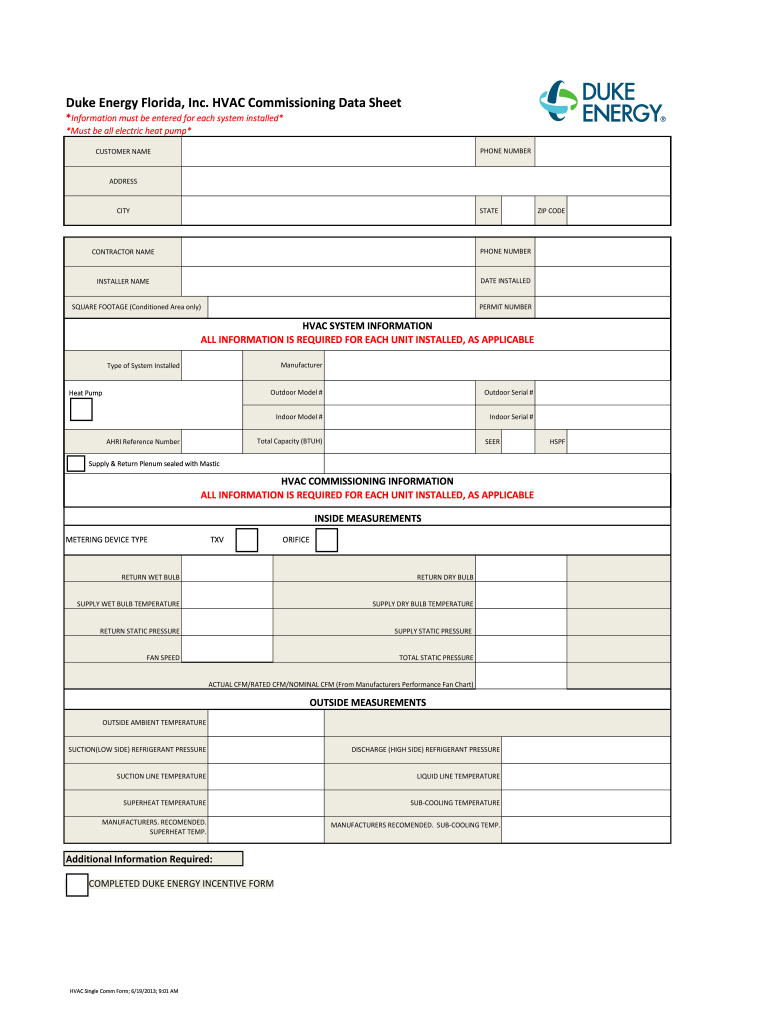
ACTOR NAME PHONE NUMBER INSTALLER NAME ZIP CODE DATE INSTALLED PERMIT NUMBER SQUARE FOOTAGE (Conditioned Area only) HVAC SYSTEM INFORMATION ALL INFORMATION IS REQUIRED FOR EACH UNIT INSTALLED, AS APPLICABLE Manufacturer Type of System Installed Outdoor Model # Outdoor Serial # Indoor Model # Heat Pump Indoor Serial # Total Capacity (BTUH) AHRI Reference Number SEER Supply & Return Plenum sealed with Mastic HVAC COMMISSIONING INFORMATION ALL INFORMATION IS REQUIRED FOR EACH UNIT .
Loading

Open form follow the instructions

Easily sign the form with your finger

Send filled & signed form or save
How to fill out the FL Duke Energy HVAC Commissioning Data Sheet online
Completing the FL Duke Energy HVAC Commissioning Data Sheet is a vital part of documenting HVAC system installations. This guide will help you navigate each section of the form with clarity and confidence.
Follow the steps to successfully complete the data sheet.
- Click 'Get Form' button to obtain the form and open it for editing.
- Begin by entering the customer's information. Fill in the customer's name, phone number, address, city, state, and zip code in the appropriate fields.
- Next, provide the contractor's name and phone number, followed by the installer's name. Ensure all names are accurate for proper identification.
- Document the installation date and permit number. This information is critical for compliance and future reference.
- Enter the conditioned area square footage to record the size of the installation space.
- In the HVAC system information section, fill in all required details for each unit installed. This includes the manufacturer, type of system, outdoor and indoor model numbers, and their respective serial numbers.
- Specify the total capacity in BTUH and include the AHRI reference number. Also, input the SEER rating.
- Indicate if the supply and return plenum is sealed with mastic, as this is an important installation detail.
- Proceed to the HVAC commissioning information section. Input inside measurements such as metering device type, return and supply wet bulb and dry bulb temperatures, as well as static pressures.
- Document fan speed and total static pressure, and if applicable, provide actual CFM, rated CFM, and nominal CFM based on the manufacturer's performance fan chart.
- Continue with outside measurements, including the outside ambient temperature and refrigerant pressures (suction and discharge).
- Record the suction line and liquid line temperatures, along with superheat and sub-cooling temperatures. Include the manufacturer-recommended superheat and sub-cooling temperatures if available.
- Finally, confirm that you have completed the Duke Energy incentive form if required. Review all entries for accuracy.
- Once all sections are filled out, save changes, download, print, or share the form as needed.
Complete your HVAC commissioning data sheet online today to ensure accurate documentation and compliance.
Experience a faster way to fill out and sign forms on the web. Access the most extensive library of templates available.
Related content
by E EFFICIENCY · 2008 — • Data collection networks and data analysis to enhance...
Contractor shall submit manufacturers' standard product data sheets for each model of...
Jun 1, 1999 — This Engineer Manual (EM) is intended to provide detailed guidance on all...
Get answers to your most pressing questions about US Legal Forms API.
How does commissioning work in HVAC?
Commissioning in HVAC involves a systematic approach to validate that the installed systems meet the design intentions and performance requirements. By referring to the FL Duke Energy HVAC Commissioning Data Sheet, you can ensure that every step is executed properly. This process includes ongoing adjustments and tests to confirm optimal operation. Ultimately, effective commissioning leads to superior comfort and energy savings in your facility.
What are the four major phases of a commissioning process?
The four major phases of a commissioning process include pre-commissioning, commissioning, post-commissioning, and documentation. Each phase is crucial for the successful implementation of the HVAC system, as highlighted in the FL Duke Energy HVAC Commissioning Data Sheet. During these phases, continuous evaluation helps achieve desired outcomes. This strategic approach not only ensures compliance but also enhances system longevity.
What is the commissioning process for HVAC?
The commissioning process for HVAC involves multiple stages, from design and installation to performance testing and documentation. Utilizing the FL Duke Energy HVAC Commissioning Data Sheet offers a structured approach to this complex procedure. By addressing potential issues early in the process, you can save time and costs later. Remember, an effective commissioning process leads to optimized system performance.
What is the HVAC commissioning process?
The HVAC commissioning process ensures that heating, ventilation, and air conditioning systems operate efficiently and as intended. By following the guidelines outlined in the FL Duke Energy HVAC Commissioning Data Sheet, you can effectively verify the performance of your systems. This process not only improves system reliability but also enhances energy efficiency. Overall, it contributes to a healthier indoor environment.
What are steps in the commissioning process?
The commissioning process typically involves several key steps, including planning, design review, installation verification, and performance verification. Familiarizing yourself with the FL Duke Energy HVAC Commissioning Data Sheet can help streamline these steps. You will need to coordinate with various teams to ensure each phase is executed properly. Additionally, regular documentation throughout these steps enhances transparency and accountability.
How does commission work in HVAC?
Commissioning in HVAC works by systematically checking all components to ensure they function together effectively. This process helps identify any issues early on, allowing for quick resolutions. The FL Duke Energy HVAC Commissioning Data Sheet serves as a comprehensive guide that highlights best practices and ensures a successful commissioning experience.
What does commissioning a unit mean?
Commissioning a unit means ensuring that the HVAC system is installed correctly and functions as planned. It involves a complete review of the operation, including performance tests and system checks. By following the instructions in the FL Duke Energy HVAC Commissioning Data Sheet, you can ensure that your unit operates efficiently, providing comfort and reliability.
How long does HVAC commissioning take?
The amount of time HVAC commissioning takes can vary depending on the complexity and size of the system. On average, the process may take anywhere from a few hours to several days. To streamline your commissioning process, consult the FL Duke Energy HVAC Commissioning Data Sheet for guidelines tailored to your HVAC needs.
How is testing and commissioning defined in HVAC systems?
Testing and commissioning in HVAC systems refers to evaluating how well the system performs against design specifications. This stage includes assessing airflow, temperature, and humidity levels to verify performance. Utilizing the FL Duke Energy HVAC Commissioning Data Sheet will guide you through the necessary tests required to validate your system's functionality.
What does commissioning an aircon mean?
Commissioning an air conditioner means completing a systematic approach to verify and document that the system is installed correctly and functioning properly. This includes testing components, calibrating controls, and putting the system through its paces. By following the guidelines in the FL Duke Energy HVAC Commissioning Data Sheet, you can ensure optimal operation of your unit.
Use professional pre-built templates to fill in and sign documents online faster. Get access to thousands of forms.
If you believe that this page should be taken down, please follow our DMCA take down process here.