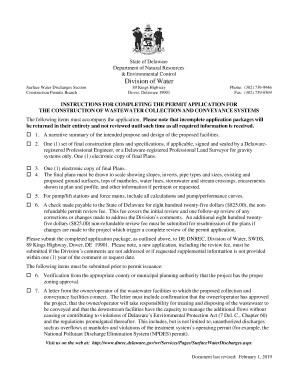
89 Kings Highway Dover, Delaware 19901 INSTRUCTIONS FOR COMPLETING THE PERMIT APPLICATION FOR THE CONSTRUCTION OF WASTEWATER COLLECTION AND CONVEYANCE SYSTEMS The following items must accompany the application. Please note that incomplete application packages will be returned in their entirety and not reviewed until such time as all required information is received. 1. A narrative summary of the intended purpose and design of the proposed facilities. 2. One (1) set of final constructi.
Open form follow the instructions
Easily sign the form with your finger
Send filled & signed form or save
How to fill out the DE DENREC Wastewater online
This guide is designed to provide users with clear and comprehensive instructions on how to fill out the DE DENREC Wastewater application for the construction of wastewater collection and conveyance systems. By following this guide, users can ensure that their application is complete and meets all necessary requirements.
Follow the steps to successfully complete your application.
- Click ‘Get Form’ button to obtain the form and open it in the editor.
- Begin by entering the date the application is submitted. Proceed to fill out the project information section, including the project name and location, tax parcel number(s), county, and watershed information.
- Specify the sewer district or interceptor and provide the name of the wastewater treatment/disposal facility along with the anticipated construction start date.
- Indicate the owner and operating permit number for the treatment/disposal facility. Choose if you are requesting plan review and comment or WPCC construction permit issuance.
- For design flow, input the average and peak flow values along with the basis of design for both averages.
- Fill out the owner/developer section with the company's name, mailing address, contact name, email address, telephone, and fax information.
- Proceed to the engineer section and complete the required contact information, including company name, address, and contact details.
- In the gravity sewer information section, indicate ownership of the system, the type of sewer system, and its attributes like type of pipe, length, diameter, and number of manholes.
- Provide information on pump/lift station specifications if applicable, including ownership, type of wastewater, pump flows, and any calculations or performance curves required.
- Complete details for force main information including the type of pipe, length, diameter, minimum pipe cover, and any relevant design factors.
- Review your completed application to ensure all required documents and information are included. Save changes, and then choose to download, print, or share the form as necessary.
Start filling out your DE DENREC Wastewater application online to ensure timely processing and compliance.
Experience a faster way to fill out and sign forms on the web. Access the most extensive library of templates available.
Related content
The DNREC Division of Water issues permits to construct facilities that will store...
These upgrades would provide a sustainable, long term wastewater solution for the...
Permanganate has been used for chemical oxidation of phenolic compounds during wastewater...
Get answers to your most pressing questions about US Legal Forms API.
How to treat wastewater?
To treat wastewater effectively, it is essential to follow a structured plan that includes collection, screening, biological treatment, and disinfection. Start by gathering wastewater, then remove larger items through screening processes. After that, employ biological treatment techniques to degrade organic waste and disinfect the water to eliminate pathogens. Utilizing resources like the DE DENREC Wastewater systems ensures that you can navigate each of these stages efficiently and in compliance with regulations.
What is the process of treating wastewater?
Treating wastewater involves a systematic process that typically includes collection, preliminary treatment, primary treatment, secondary treatment, and discharge. The initial step collects wastewater from various sources, followed by screening to remove large debris. After this, the process takes wastewater through biological and physical treatment methods to eliminate harmful substances. Finally, compliant and treated water is released back into natural bodies, contributing to environmental sustainability.
What is the most effective way to treat wastewater?
The most effective way to treat wastewater involves implementing a combination of physical, biological, and chemical methods. This multi-faceted approach enhances the removal of contaminants and ensures higher quality effluent. The DE DENREC Wastewater treatment program emphasizes integrating these techniques, leading to more effective and sustainable outcomes. Employing advanced technology and best practices can produce cleaner water and return it to the ecosystem more safely.
What are the steps of cleaning wastewater in a wastewater treatment plant Class 7?
In a Class 7 wastewater treatment plant, the steps to clean wastewater include screening, grit removal, sedimentation, biofiltration, disinfection, and sludge processing. Each step serves a specific purpose and contributes to the overall efficiency of the DE DENREC Wastewater treatment process. Screening removes large solids, while grit removal tackles smaller particles. Further processes involve biological treatment to break down waste, ensuring that the final product meets environmental standards.
What are the 7 steps in wastewater treatment?
Wastewater treatment generally follows seven steps: preliminary treatment, primary treatment, secondary treatment, tertiary treatment, disinfection, dewatering, and disposal. The preliminary stage removes debris and large particles, setting the stage for effective processing. Each subsequent stage builds on the last, enhancing the quality of the treated water. This comprehensive approach ensures that the DE DENREC Wastewater system works efficiently and safely before releasing water back to the environment.
What are the 5 steps of wastewater treatment?
The five steps of wastewater treatment typically include screening, primary treatment, secondary treatment, tertiary treatment, and sludge disposal. In screening, large objects are removed to prevent damage to equipment. Primary treatment involves settling solids and removing floating materials. Secondary treatment uses biological processes to break down organic matter, while tertiary treatment focuses on further purification. Lastly, sludge disposal manages the leftover materials from the treatment process.
How is wastewater treated in a wastewater treatment plant?
Wastewater treatment plants utilize a series of processes to treat wastewater effectively. Initially, the wastewater undergoes screening and primary treatment to remove large particles. Subsequent steps include biological treatment to further purify the water, ultimately resulting in clean discharge. The focus on DE DENREC Wastewater in these facilities highlights their critical role in maintaining public health and environmental standards.
How do you implement the primary treatment process for wastewater in your locality?
Implementing the primary treatment process for wastewater in your locality requires strict adherence to established guidelines and maintenance of treatment facilities. Regular inspections ensure that the systems operate effectively, allowing for efficient removal of solid waste. By prioritizing DE DENREC Wastewater management, local governments enhance environmental protection and community well-being.
What is the primary treatment of municipal water treatment?
The primary treatment of municipal water treatment focuses on the removal of suspended solids and organic material from the water supply. Techniques such as sedimentation and filtration are commonly employed to enhance water quality. This comprehensive approach is essential for managing DE DENREC Wastewater and safeguarding community health.
How sewage is treated in your locality?
In your locality, sewage treatment typically follows a multi-step process that includes screening, primary treatment, and secondary treatment. The combination of physical and biological approaches effectively reduces pollutants. Communities benefit from dedicated systems focusing on DE DENREC Wastewater, ensuring clean waterways and promoting public health.
Use professional pre-built templates to fill in and sign documents online faster. Get access to thousands of forms.
If you believe that this page should be taken down, please follow our DMCA take down process here.