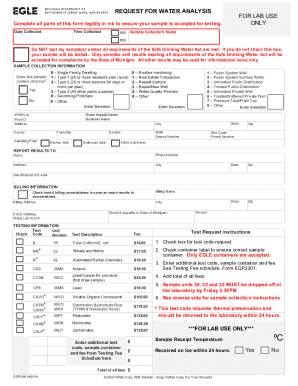
REQUEST FOR WATER ANALYSISPrint FormFOR LAB USE ONLYComplete all parts of this form legibly in ink to ensure your sample is accepted for testing. Date CollectedTime CollectedReset FormSample Collector's.

How it works
  • Open form

    Open form follow the instructions

  • Easily sign form

    Easily sign the form with your finger

  • Share form

    Send filled & signed form or save

How to fill out the Request For Water Analysis Form EQP 2300, Updated June 2019 online

This guide provides a comprehensive overview of how to complete the Request For Water Analysis Form EQP 2300 effectively. By following these steps, users can ensure their water samples are accurately analyzed according to the Safe Drinking Water Act requirements.

Follow the steps to accurately complete the Request For Water Analysis Form.

  1. Press the ‘Get Form’ button to acquire the Request For Water Analysis Form EQP 2300 and open it in your preferred online document editor.
  2. Fill in the date and time the water sample was collected. This information is critical for lab analysis and tracking.
  3. Enter the name of the sample collector in the designated field to identify who collected the sample.
  4. Check the appropriate box to indicate whether the sample contains chlorine. This detail helps determine the type of analysis needed.
  5. Select the water supply type that applies to your sample from the options provided, ensuring accurate classification.
  6. Provide details of the water supply or owner/business name, along with the address, including city, state, and zip code.
  7. Fill out the section for billing information. Indicate if the billing name and address are the same as the report results section.
  8. Choose the tests you request by checking the corresponding boxes and entering any additional codes for specific tests required.
  9. Total the fees for the selected tests and ensure all amounts are accurately entered.
  10. Once all fields are filled out, review the completed form for any errors and ensure legibility.
  11. Save the changes to your form. You may then download, print, or share the completed Request For Water Analysis Form EQP 2300 as needed.

Complete your Request For Water Analysis Form online today to ensure timely and accurate water testing!

Get form

Experience a faster way to fill out and sign forms on the web. Access the most extensive library of templates available.

Related content

Traverse=x - Grand Traverse County

20 Nov 2019 — session but they have to be in court so he requested that they...

Learn more
FACILITIES AND ADMINISTRATIVE RATE PROPOSAL

Mar 5, 2020 — F&A Rate Proposal, FYE June 30, 2019 ... Allocation by Department Report...

Learn more
Medicare - CMS

Form CMS-2552-10, which contains instructions for the completion of the new cost...

Learn more
Questions & Answers

Get answers to your most pressing questions about US Legal Forms API.

Contact support

What is water analysis report?

It will contain a list of contaminants tested, the concentrations, and, in some cases, highlight any problem contaminants. An important feature of the report is the units used to measure the contaminant level in your water. Milligrams per liter (mg/l) of water are used for substances like metals and nitrates.

The water testing report must be obtained from an FSSAI recognized and NABL accredited laboratory. Also, it is essential that the sampling is carried out by the laboratory and the report must contain the details of the date of sampling and the person carrying out the sampling.

Call the MDHHS Environmental and Health Hotline at 800-648-6942 to see if your home is in an area that is under investigation for PFAS. We may be able to test your water for free. If we cannot test your water for free, contact a certified drinking water lab about PFAS testing and the test cost.

Water testing is carried out to meet the regulatory requirements and adhere to the safety procedures that are needed for pollutant-free water. This is a broad concept that involves several procedures to analyze and evaluate the quality of water.

Water quality tests will give information about the condition of the waterway. By testing water over a period of time, the changes in the quality of the water can be seen. Parameters that may be tested include temperature, pH, turbidity, salinity, nitrates and phosphates.

Several methods can be used for water sample testing, including chromatography, spectroscopy, filtration, gravimetric analysis and titration. The most appropriate way will depend on the type of information required.

A pH of 7 is neutral. A pH value below 7 is acid, and above 7 is alkaline. The pH between 6.5 and 8.5 is considered normal. Water below pH 6.5 is corrosive and can damage plumbing fixtures or leach metals from pipes and solder.

Get This Form Now!

Use professional pre-built templates to fill in and sign documents online faster. Get access to thousands of forms.

If you believe that this page should be taken down, please follow our DMCA take down process here.

Get Request For Water Analysis Form EQP 2300. Updated June 2019